

The Ford Thunderbird really created the personal luxury car segment in 1955. The ‘Baby Birds’ carved out a market that no one else realized existed. It wasn’t a high performance sports car like the Corvette, and it wasn’t a staid luxury yacht like a Cadillac or Lincoln. As cute and as popular as they were though, they didn’t sell all that well because they were lacking one thing: a back seat. The two-seater’s three year run, 1955 through 1957, only produced 53,188 cars in three model years. Sales more than tripled when the next generation came out in 1958 with a back seat. The industry took notice. 2-seat convertibles look great in car shows but sales are what matters and buyers of personal luxury cars wanted back seats.
The competition scrambled to respond with their own car that would bite into this lucrative new market. It took a full 7 years, but Pontiac was first up with the Grand Prix in 1962. The upscale two-door hardtop was built on GM’s B-body platform and was considered a full-size intermediate, positioned between the full-size Catalina/Bonneville and the compact Tempest. They sold 34,000 of them the first year.
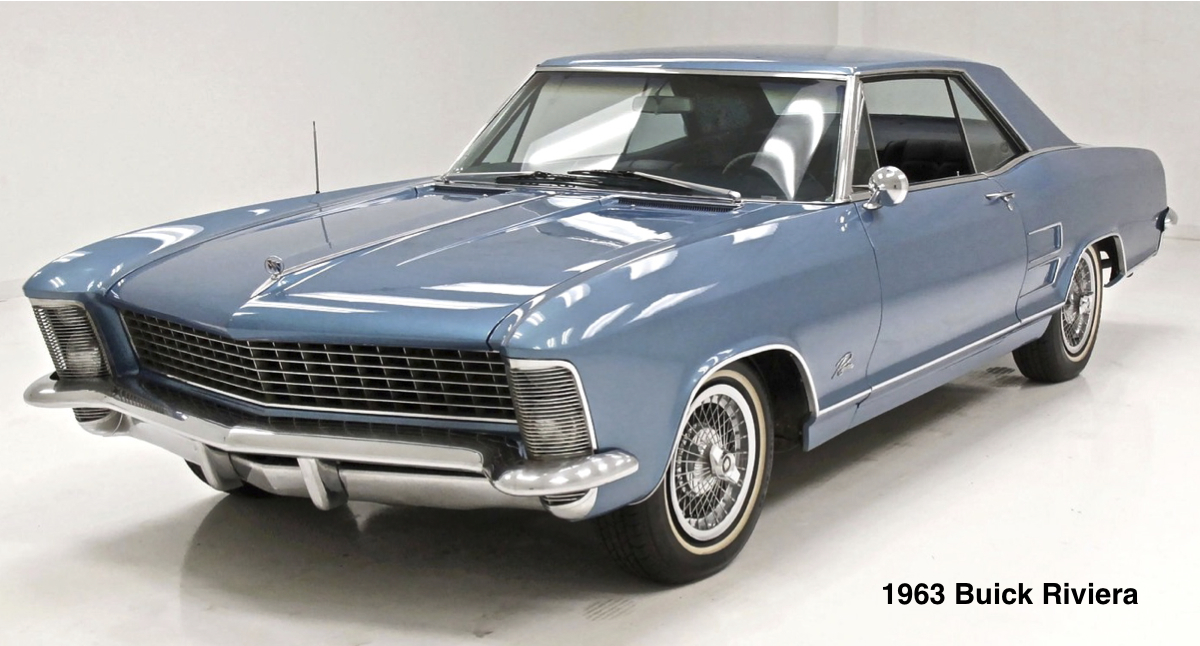
GM developed the new E-body platform to be flexible enough to accept any power train or drive configuration. It was used both for the rear-wheel drive 1963 Buick Riviera and later the front-wheel drive 1966 Oldsmobile Toronado and the 1967 Cadillac Eldorado. These were the only three cars built off the E-body.
GM Stying Chief Bill Mitchell oversaw the design with its flat surfaces, razor-sharp creases and hideaway headlights. It had classic long hood-short deck proportions and a pillar-less hardtop. It was considered at the time, and still today, to be one of the most beautiful American production cars from the 1960s. In fact, it won Motor Trend’s Car of the Year award in 1963.
The new Riviera came exclusively with Buick’s 401 ci ‘Nailhead’ V8 with 340 hp and all were automatics. 40,728 were built in its first year, 1963. This first-generation lasted just three model years and by 1965 it was over. The ’65 models took the hideaway headlights to another level with ‘clamshell’ covers over the stacked headlights that stopped people in their tracks when they saw them open or close.
1965 was also the first year for the Riviera GS (Grand Sport), the hot rod version. It came standard with the 455 and a sportier suspension. Heavy duty suspension, dual exhaust and a limited-slip differential in 3.42:1 or 3.73:1 ratios were all part of this performance package, along with special badging, unique wheel covers, special striping, dual functional hood scoops and an optional hood-mounted tach. The GS package was available on 1965 through 1973 Rivieras.
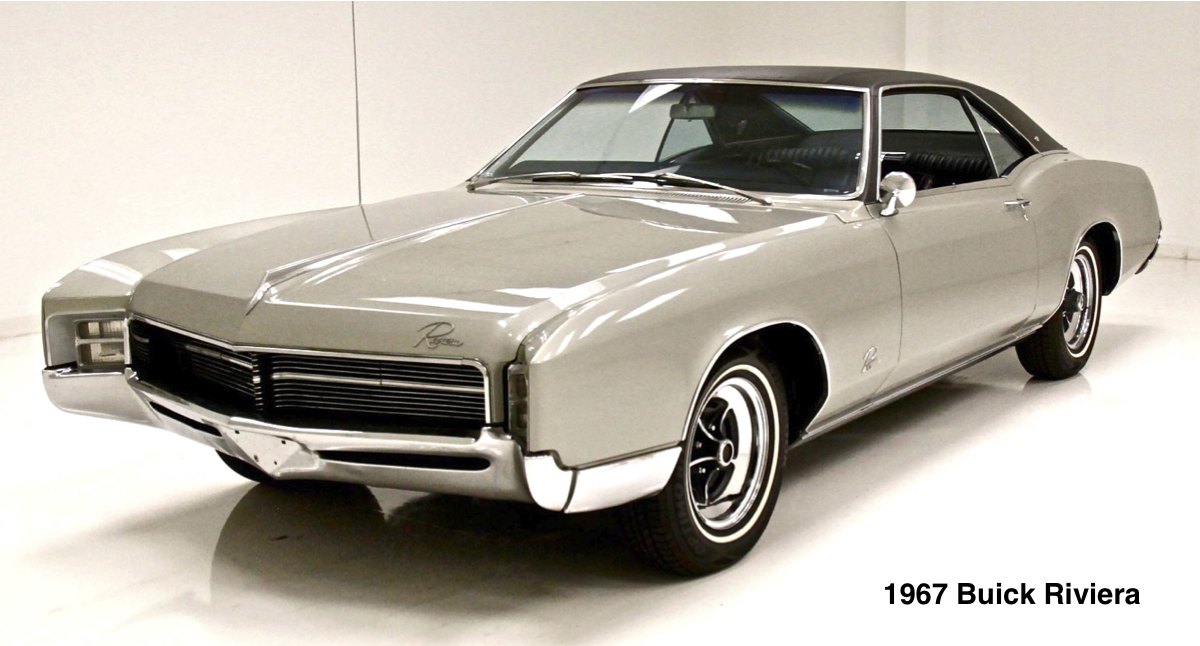
The second generation launched in 1966 introduced a more rounded, Coke-bottle shape and a semi-fastback roof line. It looked like a much bigger car than before, even though they shared the same 119-inch wheelbase. Buick upped the ante with one of the largest Nail head V8s in its arsenal, the 425 making 340 hp with single 4-barrel or 360 hp with a dual-quad setup. In 1968 they upped it again with an optional 455 that made 370 hp. Over 200,000 Riv’s were built in its 2nd-generation, its most successful generation in Riviera history.
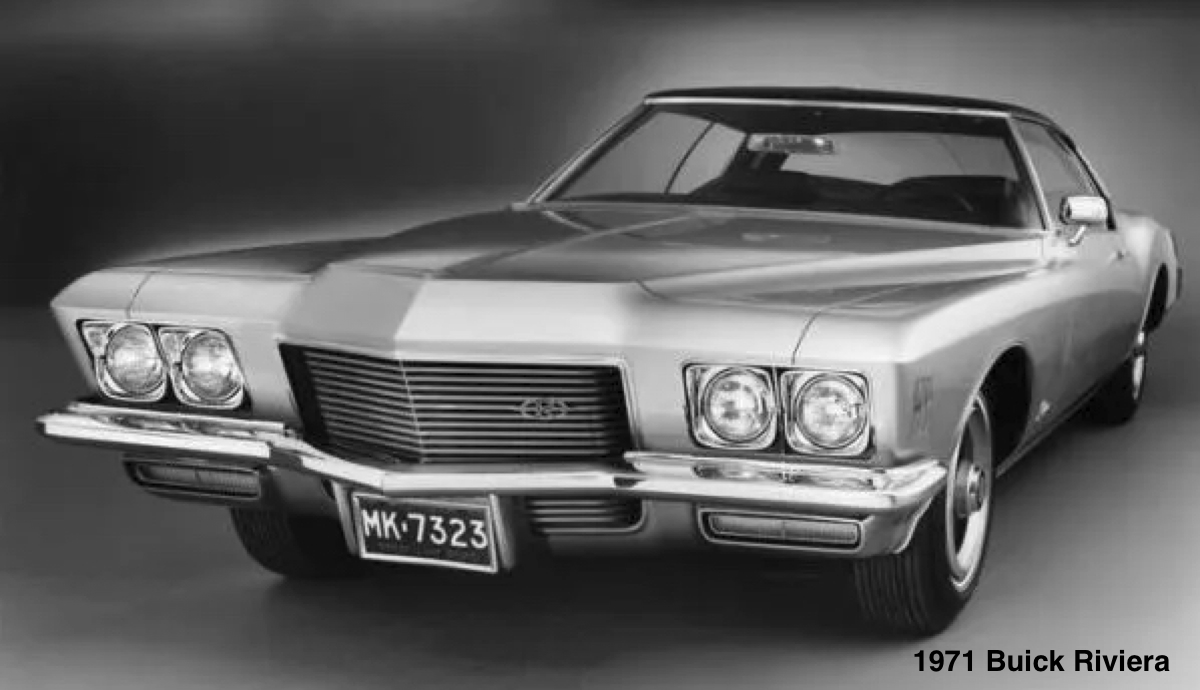
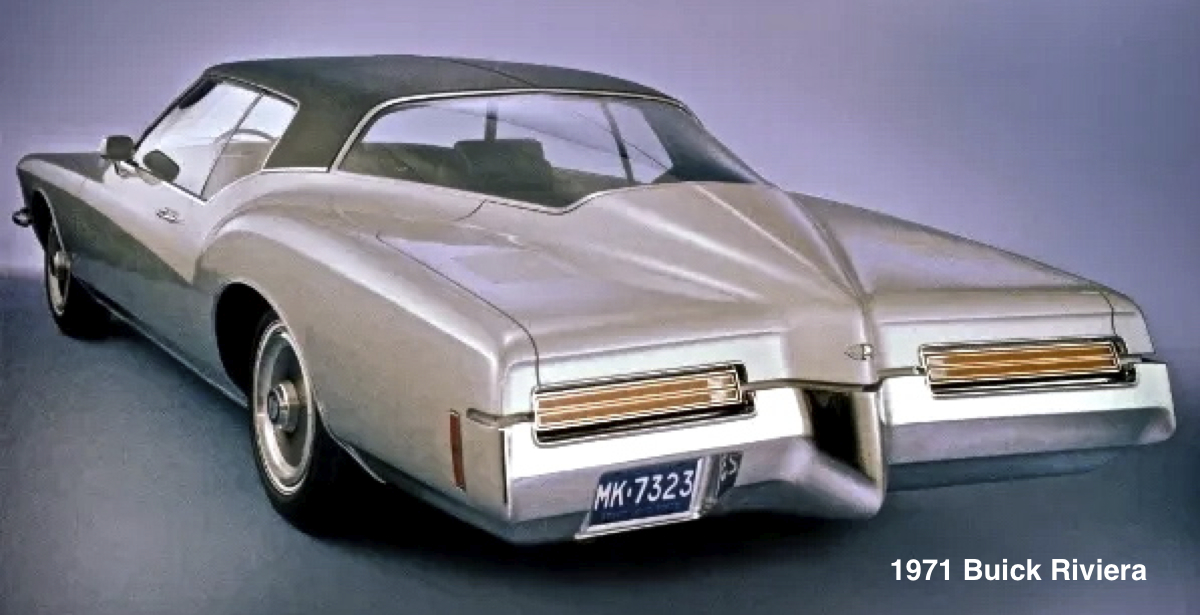
The 3rd-gen Riviera launched in 1971 and was a bigger, bolder car, longer, heavier and more formal looking. The front end was ‘shark-nosed’ which means that the grille and headlights leaned forward. But what really set it off was it’s ‘boattail’. This triangular shaped rear window aped the looks of the 2nd-gen Corvette (1963-67) and was very controversial. Some people never warmed to it but most thought it was a beautiful, novel feature that stood out among its contemporaries.
Of course this was right in the beginnings of the Malaise Era which, starting in 1971, piled on restrictive new federal smog, fuel economy and safety regulations that forced carmakers to detune their engines to get them to pass. The 455 was now the standard engine but it’s power had been clipped from 370 to 270hp. A loss of 100 ponies! Of course, at this same time the Feds were forcing carmakers to express horsepower as a ‘net’ figure rather than ‘gross’, which dropped the numbers even more than the power actually decreased.
The best year ever for Riviera sales was 1969 (2nd-gen) with 52,000 cars sold. 1971, the first year of this new 3rd-generation saw sales drop to 37,000 and they just kept going down after that. It’s not that the cars were bad, although the boat tail styling did put some buyers off, but the times were changing. Inflation was raging, the first oil embargo was right around the corner and people were concerned about fuel economy for the first time in their lives. Big cars and cars with big engines struggled to find
buyers in this environment, and Riviera sales suffered as the result. Only about half as many Riv’s were built in the 3rd-generation as in the 2nd.
 In 1974, the first oil embargo (1973) had just hit and America was still dealing with it. For the 4th generation, launched in 1974, the Riviera was downsized. It had been growing with each passing generation. The 1st-gen car weighed in at around 4,100 pounds and was 208 inches in length. The 2nd-gen grew by 200 pounds and 7 inches, despite keeping the same 119-inch wheelbase as the 1st-gen. The 3rd-gen got a 122-inch wheelbase and was of course longer by another six inches, now at 221 inches in length and got another 300 pounds heavier, bringing it to 4,600 pounds.
This new 4th-gen Riv got even bigger. The wheelbase stayed the same at 122 inches, but length grew again, now to 227 inches and the weight ballooned to 4,700 pounds. The only engine option was the 455, now rated at just 245 hp. And it wasn’t done falling yet. The 1974 455 had a 8.5:1 compression ratio and made 385 lb-ft of torque, not bad. But for 1975 the compression was reduced to 8.0:1, horsepower dropped to just 205 hp and torque fell to 320 lb-ft. 205 horsepower from a 455 cubic inch V8? How is that even possible?! Just 90,000 Rivieras were sold during the 4th generation, 1974-1976.
The big Riv got downsized for the first time, in its 5th-generation. Launched in 1977 and lasting just two model years, it was now built on the B-body platform, shared with the Chevy Impala and Buick LeSabre and had a 114-inch wheelbase, a full 8-inch reduction. Length came down to 206 inches, two inches shorter than the original in 1963, and the weight dropped by 700 pounds to roughly 4,000 pounds, also less than the original. A 350 ci V8 was available for the first time, with the 455 as an option, now making only 200 hp. This was the first round of downsizing, but it wasn’t over yet. This was also the last rear-wheel drive Riviera.
 In 1979, just two years after launching the 5th-gen Riviera the 6th-gen car replaced it, and it was…are you ready for it? Front-wheel drive. Built off the E-platform shared with the Olds Toronado and Cadillac Eldorado, the new car kept the same 114-inch wheelbase as before, and the length stayed the same, but the weight dropped by 100 pounds or so. Gone were the big blocks. Engine choices were now the Oldsmobile sourced 350 ci V8, a 4.1-liter V6, Buick’s own 3.8-liter V6 with turbocharger, and the ill fated 350 ci diesel V8. It may have helped GM’s CAFE numbers but it didn’t help sales.
Already low and slipping, sales had been hovering around 15,000 to 26,000 sales per year in the 1980s, but had taken a nose-dive in the 90s, and going into the 6th generation, even after this radical change to front-wheel drive, sales actually went up for the first year then declined steadily after that. Every new generation brings with it one good year, the first year. It almost always happens that way. The 6th-gen Riviera ran from 1979 through 1985. The turbo was the highlight.
From an enthusiasts’ point of view, things just went downhill after that. Each new generation got smaller, and they were all front-wheel drive. The 7th-gen was built off an updated E-platform with a standard 3.8L V6, optional 4.9L V8 or a 4.3L diesel. The focus was on luxury and comfort, not performance.
The 8th and final generation of Riviera ran from 1995 through 1999 and there hasn’t been a Riviera since. In its final iteration it was spun off of the G-body platform, shared with the Oldsmobile Aurora, a platform known for it’s rigid structure and good handling. The only engine was Buick’s own excellent 3.8-liter V6 in two configurations. The normally-aspirated version made 205 hp while the supercharged engine had 240 hp. All were front-wheel drive with 4-speed automatics.
The world was changing and unfortunately the Riviera had been on a steady decline from the start. Sales were never strong by GM standards. But they slowly got worse and worse over the decades. In the 1960s, sales ranged from 37,000 to 52,000 cars per year. Through the 1970s, those numbers fell to between 15,000 and 37,000. In the 1980s it fell again to between 12,000 and 25,000. In the 1990s, those same numbers were now only 6,000 to 12,000 cars per year, worst and best years. In the Riviera’s final year of production, 1999, they sold just 6,000 cars. However, over it’s life, the over 1.3 million Rivieras were built.
The first three generations were true American classics, each with their own distinct personality, but always distinctive and classy, and a notch above other cars in its class, like the Pontiac Grand Prix and the Ford Thunderbird. Their smart styling and impressive interiors, and their strong performance set them apart. Time is the test of all things and the collector car market views these early Riviera’s as treasures. A 1965 Riviera GS sold for $275,000 at Mecum’s Kissimmee sale in January 2024.
It seems surprising that a giant, high-volume corporation like GM would have invested the time, energy, money and people to make a car like the Riviera considering how relatively few sales it got. Yet, they’ve done it over and over, many times, on cars like the Corvette, the Nomad, the Z/28, the Trans Am, and the Olds Series I. It proves that they weren’t just penny-pinching bureaucrats squeezing every last dollar out of high volume models like the Chevy Nova or Impala. Taking the risk and investing in wonderful cars like the Buick Riviera shows that they had a soul, and that making great cars, legendary, memorable cars, really did matter to them after all.