“1st-Generation Corvettes”
By Andy Tallone
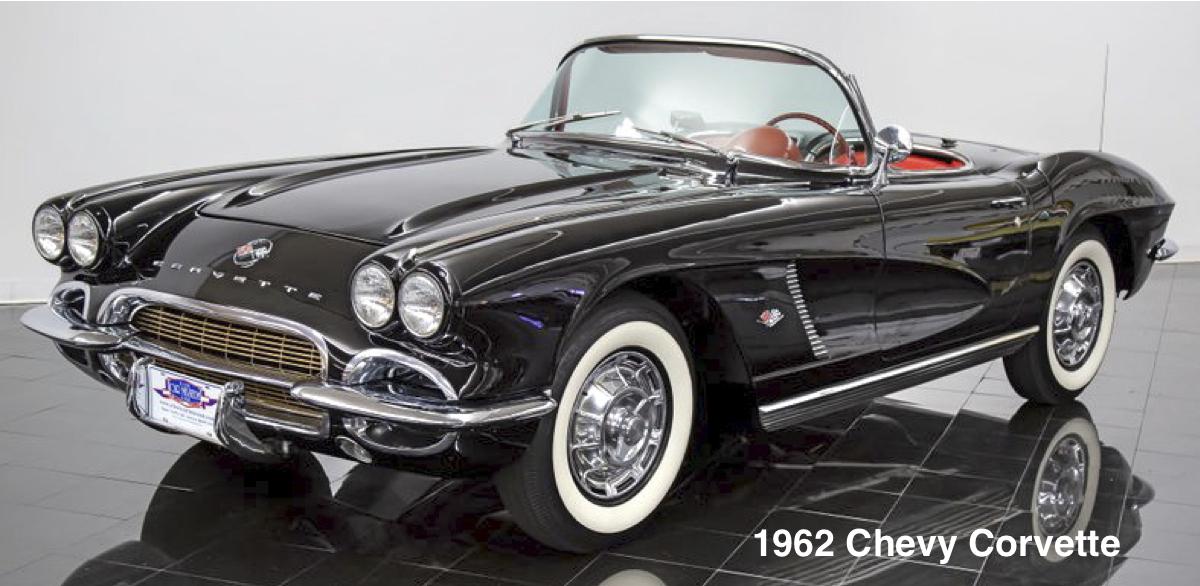 The 1962 lost its chrome side trim and 2-tone painted cove.
Among many other things, one thing that World War II did was take millions of young men off of the farm and show them the world. Sure, it was a world at war, and it was much more than their small-town minds could have possibly imagined back on the farm. But besides the horror of war, they discovered many other things. Those that fought it Europe got to see…Europe, with all it’s natural beauty and history. Many discovered women for the first time. And many were introduced to British sports cars, mostly MGs. And when the war ended and they came home, they brought their hunger
for sports cars with them.
These young men, home after 4 years of hardship and privation, all wanted the same thing: a job, a wife, a home, some kids and a car…or two. There weren’t very many cars to be had right after the war, but things were picking up quickly. Postwar optimism and prosperity were a boon to industries of every kind, especially the car industry. GM Design Chief Harley Earl wanted a piece of that, and he thought it was
high time that America had it’s own sports car. So work was begun in 1951, with GM Chief Engineer Ed Cole to push for a 2-seat American sports car under the code name “Project Opel”. The Corvette name came later. A ‘Corvette’ was a light, fast warship common in the Royal Navy at the time.
Despite its radical departure from what Chevrolet normally built, it had to be practical and financially sensible to produce, so virtually all the mechanicals were taken right out of the GM parts bin. Front and rear suspension, steering box, brakes, rear axle, even the frame were all plucked from Chevy’s 1953 passenger car line. That meant the Corvette inherited the ancient kingpin-style front suspension that the 53’s had, rather than the more modern ball joints that first appeared in 1955. The new body was
molded out of fiberglass, primarily because it was much more cost-effective on a low volume project like this than tooling up massive dies to stamp out steel body panels. But, they sold it as a lower-weight alternative, and back then fiberglass bodies were new, even exotic.
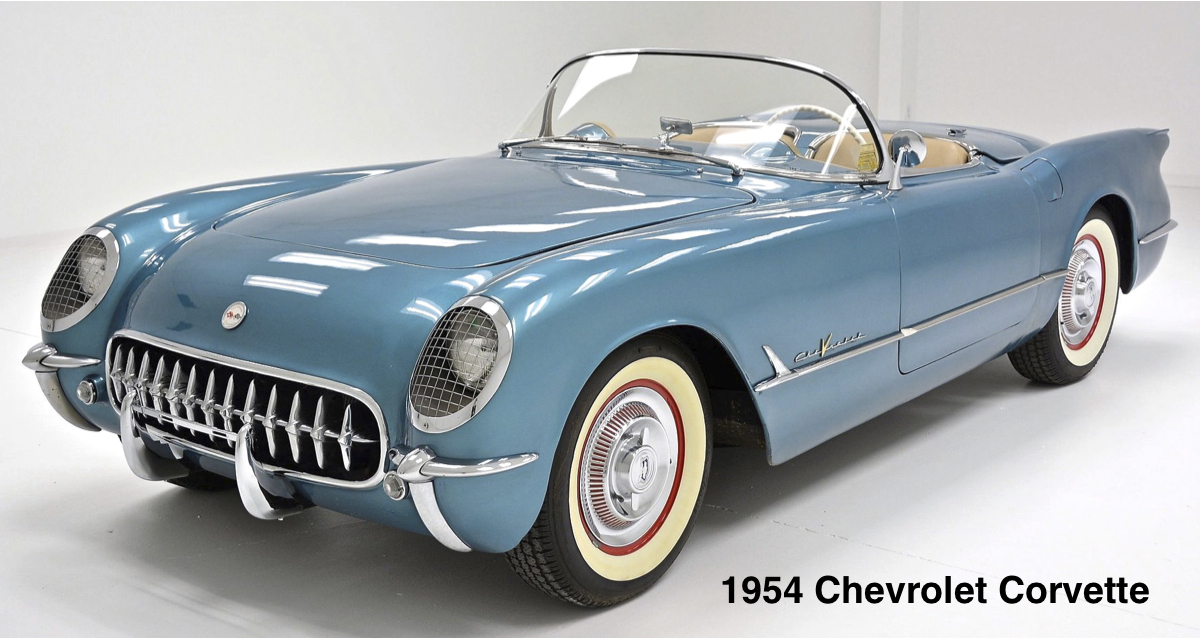 The 1953 Corvette was only available in white with red guts. More
colors were added for 1954. Obviously, this is a ’54.
The first prototype broke cover at GM’s 1953 Motorama auto show in New York in January 1953, which was late in the ’53 model year season. Production didn’t begin until June 30, 1953, a point at which model year production would usually be ramping down. But these new Corvettes were being hand built on a small line in Flint, and ultimately only 300 1953 Corvettes were made.
Chevrolet dealers had a hard time selling those. Corvettes were priced higher than any other Chevrolet product. And it didn’t help that all 1953s were Polo White with red interiors. And some people weren’t turned on by the looks of the car overall. But the real, glaring problem was the powertrain, or lack thereof. In 1953, Chevy was still two years away from launching the small block V8. The best engine they had, the only engine they had was the antique 235 ci “Stovebolt Six”. This relic was introduced in
the 1920s and had undergone decades of evolution and refinement, but it still only had four main bearings. At least it was had Overhead Valves (OHV).
In the 1953 Corvette it was painted blue and bore a big decal on the valve cover that proclaimed it the “Blue Flame Six”. As such, it sported three Rochester 1-barrel carburetors mounted on a special aluminum intake manifold, a high-performance, highlift, long-duration camshaft, a high-flow exhaust manifold and an 8.0:1 compression ratio to produce 150 hp at 4,200 rpm and 223 lb-ft of torque at 2,400 rpm. Not exactly earth- hattering but for the times it was ‘adequate’. The only transmission was the 2- speed Powerglide automatic, not very sports car-like.
Full production began in 1954 in St. Louis MO, but sales were slow. Just 3,640 1954 Corvettes were built. Some new colors and an optional heater helped. But the big news hit in the 1955 model year. Finally, Chevy’s revolutionary small block V8 was introduced with 265 ci and it made 195 hp or 225 hp. Despite the introduction of a V8, sales dipped to just 700 units in 1955. To be fair, the 265 wasn’t available until very late in the model year.
But by 1956, the word was spreading about the Corvette’s performance, and the looks were improving. The car was restyled for 1956, adding those signature coves to the sides. Sales leaped to 3,467, in 1957 it rose to 6,339, then in 1958 it was 9,168, and in 1959, 9,670, then 10,261 in 1960, 10,939 in 1961 and 14,531 in its final year 1962. This is what saved the marque. The low numbers weren’t what GM execs were used to seeing in the 1950s and there was always talk of killing the program. But diehard enthusiasts like Ed Cole, Harley Earl and Zora Arkus-Duntov lobbied hard to keep it, and it worked. Thank God.
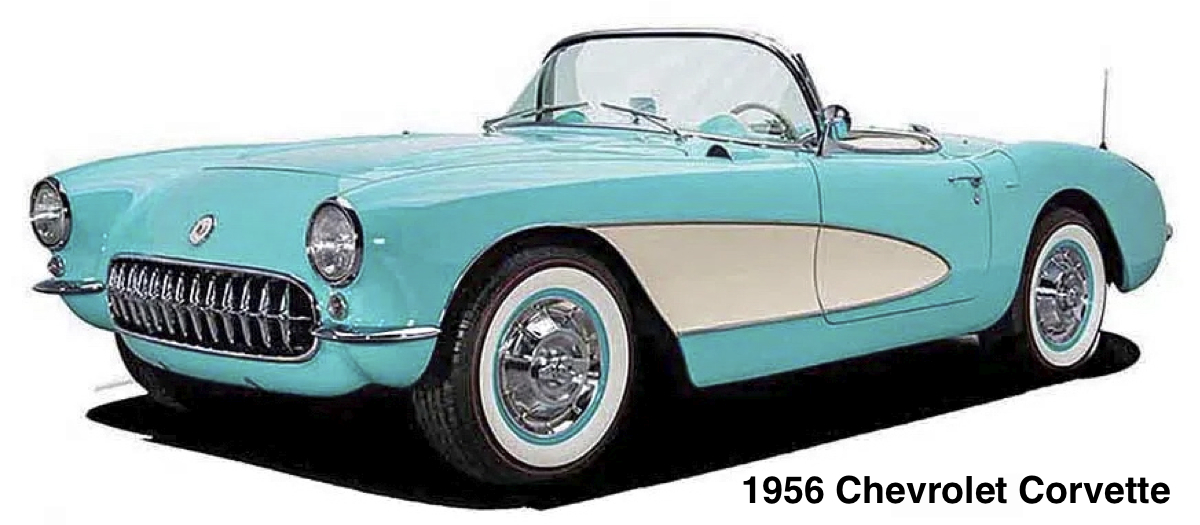 The 1956 Corvette got a whole new look, and roll-up windows.
But sales weren’t the only numbers that were climbing. Each year horsepower increased, steadily throughout the rest of the 1st-generation (1953-1962). The 265 V8 started out with 195 and 225 hp in 1955. By 1957, they’d punched it out to 283 ci and the top two engines were a dual 4-barrel setup (RPO 469A) with 245 hp and the first “Fuelie” with Rochester’s Ramjet mechanical fuel injection making 250 hp (RPO 579) or 283 hp (RPO 579D), depending upon cam and compression. This made it the first
American production car with one horsepower per cubic inch of displacement. By 1958, the Fuelie was making 290 hp (RPO 579D).
In 1962, for the 1st-gen’s final year, they punched the engine out again, this time to 327 ci and horsepower jumped again. The base engine with single 4-barrel made 250 hp (RPO 469). The dual 4-barrel (RPO 469Z) setup made 300 hp and the 327 Fuelie made up to 360 hp (RPO 579D). The dual-quad system never made it to the 2nd-generation.
Belgian-born Zora Arkus-Duntov was an incredibly talented engineer at GM who worked his way up to being the Corvette’s Chief Engineer. He fought for it, he made it better, he raced it and always advocated for it. Early on, it was he who pushed hard to drop the new 265 V8 into the ’55 Corvette. He wanted it to be a serious sports car, not a puffed up boulevard cruiser. He wanted it to be taken seriously, and comfort wasn’t high on his list of priorities.
Creature comforts had always been spartan. They didn’t even have roll-up windows until 1956. The 1953s didn’t come with heaters, you couldn’t even order one. They were noisy, they rode rough, the tops leaked, the body squeaked and rattled, and the doors sounded like they were going to break off if you slammed them too hard. The dash was so narrow that the only way they could get the radio to fit was to stand it on its side in the console. But, the little Corvette had spirit and personality and this animal magnetism that just drew people to it. It helped that a 1960 Corvette starred in the hit TV show ‘Route 66’ from 1960 to 1964.
As far as styling goes, the 1953 through 1955s all shared a common skin, then 1956 and 1957 introduced a new, tougher look. In 1958, Chevy went quad-headlights across it’s entire lineup and the Corvette was no exception. With this came another new skin that gave the Corvette a much more muscular look. The rump was rounded with two humps over the fenders that almost resembled plump tail fins. But in 1961 that look gave way to a ‘ducktail’-look that prepared buyers for what was coming next, in the second generation.
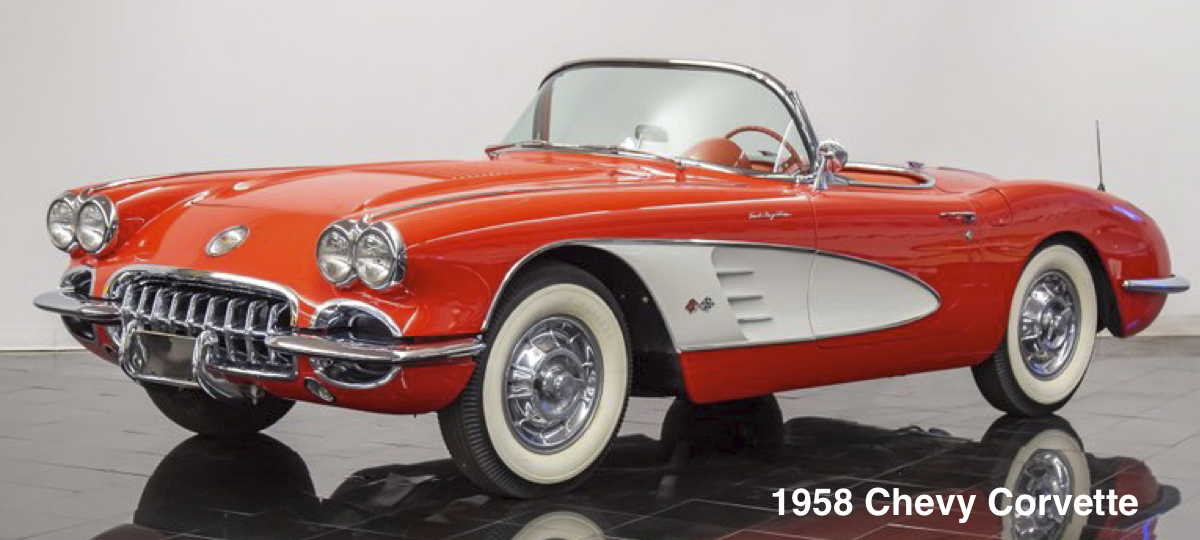 The 1958 Corvette got quad headlights like the rest of Chevy’s ‘58s.
But by the late 50s the ancient chassis architecture was showing its age. The primitive kingpin front suspension, the archaic worm-and-roller steering box and the 1940s designed brakes simply weren’t up to the job anymore. Their faults became increasingly apparent as Duntov pushed the Corvette further and further into racing. It was time to upgrade and by the very early 1960s Chevy was already looking at a replacement (the C2), with heavy influence from Duntov.
In motorsports, the C1 (1st-generation Corvette) competed hard in races like the Sebring 12 Hours. Starting in 1956, Corvettes competed at Sebring and in SCCA National Championships with strong finishes, but few outright victories.
But, its street cred was well established at countless stoplights in endless towns all across America. Everyone knew the Corvette was fast, maybe unbeatable. That kind of fan devotion doesn’t happen very often on that scale. Maybe Elvis or the Beatles. The world fell in love with the Corvette and the C1 did a lot of the heavy lifting early on to start and build its legacy.
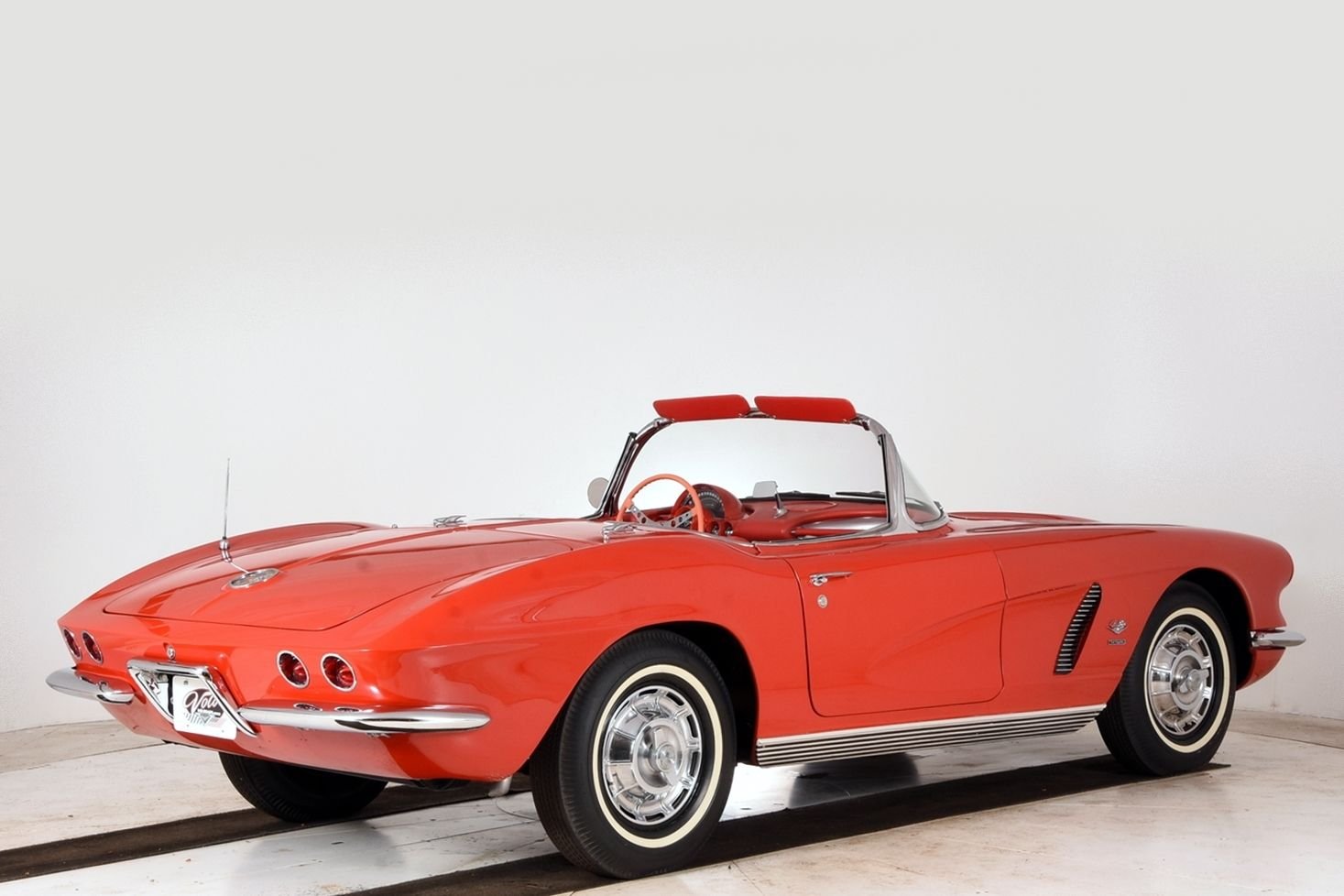 The rear of the 1961 and ’62 Corvettes got this handsome ducktail treatment.
Today, over 70 years later, the Corvette is still important and relevant, leading-edge,wickedly fast, superbly-handling and incredibly sexy. Today’s Corvette is in its 8th generation and now the engine is in the back and its insanely fast! And smooth, and easy to drive fast. It shifts for you and does so with perfection and downshifts with these awesome rev-matched throttle blips. It’s amazing how good the new Corvettes are. So good in fact that it’s hard to look at the C1 and see how it ended up as the C8,
they’re on opposite ends of the spectrum. But Corvettes through the years have always had class-leading performance at an ‘every-man’s price’. That was true in 1953 and its true today. What makes that possible is all the talented, passionate engineers and designers on the Corvette Team inside Chevrolet that make it all possible. Hats off to them!