“8 Generations of Chargers”
 Everyone knows how Ford changed the automotive world with the introduction of the Mustang in 1964 (as an early 1965-model), and how John Z DeLorean, then President of Pontiac kicked off the Muscle Car craze with the 1964 GTO, and how every other American carmaker rushed
their own versions to market. This double-whammy from two cross-town rivals touched off an arms race that didn’t end until 1971. But did you know that lowly Plymouth actually beat the Mustang to market with their own ‘Pony Car’?
That’s right, Plymouth, known for low-priced ‘strippies’ came out with the Barracuda and actually beat the Mustang to market by 16 days. Obviously, that wasn’t enough of a lead, and the Barracuda wasn’t enough of a car to stem the tide of the mighty Mustang. Plymouth had cobbled together their own ‘youth-oriented’ car by grafting an ungainly fastback roofline to the
homely Valiant to tap into the burgeoning ‘youth market’, but simply didn’t nail it the way Ford did with the Mustang. The proof is in the numbers. Plymouth sold 23,433 Barracudas in its first year, 1964, while the Mustang sold 121,538 copies in its first year, 1964, and it was a short year by industry standards.
Despite the disappointing results, Plymouth needed every sale and no one in those days could afford to ignore this new and growing market. Chrysler’s other big brand, Dodge wasn’t discouraged. In 1964, they created a show car called the Charger that was actually a roadster version of the full-size Polara. And while it bore no resemblance to what the production
Charger would become, it was a tester for the name, at least. The following year they introduced another concept car at the Chicago Auto Show, the Charger II, which looked very much like the production Chargers to follow.
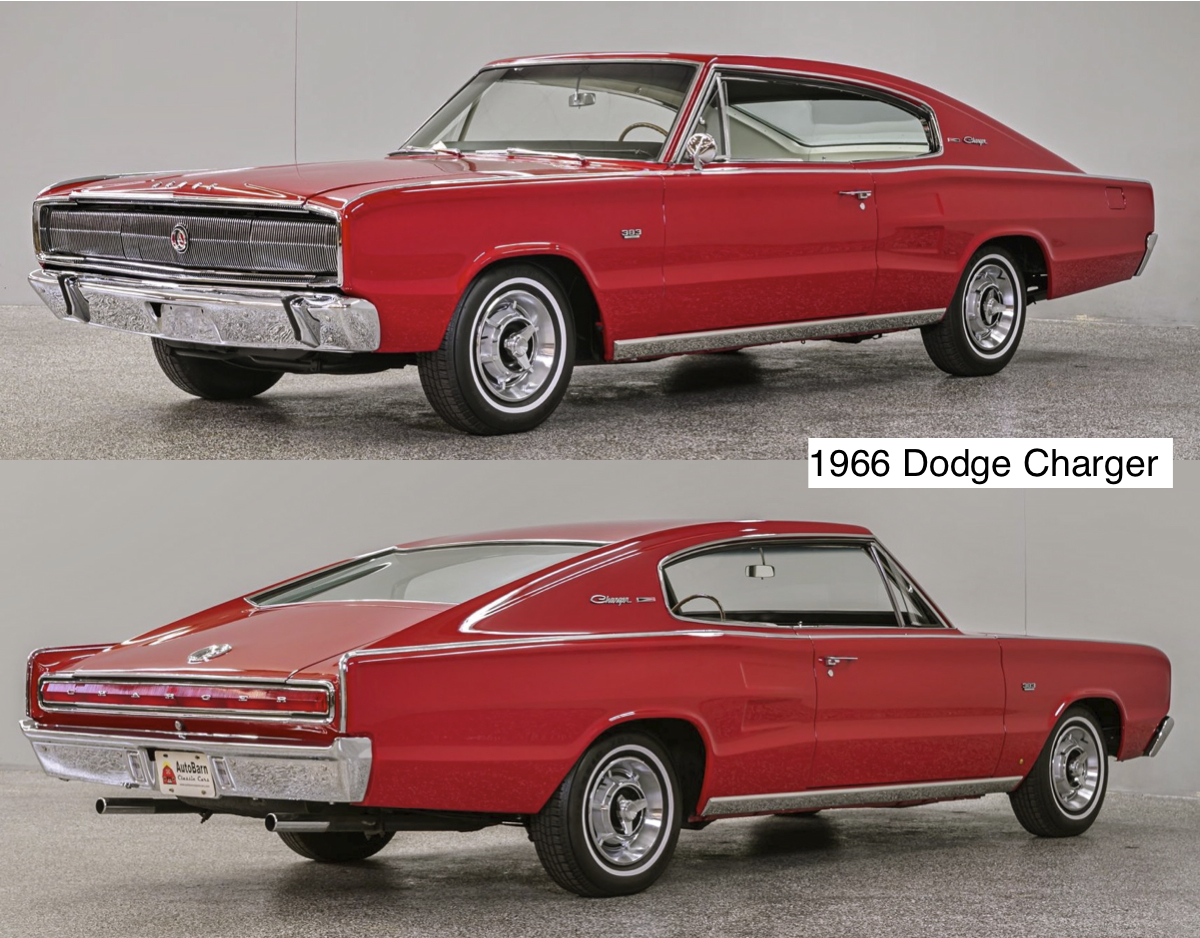
The 1st-generation Charger that we all know and love was launched late in the 1966 model year cycle on January 1, 1966 at the Rose Bowl. Based on Dodge’s midsize B-body platform shared with the Coronet, the Charger also had an ungainly fastback roofline with a huge back window, and hideaway headlights set in a grille that looked like the head of an electric shaver.
They weren’t gorgeous like the Mustang, or GM’s new crop of muscle cars (ie: Pontiac GTO, Chevy Chevelle SS, Olds 442, and in 1965 the Buick Grand Sport), but they managed to make an impression and get Dodge into the game. Sales were modest at 37,344 for 1966, which was a short production year for the Charger, but it dropped to just 15,788 in 1967, a 58% drop.
It certainly wasn’t for lack of horsepower. The 1st-gen Charger never came with Chrysler’s ubiquitous Slant 6, only V8s were offered, starting with the small-block 318 and topping out with the legendary 426 Hemi. But what it needed was better styling. GM was minting hit after hit and the Mustang was running wild, something had to be done. After just two model years, a
complete redesign was done.
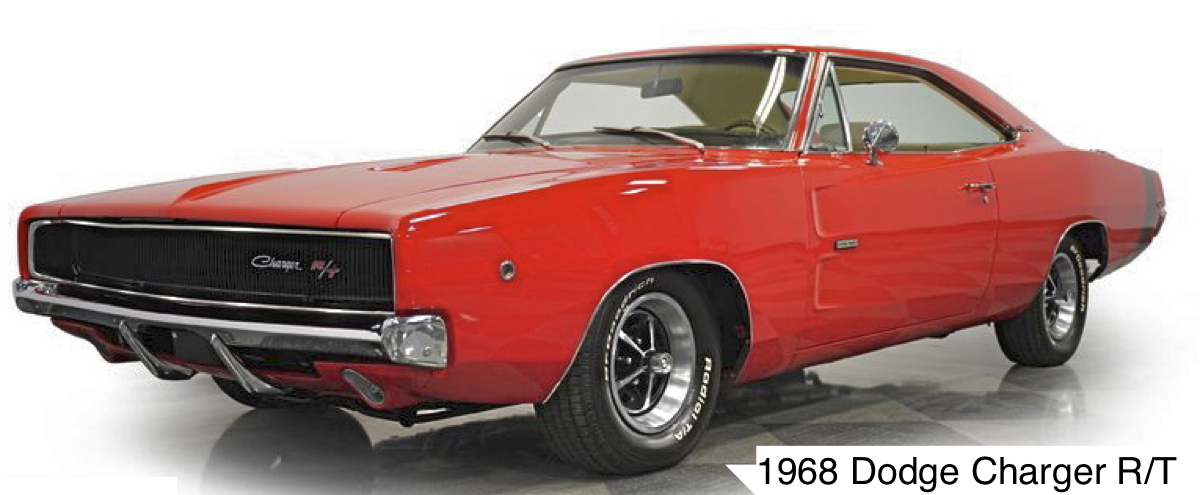 The 2nd-gen Charger hit the scene just in time. Still based on the Coronet B-body, the 1968 Charger took on a whole new shape, which came to be known as the “Coke-bottle shape”, meaning it swelled slightly at both ends with a subtle but tasteful dip in the middle. Hideaway headlights were now an option, and gone was the fastback. In its place, the C-pillars took on a
‘flying buttress’ giving it a semi-fastback look, while the rear glass was itself recessed into the cavity between them. It looked fantastic and was an instant hit. Sales jumped to 96,100 cars for it’s introductory year. 1969 cleaned up the look slightly with a split from grill and more squared-off tail lights. However the newness had worn off and competition was feverish from the other brands, so sales dropped slightly to 89,199 for the 1969 model year. For 1970, the final year for the 2ndgeneration, they further refined the looks, removing the vertical center-split on the grille. Most
Charger fans consider the 1969 model to be the best looking Charger of the 2nd-generation, and perhaps of all time. Sales of the 1970 dropped to around 55,000 cars.
Of course, Dodge offered its full range of engines. For the first time in a Charger, the humble workhorse 225 Slant Six became optional midway through the 1968 model year, but few, very few were ordered this way. V8 options started with the 318 and topped out with the 426 Hemi. There were two 383s, and the 440 came in two flavors, the 375hp 4-barrel 440 Magnum, and the 390hp 440 Six Pack with three 2-barrels on a special aluminum manifold. By 1970 the 440 Six Pack was outselling the 426 Hemi, which was a much more expensive option and was much harder to live with on the street. Just 468 1968 Chargers were ordered with Hemis, 232 in 1969, and only 118 in 1970. Today, all 2nd-gen Chargers are incredibly popular at shows and bring crazy money at auction, and of course performance models like the Charger R/T (Road and Track) and especially those with Six Packs or Hemis are in the stratosphere price wise.
During this time, both Dodge and Plymouth were competing furiously in NASCAR and it was quickly found that the Chargers were aerodynamically terrible, with their recessed grilles, concave back windows and their overall shape. Not only did they have high drag, but they also experienced dangerous lift at high speeds. This was hurting not just their performance on the track, but all in the showroom, at a time when “winning on Sunday led to sales on Monday”. So, a wild new version of the 1969 Charger was built specifically for NASCAR, the Dodge Charger Daytona.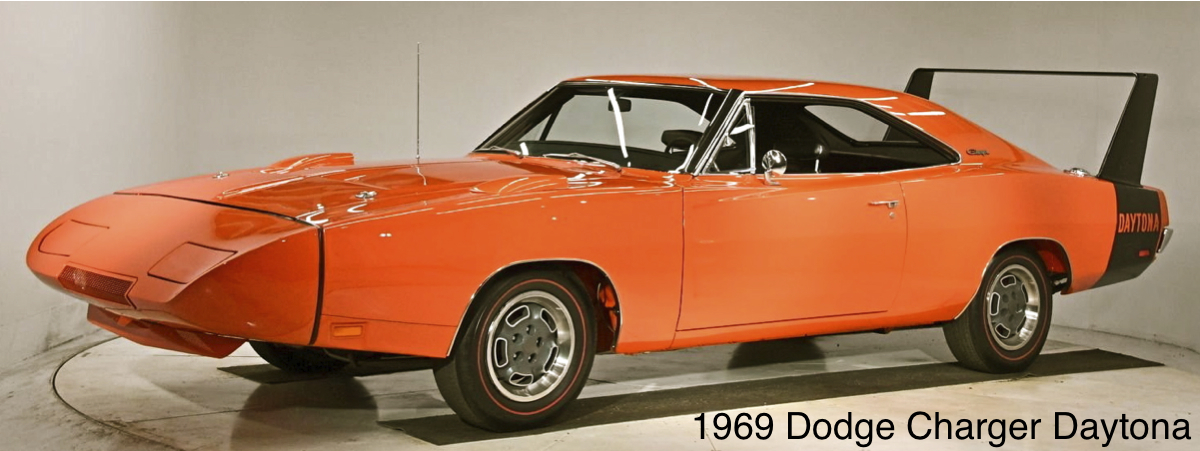 Famous for it’s huge rear wing, they also had a reworked rear window making it flush, a pair of small rear-facing air scoops on the tops of the front fenders to vent high-pressure air from the engine bay, and a huge fiberglass bullet-nose with flip-up headlights that extended the overall
length of the car by 19 inches. The results were nothing short of amazing. All these mods improved the aerodynamics and reduced the lift so much that the Charger Daytona, and it’s Plymouth sister-car the Superbird (a similarly modified Road Runner) dominated NASCAR during the 1969 and 1970 racing seasons. The Daytona debuted at the Talladega 500 in September 1969 with Richard Petty at the wheel. In fact, the aero package was so effective that the NASCAR governing body banned them at the end of the 1970 season. They simply changed the rules. But the Daytona was the first car to ever break the 200 mph-barrier in NASCAR.
Prior to their ban, the Daytona needed to be homologated by selling at least 500 examples to the public. 503 were sold, and of course today they are worth a fortune. All Daytonas came standard with the 375hp 440 Magnum, with the 440 Six Pack and the 426 Hemi as the only other engine options. The 727 Torqueflite 3-speed automatic and the A833 4-speed manual
were the only transmission offerings.
Some of these aerodynamic mods filtered down to a new Charger sub-model, the SE (Special Edition), including the flush rear window and a flush front grille. This was an appearance package only, nothing special performance-wise.
Despite all the success, things moved pretty quickly back in those days and so another generation was launched after just 3 model years. The 3rd-gen Charger was released as a 1971 model and ran through 1974, just as the Malaise Era kicked off. By 1971 horsepower ratings were dropping fast as government fuel economy and smog regulations ramped up. Yet the full range of engines was offered for 1971 including the 426 Hemi. The world was changing, and all-out horsepower was taking a back seat to ‘personal luxury’. The emphasis on luxury over performance defined the 3rd generation.
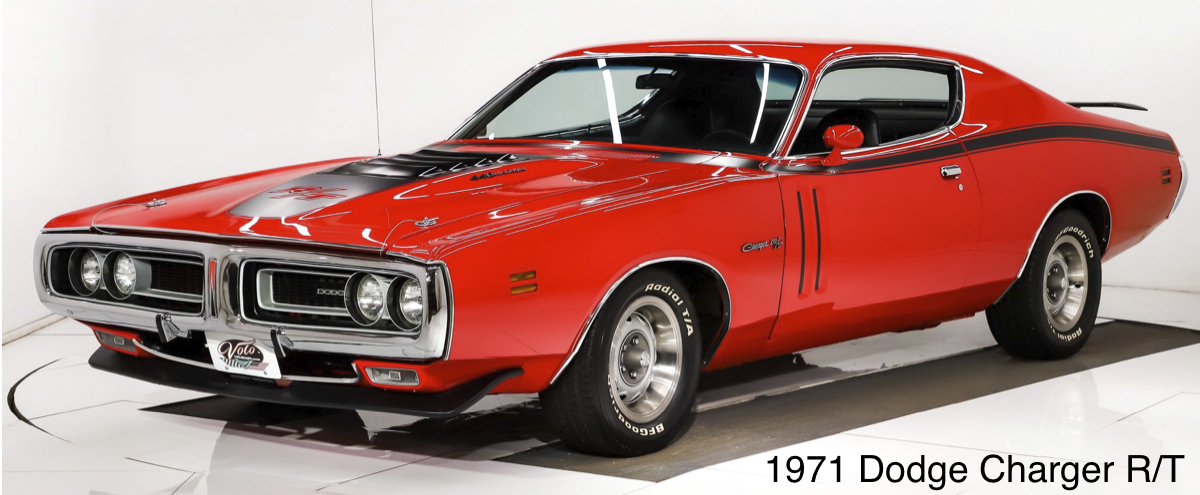 While the ‘Coke-bottle shape’ continued, it was smoothed out considerably giving it a better coefficient of drag and giving it a whole new look which was named ‘The Fuselage-look’. They were great looking cars, but never quite as pretty last the 2nd-gen. But the sales were still quite strong with 1973 being Charger’s best year ever at 119,318 units. This is a reflection of the changing times as much as the cars themselves. 1973 was a banner year for most cars back then, and the move away from straight-line performance to personal luxury, handling and comfort opened them up to a much wider market.
The 225 Slant Six became the standard engine in all non-R/T Chargers with 3 small block V8s (318, 340 and 360) and 5 big blocks, starting out at least (383, 400, 440 Magnum, 440 Six Pack and 426 Hemi), however the Hemi disappeared after 1971, and the Six Pack after 1972.
The 4th-generation ran from 1975 through 1978 and became little more than a tarted-up Chrysler Cordoba. They had formal styling and the emphasis was on luxury, not performance. Sales were modest with 1976 being its best year at 65,900 cars.
The Charger took 3 years off then returned in 1981 through 1987 as a badge-engineered Mitsubishi (Chrysler owned a controlling interest in Mitsubishi at that time). Powered by a 4- cylinder engine, it became a compact hatchback. Carroll Shelby was working with Chrysler at this point and so a higher-performance Shelby variant was offered in 1984-1986. Sales wandered between 20,000 and 50,000 units per year.
Charger disappeared altogether from 1988 through 2005 when it returned as a brawny rear wheel-drive 4-door sports sedan in 2006. Based on the full-size Chrysler 300, it was a big car, but it worked. With Hemi V8 power optional (V6 standard) sales were strong, coming close to breaking the marques all time record set in 1973. Dodge sold 119,289 units in 2007. Sales
remained strong for the entire 6th and 7th generations, averaging close to 90,000 units per year. The break came between model years 2010 and 2011 when the Charger received a mild mid-cycle refresh. Exterior and interior styling was changed slightly, barely justifying a generational change, but that’s what they called it. Engines opened with the 2.7- and 3.5-liter V6s in the 6th-gen, and the 3.6 Pentastar V6 in the 7th generation. V8 options included the 5.7 Hemi (340 to 368hp) in the 6th, bumped up to 370 in the 7th, with the top engine being the 6.1 Hemi in the R/T rated at 425hp, and the 6.4-liter Hemi (aka: the 392 harking back to the first generation of Chrysler Hemis in the 50s) rated at up to 470hp in the SRT models. They were all automatics, starting with a 4-speed, then a 5-speed and finishing with 8 speeds.
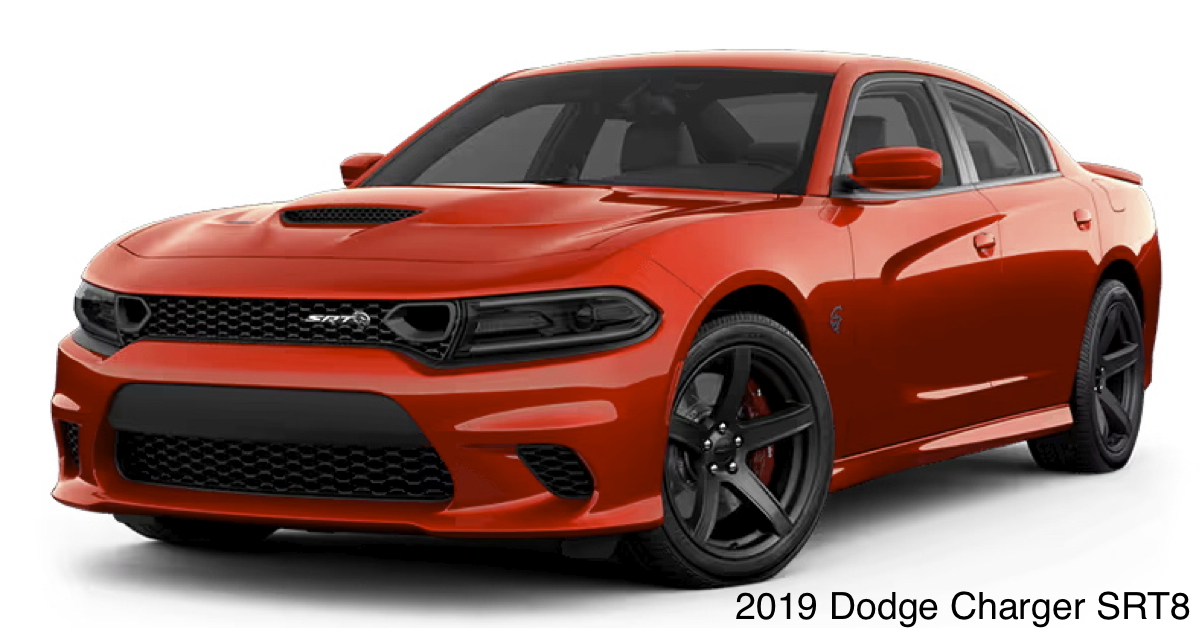
Starting in 2015, they started dropping those crazy-fast supercharged Hemis from the Challenger Hellcats into the Charger. From 2015 through 2023 the Charger SRT Hellcat made 707-717 horsepower (zero-to-60 in a scant 3.8 seconds!), in 2019 they offered an even faster version, the SRT Hellcat Redeye with 797hp, and in 2021 came they came out with the Charger SRT Hellcat Redeye Jailbreak with a whopping 807hp, with quarter-mile times of just 10.5 seconds!! And this from a factory-stock car with 4 doors, financing and a full warranty!! These are truly wonderful times to be alive!
In 2024 the 8th generation came out, but the Hemi was gone. In it’s place was an all-electric drivetrain with 670hp called the Scat Pack, and the new 3.0-liter turbocharged inline-6 called the Hurricane.
Things have changed a lot over the life of the Dodge Charger. But its still here, having endured the feverish competition of the late-60s, the Malaise of the 70s, the luxury-era of the 80s and the advent of modern technology-driven horsepower. It has endured 8 generations, quite an accomplishment for any car.
Hello there! This blog post couldn’t be written much better!
Going through this article reminds me of my previous roommate!
He constantly kept talking about this. I’ll forward this article to him.
Fairly certain he’ll have a good read. Many
thanks for sharing!