
“11 Generations of Thunderbirds”
 The Ford Thunderbird was and is one of the most iconic personal luxury cars ever built, certainly one of the longest lasting. The ’T-Bird’ spawned 11 generations over its 50- year lifespan. How many marques can make that claim?
In 1953 Chevrolet launched the legendary Corvette as America’s answer to the European sports car. Of course, early Corvettes were incredibly primitive. When first introduced, they didn’t even have roll-up windows, or outside door handles. Ford watched from across town and had ideas of their own on this. They felt they needed to fire off a response just to maintain their position in the world, but they didn’t want to simply ‘copy’ what GM was doing. They wanted their own unique take on the 2-place sports car. And it was going to be a lot nicer than the Corvette.
In 1953, Henry Ford II recruited former GM exec Lewis Crusoe to head up the project. Chief Ford stylist George Walker and designers Frank Hershey and Bill Boyer shaped the new car and positioned it as a highly-styled luxurious 2-place personal luxury car with a distinctive American flavor, rather than trying to ape the Europeans. The goals were simple and clear cut: Two seats, V8 power, a top speed of at least 100 mph and a weight of around 2,500 pounds.
The engine part was easy. Ford had just introduced it’s first OHV (overhead valve) V8 in 1954 after 2 decades of flatheads. The new Y-block V8 was made in several sizes(239, 256, 272, 292 and 312 cubic inches). The 292 came standard, but starting in 1956 the 312 was optional in the T-Bird. As did nearly every American car back then, they came standard with a 3-speed manual transmission, but a 3-speed manual with overdrive was optional, as was Ford’s Ford-O-Matic 3-speed automatic. No 4-speed was offered. The automatic was by far the most popular choice in the Thunderbird.
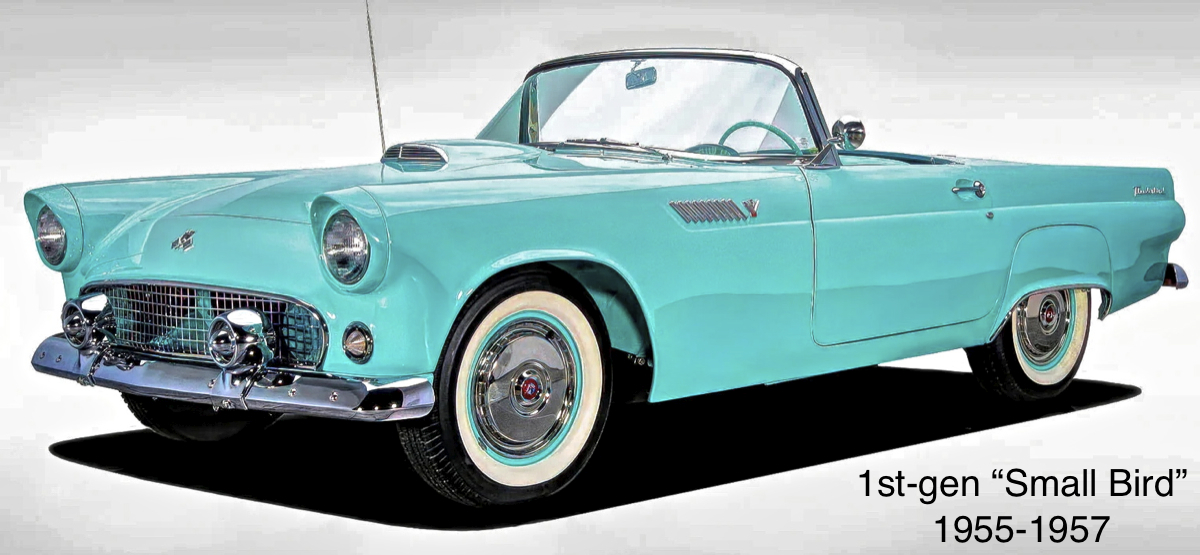
The platform used for the T-Bird was unique and used in no other car. It had a short 102-inch wheelbase. All 1st-gen T-Birds were convertibles with both a ragtop and a removable hardtop. The famous round porthole was not offered on the hardtop in 1955, and was optional on the ’56 and ’57. The interior was highly styled and of top quality for the times. In 1955, the spare tire was placed flat in the middle of the small trunk, using up most of its carrying capacity. This was panned by dealers and customers and so in 1956, the T-Bird grew a ‘Continental Kit’ (ie: the spare tire was mounted vertically between the trunk and the back bumper, visible to the world, in a
hard, metal shell. This changed again in 1957 when they simply extended the length of the trunk to provide the space to place it vertically over on one side (the passenger side). As the result, each of the 1st-gen’s 3 model years had their own distinctive look.
Known today as the “Little Bird”, the Thunderbird debuted on February 20, 1954 at the Detroit Auto Show as a concept, and production started on September 9, 1954 at the Dearborn Assembly Plant. Sales began on September 9, 1954 and over 4,000 orders came in on the first day.
Sales were modest by Ford standards with just 16,155 sales of the 1955 model, 15,631 in 1956 and 21,380 in its final year, 1957. Ford learned a valuable lesson that they wouldn’t forget, at least for another 50 years: 2-seaters don’t sell all that well.
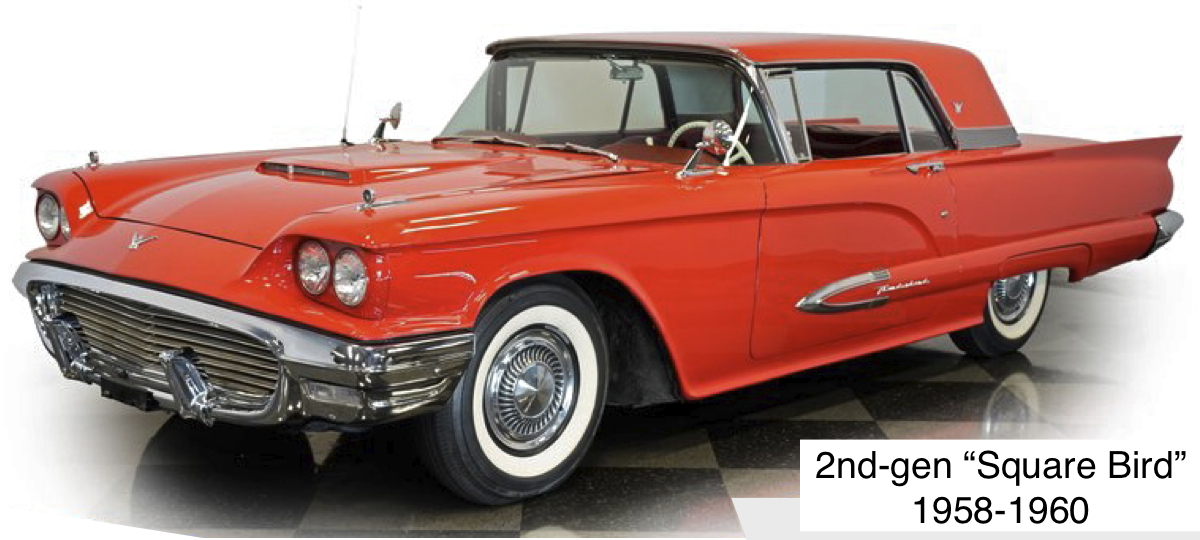 Of course, Ford wanted big sales numbers and this wasn’t doing it for them. So, the 2nd-gen T-Bird, introduced in 1958 was a 4-seater. The “Square Bird” as its known today, was a much larger car with a roomy back seat and the squared-off, flamboyant exterior styling that dominated the 1958-1959 model years of most American cars. A big, chrome grille surrounded by a shapely front bumper was flanked by quad headlights with an angry look. The rear end was just was over-the-top with two round taillights per side looking like jet afterburners, supported by a complex but attractive
rear bumper, flanked by small (by the standards of the day) tail fins. Overall, it was an attractive car that to this day draws crowds to it at shows. It was available both as a hardtop and a convertible, with a few ‘Sport Roadsters’ thrown in.
Ford’s new FE big block was introduced in 1958 across their entire line and the T-Bird got the 352 ci (cubic inch) version with 4-barrel carb making 300 hp. For 1959, the MEL (a Mercury/Edlen/Lincoln engine) V8 displacing 430 ci with 350 hp was made optional. In 1960, an “Interceptor Special” version of the 352 became an option with 360 hp. They’re rare and quite valuable today.
This new 2nd-gen ‘Square Bird’ earned Motor Trends’ coveted Car of the Year award for 1958 and sales jumped up to 37,892 in 1958, 67,456 in ’59 and 92,843 in ’60. Makes you wonder why they would change it at that time. But that’s the way it worked by in the late-50s and early 60s. Cars often got reskinned for every new model year, and generations only lasted two or three years.
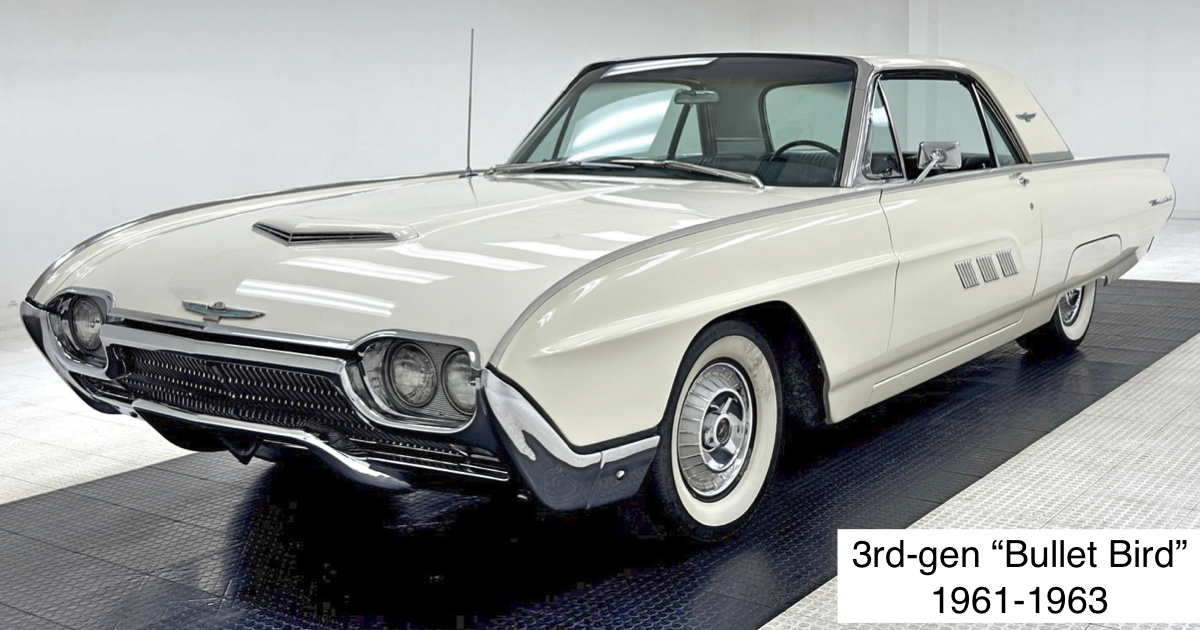 So, a new generation of T-Bird was inevitable for 1961, but as good as sales had been with the prior car, this new ‘Bird did around the same. 73,051 T-Birds were sold in 1961, 87,101 in ’62 and 63,313 in its final year, 1963. The 3rd-gen T-Bird, known today as the “Bullet Bird”, smoothed out the square, choppy lines of the older car with a svelte shape that was pointed at the front, earning it the nickname. They’re great looking cars and still very popular today. During its 3-year life, the Bullet Bird came standard with a 390 FE big block making 300 hp, and starting in 1963 could be ordered
with an ‘M-code’ 390 which used a tri-power setup (three Holley 2-barrels) and a 10.5:1 compression ratio to make 340 hp. Very rare.
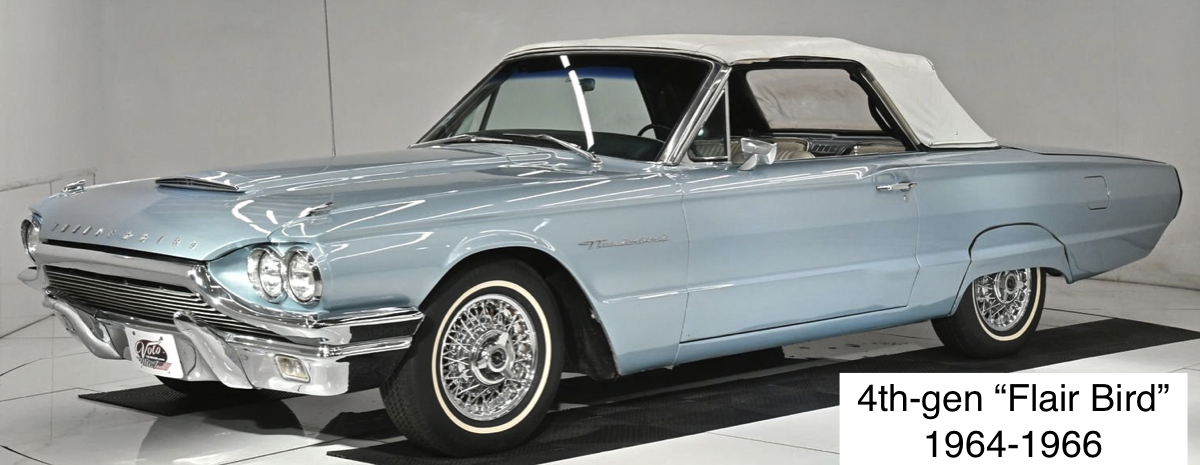 The 4th generation T-Bird came out in 1964 and whatever the Bullet Bird didn’t have, sales-wise, the new “Flair Bird” (as it’s called today) fixed that. As always, the interiors were high-quality, with nicely-upholstered front bucket seats, a center console, tricky bright work everywhere in a blend of luxury and sportiness. The front end changed dramatically with its prominent chromed front bumper and grille receding back under the front end. It was a bold new look, some hated it, but lots of people liked it. 83,897
T-Birds rolled out the door in 1964, 74,972 in ’65 and 69,989 in ’66. Was it the car, or a sign of the times? Car sales in general were on the climb throughout the 60s. Note that this 4th generation lasted 4 model years, where every prior generation lasted only 3.
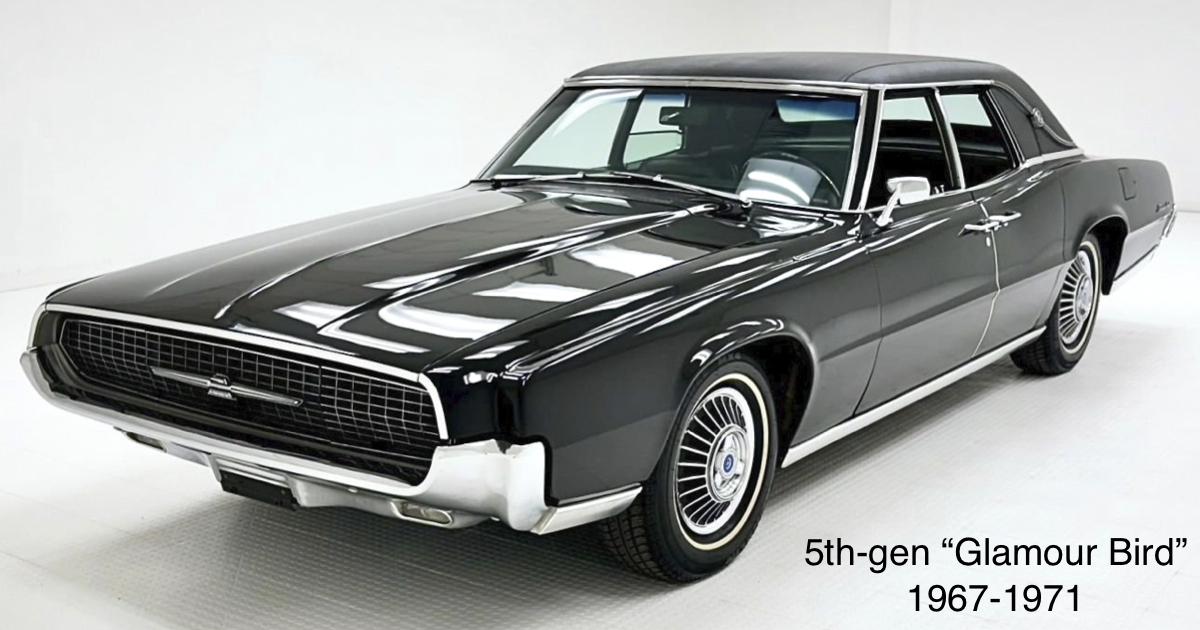 The 5th-gen Thunderbird, nicknamed the “Glamour Bird” ran for 5 model years, starting in 1967 and running through 1971, and offered a totally new look with a full width grille and hideaway headlights. For engines, the 390 was still standard with an optional 428 FE, but in 1968 the new 385-series V8 came out and was offered as an option as the 429 Thunder Jet with 360 hp. It became the only engine offered in 1969 and ’70. The body lines overall were cleaned up and several new body styles were tried. The ‘Landau’ got a unique roof covered in textured vinyl that eliminated the rear side windows with a massive, solid C-pillar eliminating the rear-side windows entirely.
This ‘blind quarter’ created a very private rear seat. There was also a 4-door version of the Landau, known today as the “More Door T-Bird” with suicide rear doors. All Landaus wore a piece of chrome trim shaped like ‘a lazy S laying down’ on the vinyl covered C-pillars that was called the ‘Landau Iron’, and harkened back to the days of horse and carriage. The Landaus sold quite well, with 155,338 2-door Landaus and 77,496 4-door Landaus sold, accounting for 32% of all T-Birds during the 5th generation.
The 6th gen launched in 1972 known as “The Big Bird” and ran through 1976, so called because they became huge land yachts. With a 120.4-inch wheelbase, the overall length grew year by year, thanks to 5 mph-bumpers being federally-mandated in front in 1973 and also in the back in 1974. The ’72 measured 214 inches in overall length, while the ’73 grew to 217.3 inches and the ’74 to a whopping 225.7 inches in length. Curb weight ballooned also, starting at 4,420 pounds in 1972 and finishing out at over 5,000 by 1976. This big boy needed big power to move so the engine choices were
both 385-series big blocks, the 429 as standard and the 460 as an option. A total of 256,411 6th-gen T-Birds were sold, an average of around 51,000 per year. Not bad, but not great.
Downsizing arrived in 1977 with the “Torino Bird”, so named because they moved it off of the full-sized Lincoln platform used in the 6th-gen and used the mid-sized Torino platform to build a smaller, lighter car, in response to rising fuel costs and customer concerns about fuel economy. They were pretty enough with a unique ‘basket handle’ roof line, a sharp-cornered, long low profile and a prominent formal grille flanked by hideaway headlights. The wheelbase shrunk to 114 inches, overall length came down
to 215 inches and weight dropped to around 4,000 pounds. Despite anemic engines and massive bumpers front and year, this new 7th-gen T-Bird blew away all the previous sales records, due in part to the car, but also to the car market at that time. Cars were flying off the shelves in the late 70s. The ’77 sold 318,140 units, around 350,000 in ’78 and around 295,000 in 1979. Wow!
The downsizing continued in the 8th generation, moving the T-Bird on to the Fox platform, which famously underpinned the Mustang at that time. It shrunk the car even further. Wheelbase shrunk again to 108.4 inches, overall length came down to 200 inches and the weight dropped to around 3,300 pounds, a 700-pound loss. Most of the weight reduction was due to the adoption of the Fox’s lightweight unibody platform, compared to the body-on-frame design of the previous car. As good as that sounds, sales dropped dramatically, averaging around 95,000 cars per year.
The 9th generation launched in 1983, again on the Fox platform. The new “Aero Bird” was very sleek and aerodynamic, having been influenced by the yet-to-be-released 1986 Ford Taurus, still on the drawing board. It was a very handsome car, looking almost European inside and out. The 3.8L Essex V6 was standard but the 5.0 V8 was the main engine of choice. They also offered a hot new “Turbo Coupe” version with the Pinto’s 2.3-liter OHC 4-cylinder and turbo producing 155 hp with without the weight of the cast-iron V8. They were available with either automatic or 5-speed stick. I owned
a 1985 Turbo Coupe with 5-speed and loved it. I’d love to find another. The 9th generation ended with the 1988 model year. A total of around Aero Birds 200,000 were built.
The 10th generation “Super Bird” brought with it a refined look that resembled the BMW 6-series 2-door sport coupe. It even had independent rear suspension, a first for the T-Bird. Gone was the Turbo Coupe with its 4-cylinder turbo, replaced by the ‘Super Bird’ with a 3.8 Essex V6 with an Eaton M90 Roots-type supercharger making 210 hp to 230 hp, added ABS brakes and 4-wheel disc brakes and 16-inch wheels and tires. The 5.0 OHV V8 powered most normal T-Birds, all with automatics, although the Super
Bird could be ordered with a 5-speed stick. The 10th generation ran from 1989 through 1997. Production averaged around 40,000 per year.
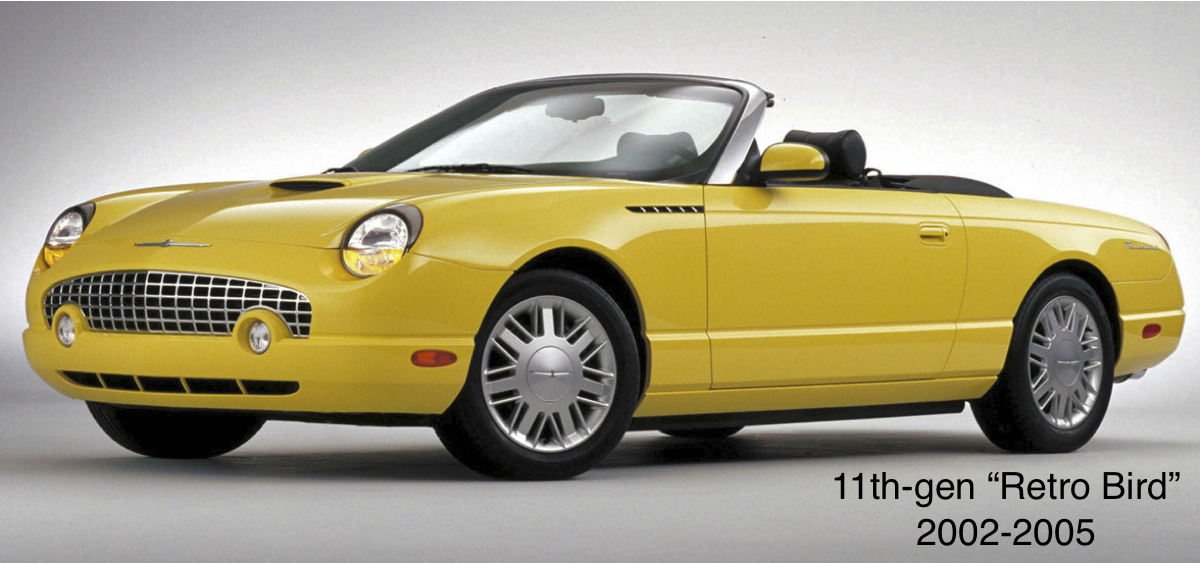 We had to wait until 2002 for a new Thunderbird, ruining an unbroken line of production that started in 1955. But the new 11th-generation T-Bird was part of that crazy Retro Craze that was booming in the early 2000s. Everyone was doing it, from the Chrysler PT Cruiser to the New Beetle, and this new T-Bird just added to the fire. It’s looks aped the 1st-gen cars with seating for two, a convertible-only body style that really paid homage to the ’55-’57 ‘Birds. They even had a removable hardtop with porthole windows. The interior and exterior successfully blended classic 50s design cues with
modern day technology. It was a stunning car and a stunning achievement.
Unfortunately, sales numbers didn’t justify its existence, with just 31,368 sold in it introductory (and best) year, only 14,678 in 2003, 12,757 in 2004 and just 9,295 in its final year 2005. Some blame Ford’s choice in engines, a version of the 3.9-liter V8 from the Jaguar AJ35, and despite having DOHC and 32 valves, it was small and only made 252 hp at launch, not enough to get it into the big game. It’s a shame. Ford really hung it out there with the “Retro Bird”, and did a commendable job of it. But it wasn’t enough. And, at least as of now, 2005 was the last T-Bird ever.