
 The Art & Science of Cars “Second-Channel Brands” By Andy Tallone
First off, what is a ‘Second-Channel Brand? It’s what Acura is to Honda, or
Infiniti is to Nissan. It’s what happens when a volume carmaker like Toyota wants to continue making gobs of common, high-volume cars, but they also want to cash in on the lucrative, high-profit luxury car market. If Toyota would have tried to build high-end luxury cars with Toyota badges on them they would likely have met with market resistance because people associate Toyotas with cheap cars, not prestigious luxury models. Think VW Phaeton.
Instead, Toyota launched a whole new brand under its corporate umbrella and called it Lexus, and today some of the finest luxury- and near-luxury cars come from them. And Lexus is widely accepted as a legitimate luxury brand, on par with Cadillac and a notch above Lincoln. In the past, some Lexi have been tarted-up rebadged Toyotas, but most only share some platforms and powertrains, just like over here.
But, it was Detroit who did it first. Long ago. William P. Chrysler was on a tear in the late 20s. He acquired Dodge in 1928 and formed a whole new car brand, Plymouth in 1929. Plymouth was Chrysler’s second-channel brand, their Lexus if you will. However, this wasn’t intended to be a high-end brand, quite the opposite, it was going to be their bargain brand, positioned below their high-volume brand, Dodge, meant to compete with Ford and Chevrolet.
And compete they did. By 1931, Plymouth was the third-biggest carmaker in
America, and maintained that position until World War II curtailed all the fun. They even passed Ford for the #2-spot for a few months at a time during the early 30s, but never for a full year. However, considering the number of brands that were competing for the car-buying dollar back then, #3 is admirable. And of course, Plymouth continued to be Chrysler’s bargain brand until their demise in 2001, at a time when they were still averaging over 150,000 cars per year. That’s more that some stand-alone brands.
Jaguar would have killed for numbers like that. In 1973, Plymouth sold 882,196 cars!
So, clearly the second-channel concept worked for Chrysler. It’s hard to believe they killed the brand. It gave them an outlet for cheaper versions of their Dodge products. That’s all they were really doing of course, de-contenting Dodges and giving them different skins and interiors. It only made sense. They were already building the cars over at Dodge. In the 60s, that meant the Dodge Coronet was morphed into the Plymouth Belvedere with cheaper upholstery, less trim, fewer standard features (most were still available as options), and a one-inch shorter wheelbase. What? That’s right.
Chrysler went to the trouble of shortening the Dodge to make the Plymouth. Not much, just enough to say they did it, thus differentiating the two cars and the two brands. The Dodge had the longer wheelbase, which placed it above the Plymouth in Chrysler’s hierarchy of brands.
They did the same thing on the Challenger and Barracuda. There was a two inch difference in wheelbases there, and the Challenger had four headlights to the Barracuda’s two. All of this was code for their brand positioning. Did the public notice it or even care? What it did bring us though was two takes on the same great car. The same can be said about the Dodge Charger and Plymouth Road Runner. They call them ‘sister cars’.
Ford took an entirely different approach. Where Chrysler, the brand, was that company’s high-end luxury product, over at Ford, Ford cars were the bargain-brand and the high-volume brand. And Old Henry was opposed to opulence or complexity in the cars that bore his name. But the company wanted and needed to go upmarket. Ford’s ‘everyman reputation’ would have likely hurt any attempt at building luxury Ford cars at that time, and would have diluted Ford’s public image. So, in 1922 Ford acquired Lincoln and applied it’s massive engineering and production acumen to building luxury cars and establishing Lincoln as a legitimate luxury brand, on par with, or surpassing Cadillac.
Lincoln was never a high-volume car brand, but then that’s the point. Cars like this carry much fatter markups than economy cars. More profit can be made on fewer cars. Ford did it again with the creation of Mercury in 1938. Ford wanted a midmarket brand, nicer than a Ford, but not as nice as a Lincoln, to compete with the midmarket brands over at GM, like Buick and Oldsmobile.
Ford also took a different approach to making the cars. Unlike Chrysler, who
altered the wheelbases between brands, a very expensive proposition compared to leaving it alone, Ford simply reskinned its Ford cars with unique Mercury bodies, redid the interiors, loaded the Mercs up with more chrome and more standard features and voila’, you’ve got a Mercury. They also put larger engines in the Merc as standard. By the 1960s though, the two brands shared engines. Mercury barely got going before the War started but by 1950 they sold 344,082 cars that year. Throughout the 70s, Mercury was good for over 500,000 sales annually with 1979 being their best year ever at 669,138 cars. In the early 2000s they were still averaging over a quarter million cars, but volume fell starting in 2005. Ford killed the
brand in 2011.
GM literally invented the game of second-channel branding. Their entire
corporate structure is an ascending pantheon of brands, starting at the bottom with Chevrolet, then moving up to Pontiac, then Buick, then Olds, then finally Cadillac. It was a system that produced some outstanding cars and some duds, and everything in between, and kept car buyers for life as they moved up the ladder. William C. “Billy” Durant never created new brands, he acquired them, Buick and Oldsmobile in 1908, Cadillac, Oakland (later to be renamed Pontiac) and Rapid and Reliant truck companies (renamed GMC) in 1909, and Chevrolet in 1918. That was the entire basis of the GM empire for decades. Then, as the world changed, in 1985
GM decided it was time to invent a second-channel brand, this one to compete with those industrious Japanese car companies. They called it Saturn. Then in 1999 they acquired the rights to the Hummer name from AM General and bought Saab in 2000.
All of these second-channel moves were intended to broaden their market reach and to allow them to leverage their incredible manufacturing capacity and economies of scale into new segments they weren’t reaching before or that didn’t exist until then. All of this created a top-heavy structure, each brand with its own redundant requirements, a massive bureaucracy and brands that were competing with one another. They were literally cannibalizing each other’s sales. Chevy and Pontiac were in constant competition, Chevy Trucks and GMC, Olds and Buick all battled it out for
an ever smaller slice of a dwindling pie.
Oldsmobile was the first to go. GM pulled the plug in 2004, 101 years after it’s acquisition. But GM had to pare down. Too many brands, too many people, too much capacity, too much money. Then hard times hit in 2008-2009, GM went into bankruptcy and the government stepped in to both save them and to slash and burn.
Pontiac was the next to go in 2010. What a shame. They had positioned
themselves as the high-end performance brand and now had cars like the G6 and G8 and the awesome GTO coming over from Holden in Australia. Great cars that deserved better, but GM stateside gave them no advertising and so they died on the vine. Likely it still might not have saved Pontiac from the government axe men. Hummer was put up for sale but no buyers materialized, so it was shut down in 2010. Saturn was also shut down in 2010, with no attempt made to sell it. Saab, theperpetually unprofitable Swedish niche brand was finally sold to Spyker Motors of the Netherlands also in 2010. That left GM with just a few core brands: Chevrolet, it’s bargain/high-volume brand; Buick, preserved primarily for the Chinese market; Cadillac, the premier luxury brand; Chevy and GMC trucks. All the second-channel brands have been wrung out,if Buick gets cut. They sell almost nothing in the US and now their hopes for lucrative returns from Buick in China are fading.
So, if Buick bites the dust, GM’s only second-channel brand will be GMC.
Chevy will fill three roles in the new GM: 1.) the bargain-priced brand; 2.) the high volume brand; and 3.) the performance brand. Cadillac will of course be the high-end luxury brand, and the two truck brands will continue to compete with one another. Ford shuttered Mercury in 2001 so that leaves only Ford as the: 1.) bargain priced entry-level brand; 2.) high-volume brand; and 3.) performance brand, and Lincoln, the high-end luxury brand. However, Lincoln is wobbly and struggling forrelevance with just 106,868 units sold in 2025.
Chrysler is a little harder to nail down since it’s part of this global consortium of second-rate brands. Stellantis has 14 brands in all. Dodge, Jeep and Ram are the crown jewels, although its doubtful the suits in Europe would ever admit it. From here its like a list of who hasn’t succeeded in selling cars in America. Abarth, Alpha Romeo, Fiat, Lancia, Maserati, Citroen, DS Automobiles, Peugeot, Opel and Vauxhall. And of course, the ailing Chrysler brand, now down to just the Pacifica minivan.
For Chrysler, Dodge is obviously the bargain brand, the volume brand and the performance brand, and Chrysler is supposed to be the luxury brand, their Cadillac, but it’s just not cutting it. The Jeep brand and the newly-minted RAM truck brand both do well generally, although everyone’s fallen on hard times lately.
So, really the Big 3 don’t have much left of their second-channel brands. It’s interesting that almost all of the at-one-time-successful second channel brands that the Big 3 fostered are gone now, and the only good examples of the practice that are left come out of Asia. Lexus for Toyota, Infinity for Nissan, Acura of Honda and Genesis for Kia. For them, it makes sense because their core brands were built on lower-priced economy cars, so all of them benefitted by moving upmarket. Most of Europe’s brands, at least those that make it to America are already considered luxury or near-luxury brands so their second channels would only likely move them down
market, and Europe being the most expensive place on Earth to manufacture cars, that doesn’t make much sense.
BMW tried it with the Mini, but after the initial cuteness wore off, they’ve
struggled to get people to pay a premium price of such a tiny car. Toyota tried it with Scion in 2004, a brand aimed at the ‘youth market’. It struggled from the start and died in 2016. In the end, the car business is a business, and car companies have to make money. To do that, they need to make cars that people want to buy and can afford. Looking back, the auto industry has done an admirable job of delivering some solid, worthy products that were safe, reliable and served us well, along with some stunning standouts that please the eye and move the soul.
Second channels have given large manufacturers new avenues to reach niches that their normal product line didn’t address. The result of all this is a plethora of wonderful cars that, at one time were within reach of most people, financially. Great cars that everyone could afford, what a concept.
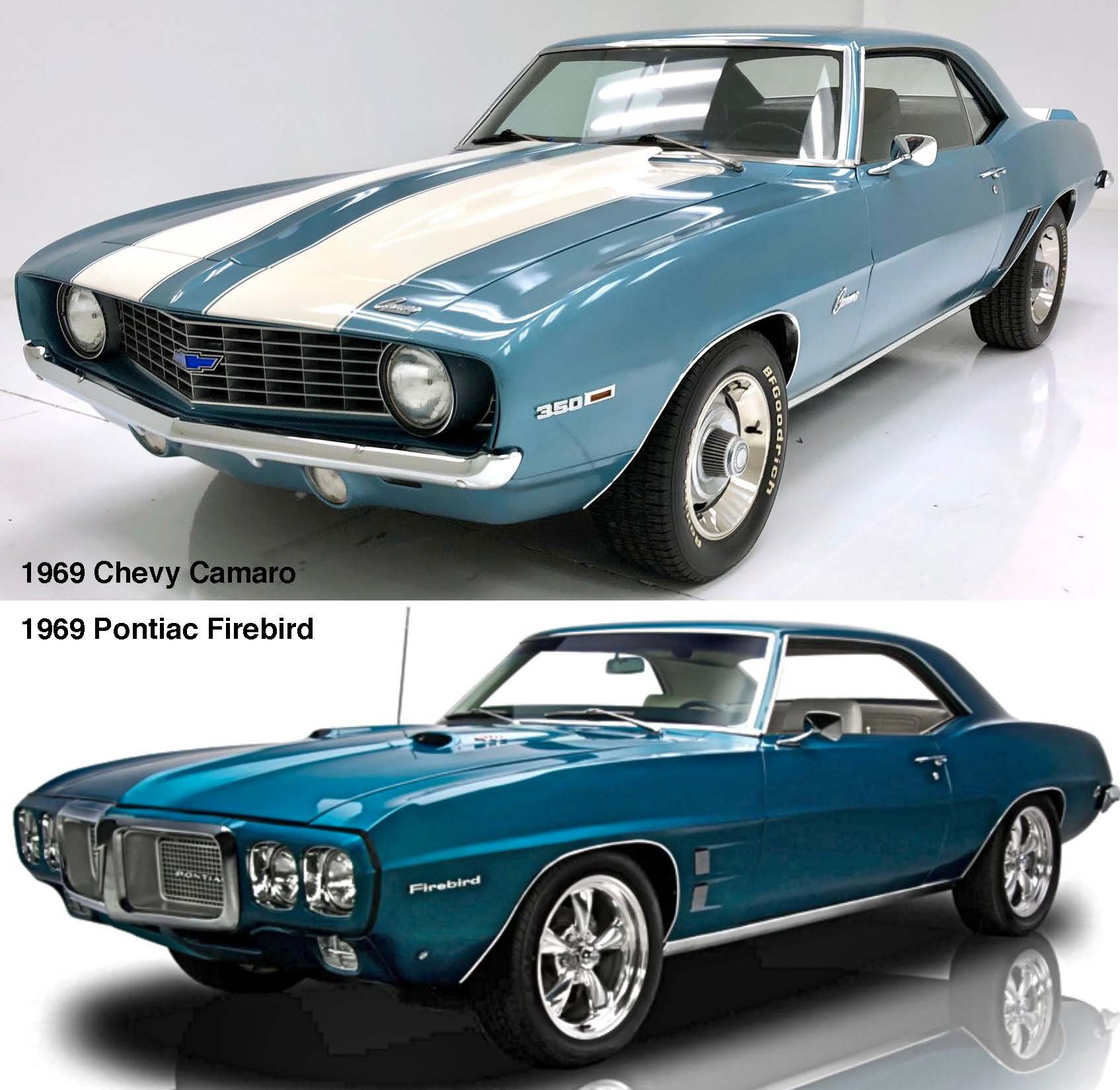 The Camaro and Firebird have always been essentially the same car, just with a different skin.
 The Fox-body T-Birds and Cougars were very similar. The Merc was slightly better appointed inside and had a standup rear window to the T-Bird’s semi-fastback.
 The Challenger had 2-inches more wheelbase than the Barracuda, and two extra headlights. Different skins also. Only the roof and glass are the same.