“Cadillac, the Standard of the World” By Andy Tallone

“Cadillac, the Standard of the World”

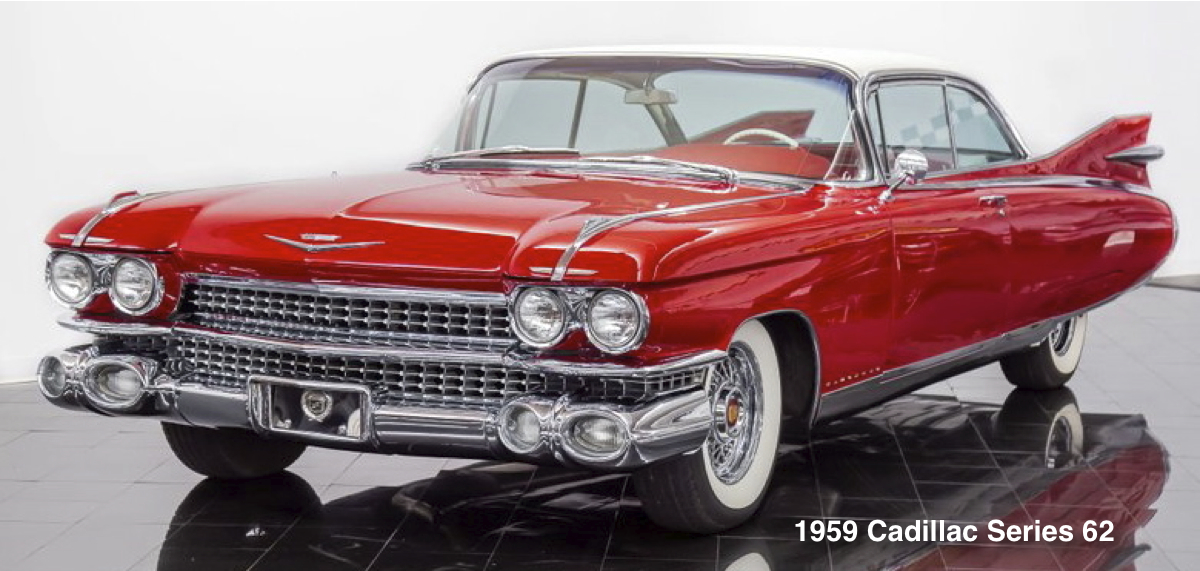
59 Cadillac Series 62Young people today probably have no idea of Cadillac’s former glory, or its place in automotive history. Unfortunately, the changing world has moved the brand to a place where it’s more famous for its SUVs than for its premium luxury cars. In fact, even those are more sport sedans. The world has changed and Cadillac has changed with it. But it’s been a long and storied ride.

Cadillac was founded on August 22, 1902 in Detroit by Henry Leland, a master machinist and engineer. The company was named after Antoine de la Mothe Cadillac, a French explorer who founded Detroit in 1701. By 1903 they were building cars. Their first was the Model A, a single-cylinder 10 hp rig with chain drive. But as primitive as it was, this wasn’t just any car. At the time, most carmakers were literally hand-building their cars. Every part was crafted to fit its application, often using blacksmithing techniques. A part made for one car only fit that car, and couldn’t be used on another
without some ‘fitting’. The Cadillac Model A was the first car ever to use
interchangeable parts. Every part worked on every car Cadillac built.

It was a revolutionary concept that was demonstrated to the world at the 1908 London Auto Show. Three Cadillacs were disassembled in front of the crowd, the parts mixed up, then all three cars went back together and started right up. The crowd was amazed. This had never been done before. This resulted in Cadillac receiving the coveted Dewar Trophy from the Royal Automobile Club in London for the precision manufacturing that would make Cadillac famous. It was a milestone in automotive history, and it earned Cadillac the nickname “The Standard of the World”.

One year later, William C Durant, founder and president of General Motors, bought Cadillac for $4.5 million and turned it into GM’s luxury division. With GM’s already formidable resources backing them Cadillac continued their tradition of innovation. In 1912 Cadillac introduced the world to the first electric starter. Charles Kettering invented it while at Cadillac and it revolutionized the automobile. Until then, you had to crank the motor by hand to start it. This was beyond most women and some men. It was also dangerous. If the engine kicked back, the crank could swing back violently.
In fact, as the story goes, a personal friend of Kettering’s died when the crank kicked back and broke his jaw. He died from the complications and Kettering swore to find a solution so that this wouldn’t happen to anyone else. So, every time you start your car without thought, thank Cadillac.

Throughout the 1920s, the ‘Roaring Twenties’, they continued to lead the industry while establishing themselves as the premium luxury brand. They introduced closed bodies, V8 engines and other advanced features. In 1930, in the height of the Great Depression, they introduced their 452 ci (cubic inches) V16, the first production car to have a V16. They also had a V12. The V16 was a 7.4-liter OHV (Overhead Valve) beast that breathed through two tiny Stromberg updraft carburetors making 165 hp. The V12 had 368 ci, was also an OHV design and made 135 hp. Cadillac introduced its new Series 60 Special in 1938, considered a landmark luxury sedan and a nameplate that
would endure for decades.

Of course World War II intervened and from early 1942 through 1945, all civilian car production was halted while all the factories made war materials. Cadillac famously produced tanks, airplane engines and other things. Civilian production resumed with the 1946 model year, but due to the full concentration on the war effort over the past four years, there were no new designs in the works. But when Pearl Harbor hit on December 6, 1941, GM had already been producing 1942 model year cars for five months. All the tooling was done, everything was there. And after four years of war
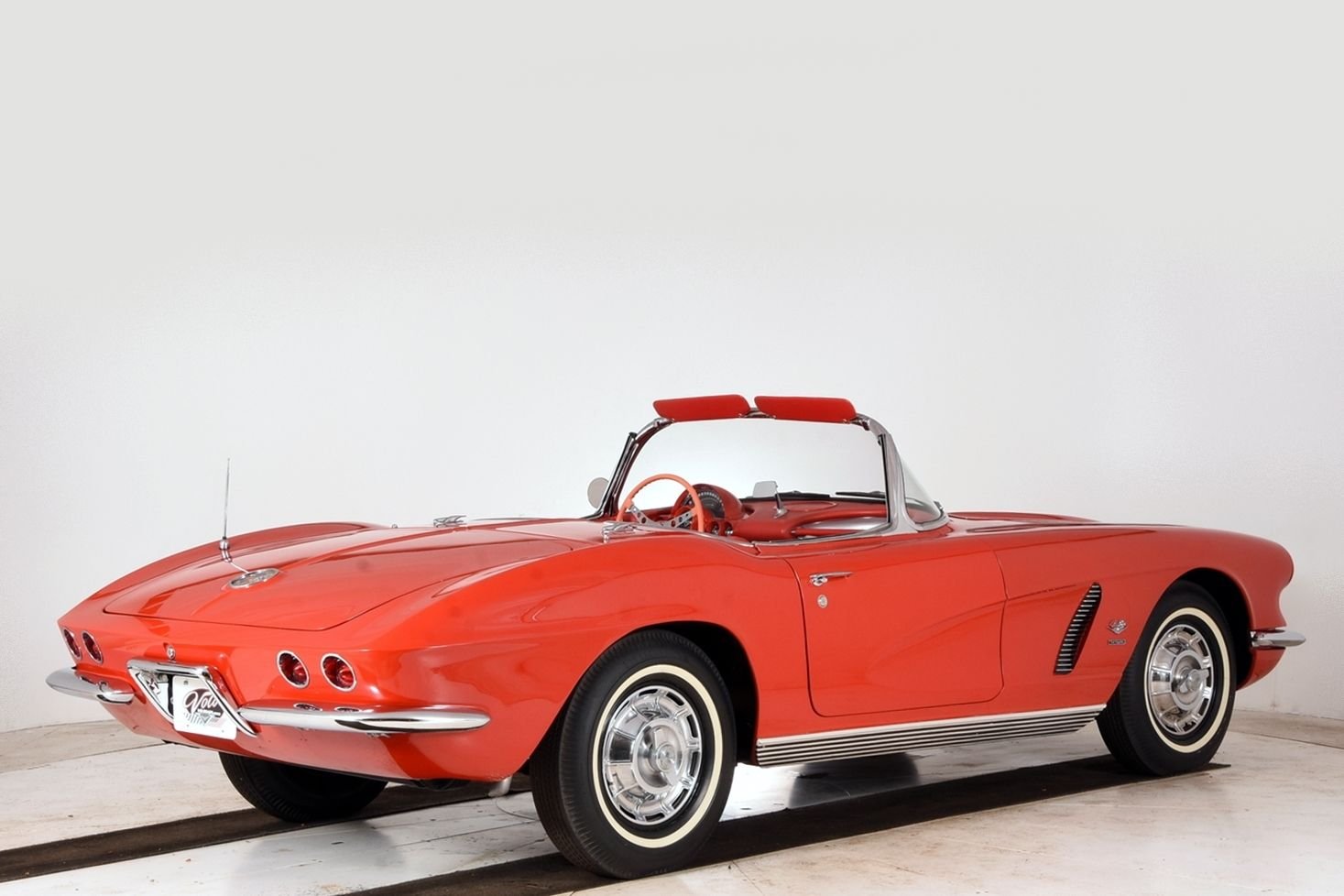
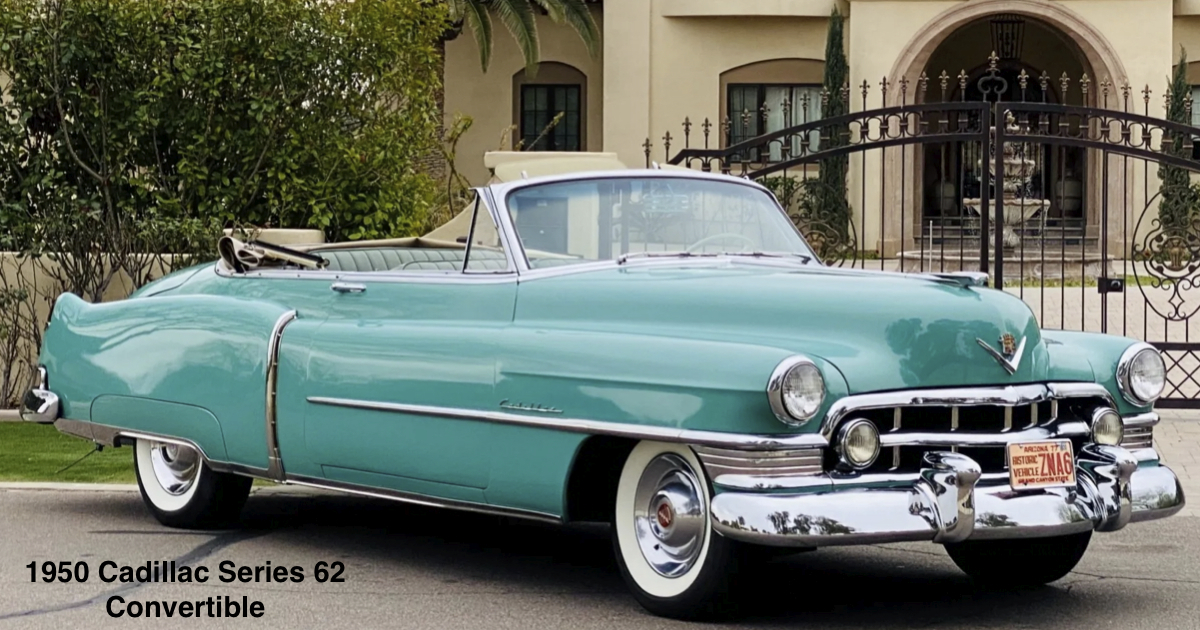
America was ready to buy some cars. So Cadillac did what they all did, they fired up the production line, tarted up the 1942 models with some new trim, then called them 1946s. America was so hungry for cars that they were buying anything with wheels on it. But as production ramped up, the market calmed down a bit, although growing strongly every year.50 Cadillac 62 Convt
Cadillac can literally take credit for, or be blamed for, the tail fin craze. Their 1948 models were the first to show any vestige of a tail fin. Conceived by GM’s legendary Design Chief Harley Earl, they were inspired by the twin tail booms on the P38 Lightning fighter plane of World War II. Every 1948 Caddie got them, and each year they grew. Cadillac’s tail fins were not only first, they were also the biggest. By 1959 Cadillac’s tail fins were huge and garishly trimmed in way too much chrome. The long chrome spears running down the sides of the car were attached with fasteners that popped through holes in the body, and since the trim slowly narrowed toward the back, each fastener was unique. And there were hundreds of them in all. This is the way Cadillacs were put together in those days, and one reason why they suffered from corrosion later in life. The 1959s were bold, gaudy, huge, and in-your-face. Thank goodness 1959 was the peak of the tail fin era. The 1960 models had toned-down fins and they continued to tone down, getting smaller and more subtle each year until they were mostly gone by 1965 or so. However, a vestige of the tail fin has always remained
in Cadillac styling, all the way up to modern times. You can see it in the vertical tail lights on a new Caddie.

It takes about 3 to 5 years to take a new car from concept to production. Postwar civilian production resumed in 1946 and it took until model year 1949 for the genuinely new models to come out. Compared to the old ones, designed before the War, these new cars were sleek, modern, lower, wider and just…better. By this time Cadillac was truly America’s luxury brand and they were proving it with cars like the 1953 Eldorado convertible, the Series 62, and at the top of the heap, the 1957-58 Eldorado Barritz (officially called Brougham). Only 904 of these ultra-luxury flagships were built making
them worth as much as $300,000 today in collector car auctions. But they were expensive back then as well. The MSRP of a 1957 Eldo Barritz was $13,074, more than a Rolls Royce at the time. A 1957 Corvette went for $3,176.
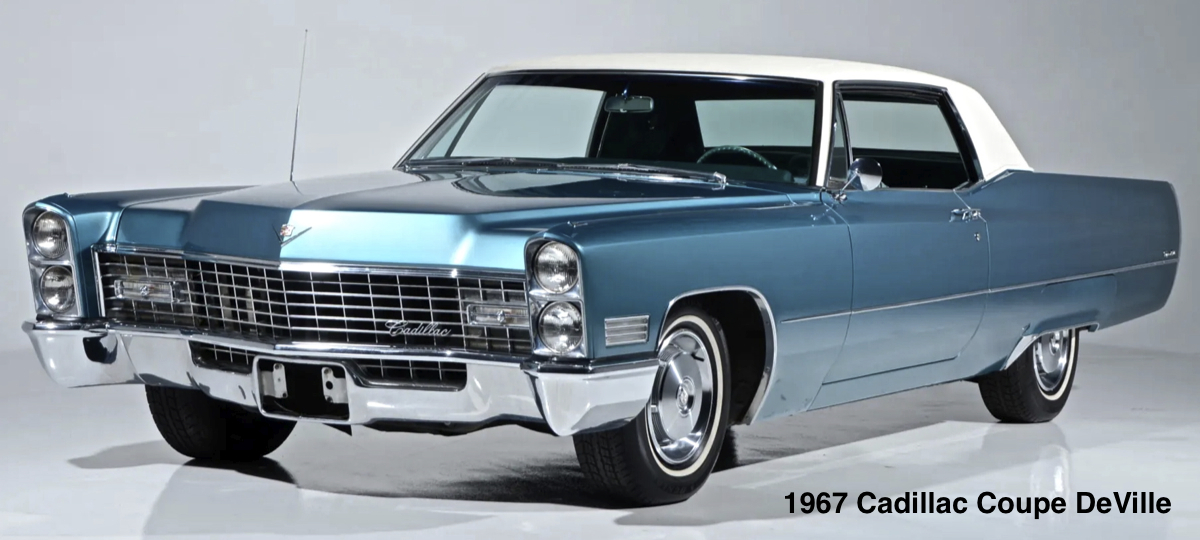
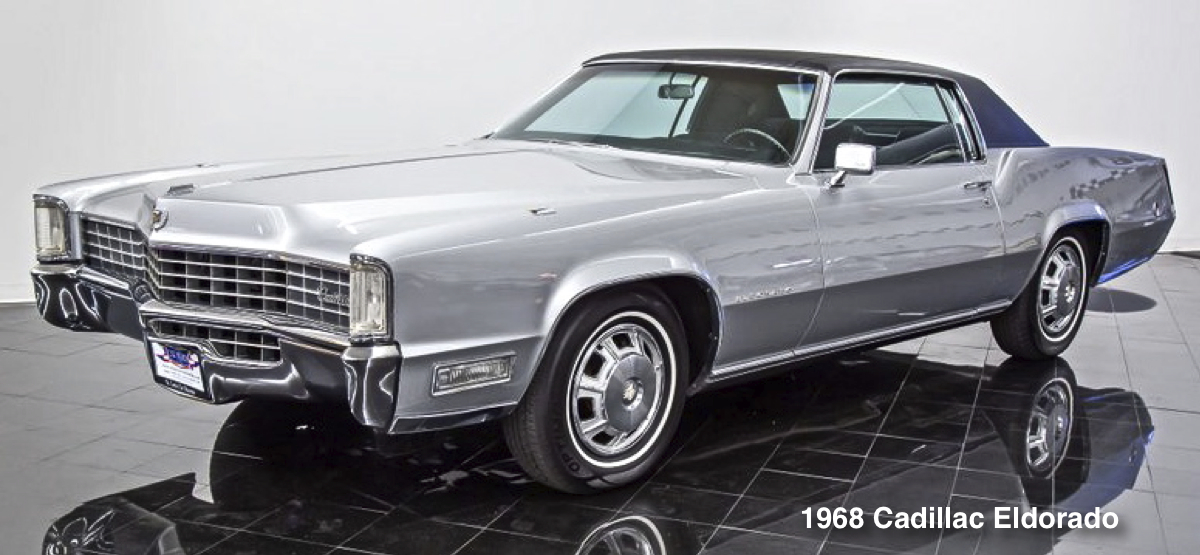
67 Cadillac Coupe DeVillleeThe 1960s were good to Cadillac. They entered the decade making around 148,000 cars per year, and by 1970 that number had grown to 210,000 cars. It had been a steady growth, free of spurts and fits. And the sales numbers just kept growing right up into the 1980s. In 1980 Cadillac produced 310,000 cars. The 60s also had some great Cadillacs. Sedan Devilles, Coupe Devilles, Fleetwood, and Eldorado. The Eldo changed significantly in 1967. Until then, it had been a fancier version of Deville convertible, but in 1967 it went front-wheel drive. Oldsmobile had just come out with its radical front-drive 1966 Toronado and GM wanted to amortize out the tremendous cost of that development program with a Cadillac version. While both cars were built
on GM’s new E-platform, its first-ever with front-wheel drive, there were differences besides the looks. Of course they had different engines, the Caddie with its 429 V8 making 340 hp and Olds with their 425 ci Rocket V8 with 385 hp, and there were subtle tuning, trim and feature differences between the two. Generally, the Toronado was sportier and aimed at a younger buyer.

The 1970s saw much turmoil in the market as the Malaise set in. Tough government regulations addressing smog, fuel economy and safety, along with lead being removed from the gas and soaring insurance rates was killing the high-performance car market. And all during the 1960s it seemed every brand had been cashing in on the muscle car craze. But, Cadillac was never any part of that, so when it ended, it had little effect on
them. Cadillac’s sales continued on as always, steadily growing right through the 1970s.

In 1975 Cadillac released a radical new car for them, a smaller, more economical luxury sedan, the Seville as a 1976 model. It was an instant hit and sold 43,466 cars its first year. Despite being their smallest model, the Seville was the most expensive model Cadillac was selling. Built on the K-body platform, shared with the rear-wheel drive Olds Cutlass and Pontiac Grand Prix among others, Cadillac engineers managed to build a feeling of quality and luxury into it despite its humble roots. The smaller, lighter car didn’t need a 500 ci Cadillac V8, a smaller engine was needed and Caddie didn’t make one. So they used the L26 Oldsmobile 350 making 180 hp. It came with a Bendix EFI (Electric Fuel Injection) system, GM’s first on a V8.68 Cadillac EldoradoThe Seville was meant to go toe-to-toe against Mercedes and BMW. That didn’t go too well. Despite their move into a younger buyer strata, they still weren’t the same ones buying European. Those people didn’t take the little Cadillac, any Cadillac seriously and that was beginning to be a problem, a very big problem. Demographics move as generations grow old, markets change, economics rise and fall and through it all Cadillac was losing its core market. They used to be regarded as the world’s premium luxury car, rivaling anything from anywhere, the car you wanted to drive once you’d ‘made it’. Driving a Cadillac used to signify your success, your status. But that was all changing. That brand snobbery had left our shores and landed in Germany. Starting in the early 1980s, owning a Mercedes or BMW was a sign of prosperity and intelligence. Cadillacs were increasingly being thought of as “a relic of the past”, or “my father’s car”, or worse “my grandfather’s car”.

In 1982 Cadillac decided it needed to move down market to capture more younger buyers, so they launched one of their most problematic and controversial cars of all time, the Cimarron. Being built on the J-body front-drive platform meant it shared its bones with the humble Chevrolet Cavalier, Pontiac J2000, Olds Firenze and Buick Skyhawk. It launched with a rumbly 1.8-liter 4-cylinder making 88 hp, which was later upgraded to a 2.0 with 110 hp, or an optional V6 with 135 hp. They didn’t even bother to reskin the Cavalier, it was essentially a facelift, where just the front and rear facias
were changed along with some trim and a new leather-swathed interior. With a big Cadillac grille on the front of it with a hood ornament. It wasn’t nearly enough and the public figured it out rather quickly. It turns out they didn’t like paying Cadillac prices for a Chevy. The car bombed and with it some of Cadillac’s hard won reputation.

Perhaps in an effort to win some of it back, Cadillac unveiled its first truly new engine in decades, the DOHC 32-valve Northstar V8 in 1993. It was a gorgeous all-aluminum feat of engineering but unfortunately early engines suffered head gasket failures and head bolt threads pulling out and it ruined the reputation of this fine engine. Built in 3 generations, produced through 2009 during which time it made from 275 to 315 hp in naturally-aspirated form and 439 hp in the supercharged LC3. It was dropped in favor of the much cheaper and more reliable LS family of Chevy engines from the Corvette.

Cadillac discovered a whole new world when it introduced the Escalade full-sized SUV in 1999. It turned out to be a monster hit with rappers and movie stars and by 2003 it has become Cadillac’s biggest seller. In 2000 Cadillac abandoned all the names of its cars in favor of ‘letter names’ like CTS
(formerly Catera), DTS (formerly DeVille) and later the XLR and SRX. It probably confused the market but it seemed to help sales slightly. Perhaps Cadillac was trying to cut the ties from its past. A shame really, when one considers how proud they used to be of their heritage.

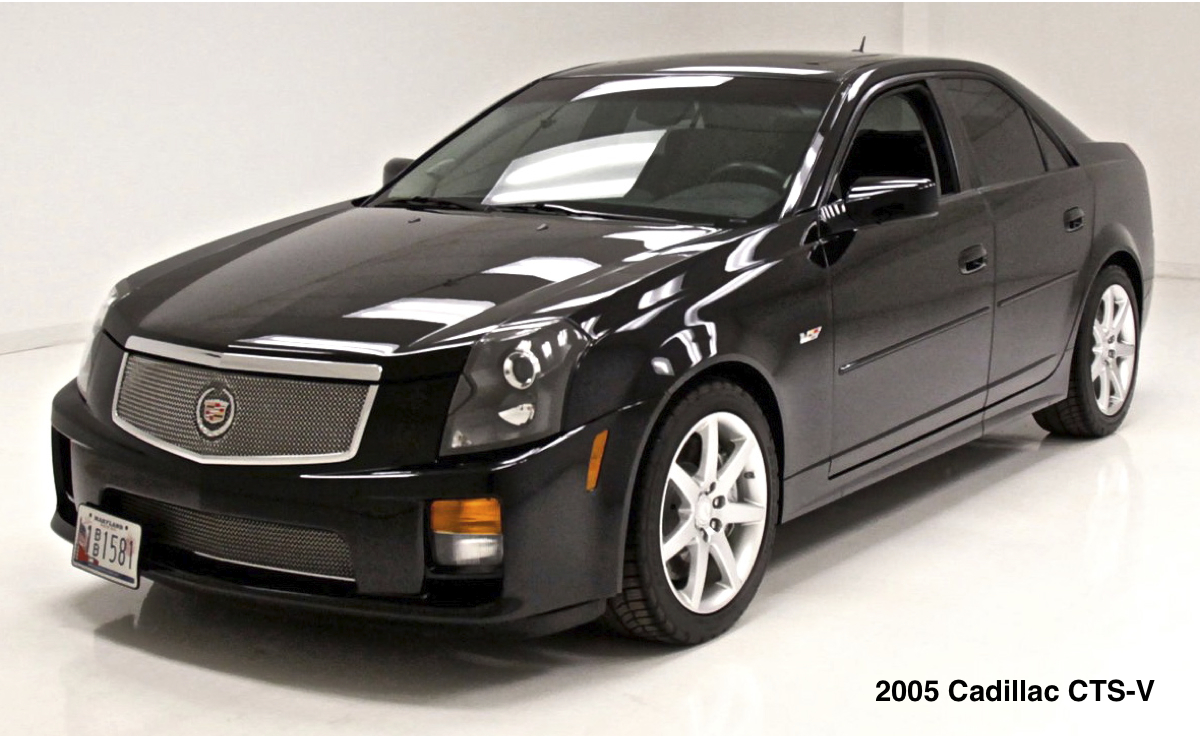
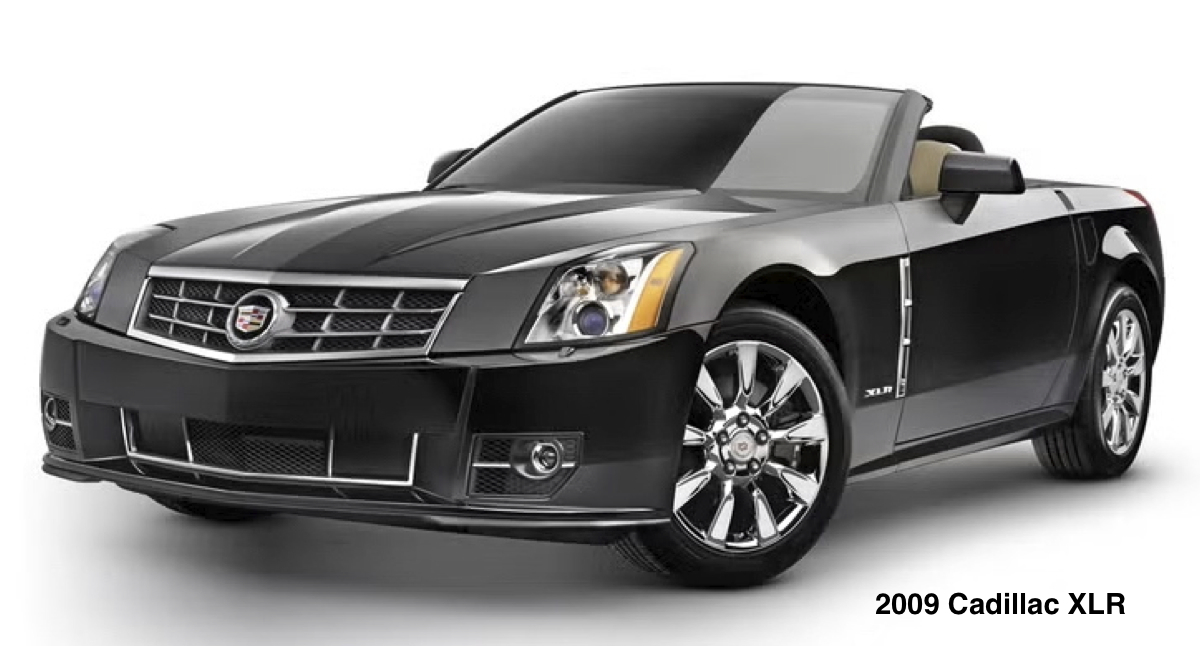
The 2004-2009 Cadillac XLR was a reimagined Corvette built on the C6’s chassis butwith 4.6-liter Northstar power (320 hp). The 2006-2009 XLR-V used a 4.4-liter supercharged Northstar good for 469 hp. All had either 5- or 6-speed automatics. All had power-retractable convertible hardtops. Prices were sky-high at the time, $75-85K, $100K+ for the XLR-V and total sales for all 6 model years totaled around 16,000 units. But it was a halo car for the brand and that’s a good thing.05 Cadillac CTS-VStarting in 2003 with the CTS, Cadillacs took on a sharply-angled, slab-sided, stealth fighter-look that was a little alarming at first. Then, that look began to spread across Cadillac’s entire lineup. It became the brand’s signature look. And it was sort of a love-it-or-hate-it affair. Traditional Cadillac fans hated it, but someone must have liked it because CTS sales climbed from 35,000 in 2003 to 70,000 in 2007. In fact, overall sales of the Cadillac brand also improved during the adoption of the “Art & Science”
look, as Cadillac named it. 145,000 sales in 2003 and 232,500 in 2007. Then the housing crisis hit and sales fell and continued to fall. They hit a low of 120,000 cars in 2011 but have recovered, slowly and steadily. They sold 350,000 cars in 2025, their best year ever.

In the 2026 model year the Cadillac lineup consists of two sedans, the CT4 ($36K) and CT5 ($40K), both with 4-cylinder turbo power; two crossovers, the XT4 ($37K) and the XT5 ($44K) also both with turbo 4’s; two SUVs, the XT6 ($50K) with 4-cylinder turbo, and the full-size Escalade ($82-100K+) with 6.2-liter 420hp V8 or supercharged with 682 hp in the Escalade-V.

Then, we get into the electrics. GM spent a literal fortune converting over to EV production because of the Biden mandates and it took much-needed money away from developing the vehicles that people actually want to buy. Lyriq is Caddie’s best selling EV with 40,000 sales in 2025. The new Optic launched in late 2025 and sold roughly 3,000 units. Same with the Vistiq with around 2,000 sales in 2025. The Escalade IQ is a fully electric SUV that seems to be struggling at 10,000 sales for 2025. Obviously Cadillac is betting heavily on an all-electric future. But at what cost? If all their gas-powered cars are 4-cylinders they’re no fun anyway. It’s hard to imagine 4- cylinder Cadillacs.09 Cadillac XLR
Today, more than a purveyor of luxo-barges like before, Cadillac wants to become known, and has become known as a maker of fine high-performance luxury sports sedans, crossovers and one big-ass SUV. At one time they leaned on Corvette power but now it’s all turbo 4s. The only V8 left is in the Escalade, a vehicle that the classic Cadillac of old would never have considered building. Lately, there have been reliability and quality issues that have further harmed the brand’s image. There have been
technical problems, and as cars get more and more tech-laden these problems will likely persist. Then of course inflation and bad corporate management have driven the cost of new cars out of reach for most buyers today. All of these things should conspire to hurt Caddie’s sales yet they’ve just had their best year eve. The biggest issue, and their biggest loss is one of reputation and public image. And you can’t just buy that back or win it back with racing victories or fancy new models. It took decades to build and decades to lose. Will they ever win it back? Only time will tell.

Motorsports News – 6-10-26 by David Vodden

Motorsports News by David Vodden

The best race event I saw last weekend took place at nearby Silver Dollar Speedway. The event honored driver David Tarter who was killed in a pit accident. The main event for winged sprint cars had everything. Top area driver Justin Sanders had to work his way around Chance Grasty to take the lead which he held until the last lap when a car spun in front of him that he could not avoid hitting. With only two laps remaining and Sanders out, Grasty zoomed to his first career win in the high-speed, dangerous form of auto racing. Track co-promoter Colby Copeland drove wildly to take second ahead of Tim Kaeding, Landon Brooks, and D. J. Netto. There was a great crowd on hand, the preliminary races were good and even the dwarf cars put on an entertaining show. Dalas Gunderson was there! The next opportunity to see a sprint car race at Silver Dollar Speedway is Wednesday July 1st. That program will include a huge fireworks show and can be seen for a special $2.50 admission price. Wow! Call the track to confirm details and come early. The fireworks show fills the fairgrounds grandstands to capacity.

The Formula One racers spent a luxurious race weekend in Monaco. Kimi Antonelli won for the fifth time in a row keeping all six F-1 races run thus far in the Mercedes camp. His closest rival and teammate, George Russell finished twelfth after two pit stop penalties. Mercedes screwed up. Lewis Hamilton took Ferrari to second place followed by Isack Hadjar – Red Bull, Oscar Piastri – Mclaren, and Liam Lawson – Racing Bulls. Notable events included pole starter Max Verstapen failing to start at the drop of the start lights. Charles Leclerc lost traction on broken asphalt and punched the tire wall, knocking him out. Reigning champion Lando Norris had a mechanical DNF for the second race in a row. More than usual, the narrowness of the streets of Monaco were cited as making passing on the track impossible. The chunking asphalt was new, at least to me. Formula One goes to Spain next weekend and stays in Europe until September.

The Indy car race in Illinois saw Josef Newgarden win for the Captain, Roger Penske, in a race that had more than one rain-delay, one big crash and saw perennial winner Alex Palou run out of gas while leading with fifty-seven laps to go. Palou ended up seventeenth. Weird! Marcus Erickson finished second, Christiam Rasmussen third, Rinus VeeKay fourth and Scott McLaughlin was fifth. For the record that is USA, Sweden, Denmark, Netherlands, and New Zealand in terms of driver country of origin. Newgarden tied Al Unser Jr for ninth place on the all-time Indy car win list with thirty-four first place finishes. Indy car racing goes to Road America on June 21st.

The National Hot Rod Association [NHRA] saw action in New Hampshire where the top fuel dragster and funny car final was rescheduled to this weekend in Bristol due to rain. Dallas Glenn took the Wally in Pro Stock over Matt Hartford before the rain came. Last weeks delayed finals between Leah Pruett and Shawn Langdon -dragsters, and Jack Beckman and Jordan Vandergriff – funny cars, will go on Friday night at Bristol.

NASCAR was in Michigan last weekend where Denny Hamlin once again qualified for the front row for the CUP race, was put to the back at the start and then drove to the win in the closing laps. You will recall that Hamlin did the same thing the weekend before and is now fifty-nine points behind leader Tyler Reddick. Reddick has been all but impossible to catch for the regular season point championship until Michigan. Reddick was involved in a major crash on lap 107 and finished thirty-fifth. It was the first DNF for the Michael Jordan owned Toyota number forty-five. Erik Jones got his best finish of the year with second. Bubba Wallace was third with Kyle Larson and exciting Carson Hocevar completing the top five. It is worth noting that catching Reddick in the CUP regular season points is more about Hamlin’s results than Reddicks. Reddick has 669 points after Michigan. Hamlin is now fifty-one behind at 618. It drops 106 points to third place Ryan Blaney who has 512 tallies. From fourth place Chase Elliott who has 482 points to tenth place Chris Bell, who has 410 the spread is a mere seventy-two points. There is clearly room for changes to take place in the final sixteen contenders with eleven-point races remaining before the playoffs begin September 6th at Darlington Raceway. At Michigan C. Bell was hit by Chase Elliott, resulting in severe wall impacts for both drivers. Elliott seemed OK after extricating himself from his Hendrick Chevy but not so Bell who is reported to be suffering post-crash injuries. Corey Heim, who was announced as the new full-time driver in the 23/11 number 35 car next year, won the Craftsman truck race by a mere .065 second over jealous teammate Kaden Honeycutt. Hocevar led the most laps but faded to third with heating problems. Layne Riggs and Chandler Smith followed. It was Heim’s third win in the class despite only being part time. The NASCAR trucks have six regular season point races left before ten drivers compete in ten races where the highest point driver will be the 2026 truck series champion.

The American Federation of Motorcycles [AFM] is on track at Thunderhill Saturday and Sunday. This is one of the best spectator-shows at the track each year as wild and crazy riders risk it all to win on the three-mile, fifteen-turn course. The two-mile track will have the Reno Region SCCA open track for street cars that you can show up and enter. There will be other activities on site at 5250 Hwy 162 just west of Wal Mart.

Willows Vice Mayor and current Rotary Club president, Rick Thomas will be feted at a dinner Thursday, June 25th at the Elk Creek Lodge. If you are a friend of Rick’s or have benefited from his years of community service, you are welcome to join the dinner group. Call David Vodden on 530-330-2186 to reserve a spot.

“8 Generations of Chargers” by Andy Tallone

“8 Generations of Chargers”


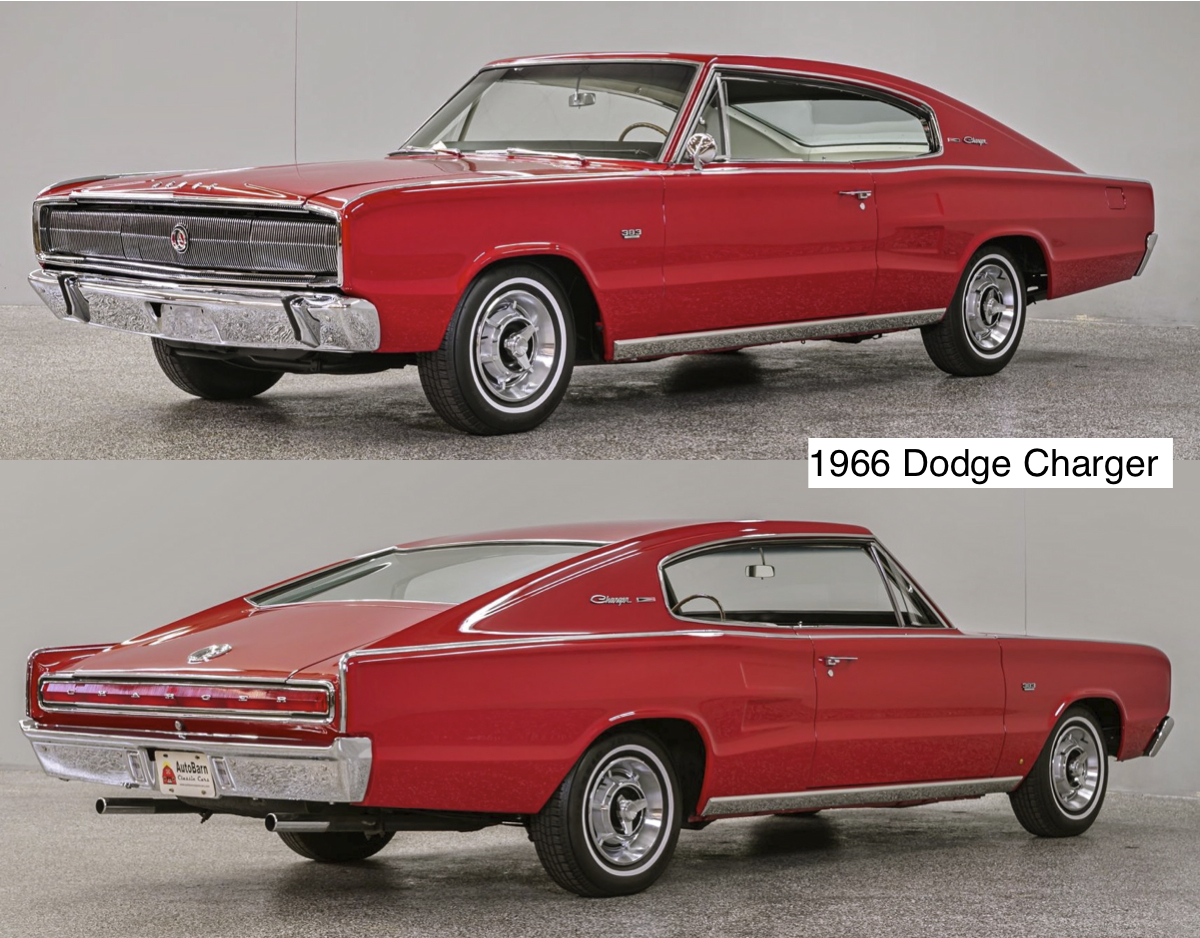
1966 CHARGEREveryone knows how Ford changed the automotive world with the introduction of the Mustang in 1964 (as an early 1965-model), and how John Z DeLorean, then President of Pontiac kicked off the Muscle Car craze with the 1964 GTO, and how every other American carmaker rushed
their own versions to market. This double-whammy from two cross-town rivals touched off an arms race that didn’t end until 1971. But did you know that lowly Plymouth actually beat the Mustang to market with their own ‘Pony Car’?

That’s right, Plymouth, known for low-priced ‘strippies’ came out with the Barracuda and actually beat the Mustang to market by 16 days. Obviously, that wasn’t enough of a lead, and the Barracuda wasn’t enough of a car to stem the tide of the mighty Mustang. Plymouth had cobbled together their own ‘youth-oriented’ car by grafting an ungainly fastback roofline to the
homely Valiant to tap into the burgeoning ‘youth market’, but simply didn’t nail it the way Ford did with the Mustang. The proof is in the numbers. Plymouth sold 23,433 Barracudas in its first year, 1964, while the Mustang sold 121,538 copies in its first year, 1964, and it was a short year by industry standards.

Despite the disappointing results, Plymouth needed every sale and no one in those days could afford to ignore this new and growing market. Chrysler’s other big brand, Dodge wasn’t discouraged. In 1964, they created a show car called the Charger that was actually a roadster version of the full-size Polara. And while it bore no resemblance to what the production
Charger would become, it was a tester for the name, at least. The following year they introduced another concept car at the Chicago Auto Show, the Charger II, which looked very much like the production Chargers to follow.

The 1st-generation Charger that we all know and love was launched late in the 1966 model year cycle on January 1, 1966 at the Rose Bowl. Based on Dodge’s midsize B-body platform shared with the Coronet, the Charger also had an ungainly fastback roofline with a huge back window, and hideaway headlights set in a grille that looked like the head of an electric shaver.
They weren’t gorgeous like the Mustang, or GM’s new crop of muscle cars (ie: Pontiac GTO, Chevy Chevelle SS, Olds 442, and in 1965 the Buick Grand Sport), but they managed to make an impression and get Dodge into the game. Sales were modest at 37,344 for 1966, which was a short production year for the Charger, but it dropped to just 15,788 in 1967, a 58% drop.

It certainly wasn’t for lack of horsepower. The 1st-gen Charger never came with Chrysler’s ubiquitous Slant 6, only V8s were offered, starting with the small-block 318 and topping out with the legendary 426 Hemi. But what it needed was better styling. GM was minting hit after hit and the Mustang was running wild, something had to be done. After just two model years, a
complete redesign was done.

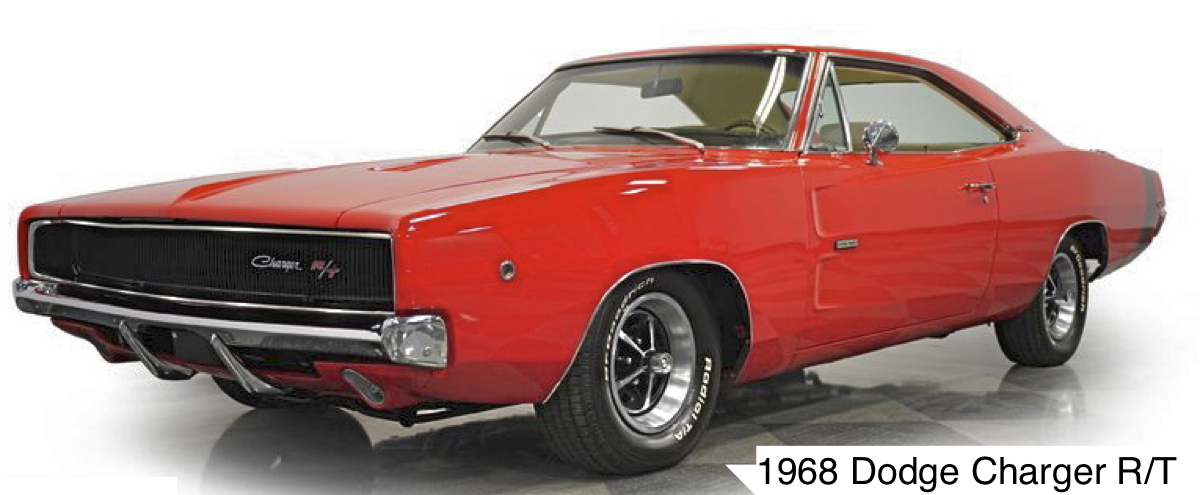
1968 CHARGER R_TThe 2nd-gen Charger hit the scene just in time. Still based on the Coronet B-body, the 1968 Charger took on a whole new shape, which came to be known as the “Coke-bottle shape”, meaning it swelled slightly at both ends with a subtle but tasteful dip in the middle. Hideaway headlights were now an option, and gone was the fastback. In its place, the C-pillars took on a
‘flying buttress’ giving it a semi-fastback look, while the rear glass was itself recessed into the cavity between them. It looked fantastic and was an instant hit. Sales jumped to 96,100 cars for it’s introductory year. 1969 cleaned up the look slightly with a split from grill and more squared-off tail lights. However the newness had worn off and competition was feverish from the other brands, so sales dropped slightly to 89,199 for the 1969 model year. For 1970, the final year for the 2ndgeneration, they further refined the looks, removing the vertical center-split on the grille. Most
Charger fans consider the 1969 model to be the best looking Charger of the 2nd-generation, and perhaps of all time. Sales of the 1970 dropped to around 55,000 cars.

Of course, Dodge offered its full range of engines. For the first time in a Charger, the humble workhorse 225 Slant Six became optional midway through the 1968 model year, but few, very few were ordered this way. V8 options started with the 318 and topped out with the 426 Hemi. There were two 383s, and the 440 came in two flavors, the 375hp 4-barrel 440 Magnum, and the 390hp 440 Six Pack with three 2-barrels on a special aluminum manifold. By 1970 the 440 Six Pack was outselling the 426 Hemi, which was a much more expensive option and was much harder to live with on the street. Just 468 1968 Chargers were ordered with Hemis, 232 in 1969, and only 118 in 1970. Today, all 2nd-gen Chargers are incredibly popular at shows and bring crazy money at auction, and of course performance models like the Charger R/T (Road and Track) and especially those with Six Packs or Hemis are in the stratosphere price wise.

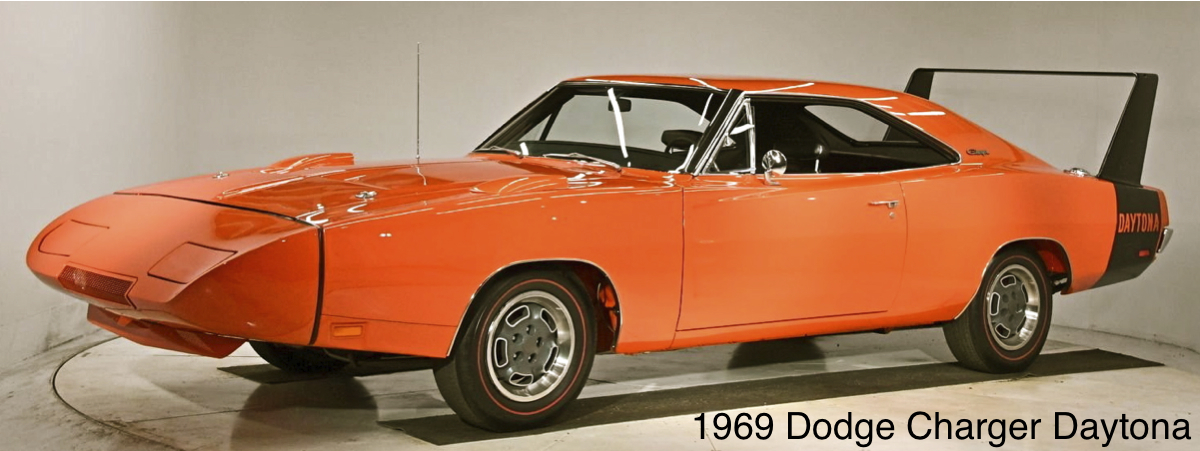
During this time, both Dodge and Plymouth were competing furiously in NASCAR and it was quickly found that the Chargers were aerodynamically terrible, with their recessed grilles, concave back windows and their overall shape. Not only did they have high drag, but they also experienced dangerous lift at high speeds. This was hurting not just their performance on the track, but all in the showroom, at a time when “winning on Sunday led to sales on Monday”. So, a wild new version of the 1969 Charger was built specifically for NASCAR, the Dodge Charger Daytona.1969 CHARGER DAYTONFamous for it’s huge rear wing, they also had a reworked rear window making it flush, a pair of small rear-facing air scoops on the tops of the front fenders to vent high-pressure air from the engine bay, and a huge fiberglass bullet-nose with flip-up headlights that extended the overall
length of the car by 19 inches. The results were nothing short of amazing. All these mods improved the aerodynamics and reduced the lift so much that the Charger Daytona, and it’s Plymouth sister-car the Superbird (a similarly modified Road Runner) dominated NASCAR during the 1969 and 1970 racing seasons. The Daytona debuted at the Talladega 500 in September 1969 with Richard Petty at the wheel. In fact, the aero package was so effective that the NASCAR governing body banned them at the end of the 1970 season. They simply changed the rules. But the Daytona was the first car to ever break the 200 mph-barrier in NASCAR.

Prior to their ban, the Daytona needed to be homologated by selling at least 500 examples to the public. 503 were sold, and of course today they are worth a fortune. All Daytonas came standard with the 375hp 440 Magnum, with the 440 Six Pack and the 426 Hemi as the only other engine options. The 727 Torqueflite 3-speed automatic and the A833 4-speed manual
were the only transmission offerings.

Some of these aerodynamic mods filtered down to a new Charger sub-model, the SE (Special Edition), including the flush rear window and a flush front grille. This was an appearance package only, nothing special performance-wise.

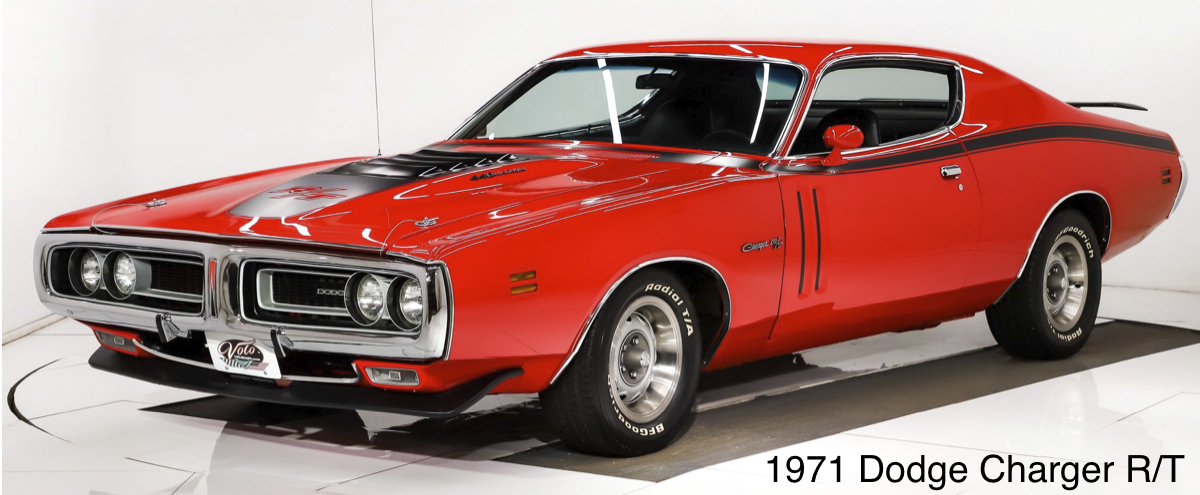
Despite all the success, things moved pretty quickly back in those days and so another generation was launched after just 3 model years. The 3rd-gen Charger was released as a 1971 model and ran through 1974, just as the Malaise Era kicked off. By 1971 horsepower ratings were dropping fast as government fuel economy and smog regulations ramped up. Yet the full range of engines was offered for 1971 including the 426 Hemi. The world was changing, and all-out horsepower was taking a back seat to ‘personal luxury’. The emphasis on luxury over performance defined the 3rd generation.

1971 CHARGER R_TWhile the ‘Coke-bottle shape’ continued, it was smoothed out considerably giving it a better coefficient of drag and giving it a whole new look which was named ‘The Fuselage-look’. They were great looking cars, but never quite as pretty last the 2nd-gen. But the sales were still quite strong with 1973 being Charger’s best year ever at 119,318 units. This is a reflection of the changing times as much as the cars themselves. 1973 was a banner year for most cars back then, and the move away from straight-line performance to personal luxury, handling and comfort opened them up to a much wider market.

The 225 Slant Six became the standard engine in all non-R/T Chargers with 3 small block V8s (318, 340 and 360) and 5 big blocks, starting out at least (383, 400, 440 Magnum, 440 Six Pack and 426 Hemi), however the Hemi disappeared after 1971, and the Six Pack after 1972.

The 4th-generation ran from 1975 through 1978 and became little more than a tarted-up Chrysler Cordoba. They had formal styling and the emphasis was on luxury, not performance. Sales were modest with 1976 being its best year at 65,900 cars.

The Charger took 3 years off then returned in 1981 through 1987 as a badge-engineered Mitsubishi (Chrysler owned a controlling interest in Mitsubishi at that time). Powered by a 4- cylinder engine, it became a compact hatchback. Carroll Shelby was working with Chrysler at this point and so a higher-performance Shelby variant was offered in 1984-1986. Sales wandered between 20,000 and 50,000 units per year.

Charger disappeared altogether from 1988 through 2005 when it returned as a brawny rear wheel-drive 4-door sports sedan in 2006. Based on the full-size Chrysler 300, it was a big car, but it worked. With Hemi V8 power optional (V6 standard) sales were strong, coming close to breaking the marques all time record set in 1973. Dodge sold 119,289 units in 2007. Sales
remained strong for the entire 6th and 7th generations, averaging close to 90,000 units per year. The break came between model years 2010 and 2011 when the Charger received a mild mid-cycle refresh. Exterior and interior styling was changed slightly, barely justifying a generational change, but that’s what they called it. Engines opened with the 2.7- and 3.5-liter V6s in the 6th-gen, and the 3.6 Pentastar V6 in the 7th generation. V8 options included the 5.7 Hemi (340 to 368hp) in the 6th, bumped up to 370 in the 7th, with the top engine being the 6.1 Hemi in the R/T rated at 425hp, and the 6.4-liter Hemi (aka: the 392 harking back to the first generation of Chrysler Hemis in the 50s) rated at up to 470hp in the SRT models. They were all automatics, starting with a 4-speed, then a 5-speed and finishing with 8 speeds.

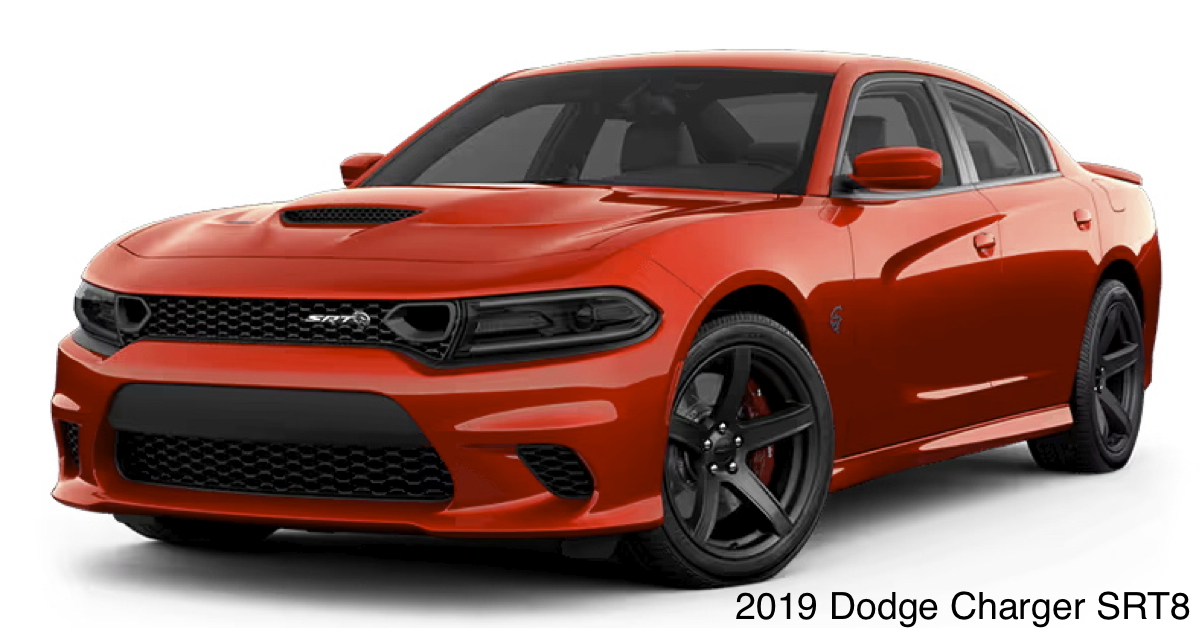
Starting in 2015, they started dropping those crazy-fast supercharged Hemis from the Challenger Hellcats into the Charger. From 2015 through 2023 the Charger SRT Hellcat made 707-717 horsepower (zero-to-60 in a scant 3.8 seconds!), in 2019 they offered an even faster version, the SRT Hellcat Redeye with 797hp, and in 2021 came they came out with the Charger SRT Hellcat Redeye Jailbreak with a whopping 807hp, with quarter-mile times of just 10.5 seconds!! And this from a factory-stock car with 4 doors, financing and a full warranty!! These are truly wonderful times to be alive!

In 2024 the 8th generation came out, but the Hemi was gone. In it’s place was an all-electric drivetrain with 670hp called the Scat Pack, and the new 3.0-liter turbocharged inline-6 called the Hurricane.

Things have changed a lot over the life of the Dodge Charger. But its still here, having endured the feverish competition of the late-60s, the Malaise of the 70s, the luxury-era of the 80s and the advent of modern technology-driven horsepower. It has endured 8 generations, quite an accomplishment for any car.

2019 CHARGER SRT8

“11 Generations of Thunderbirds” By Andy Tallone

“11 Generations of Thunderbirds”

The Ford Thunderbird was and is one of the most iconic personal luxury cars ever built, certainly one of the longest lasting. The ’T-Bird’ spawned 11 generations over its 50- year lifespan. How many marques can make that claim?

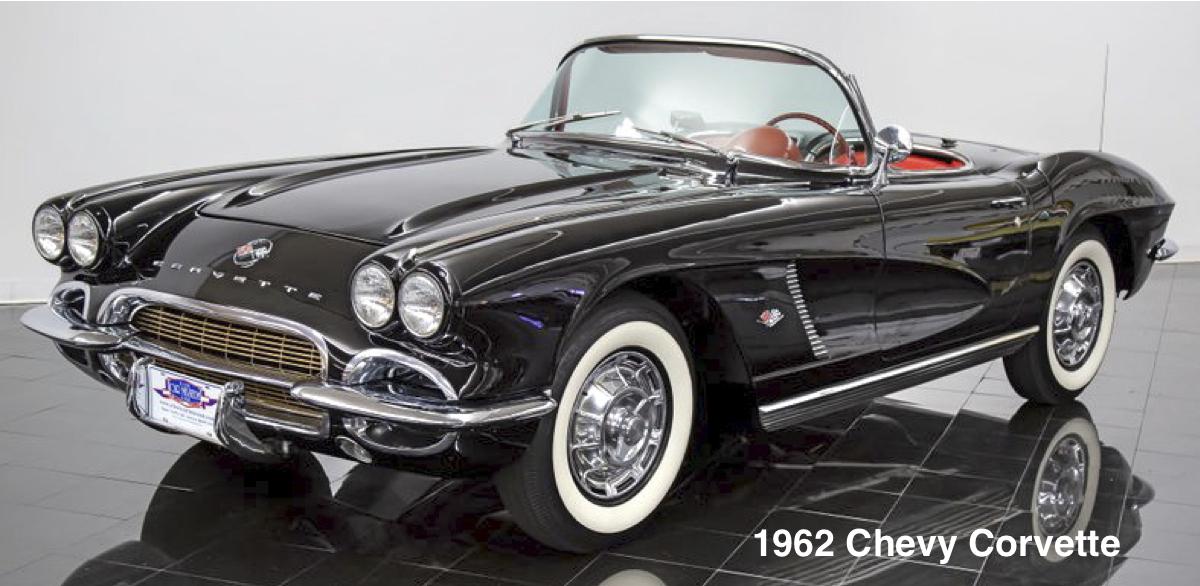
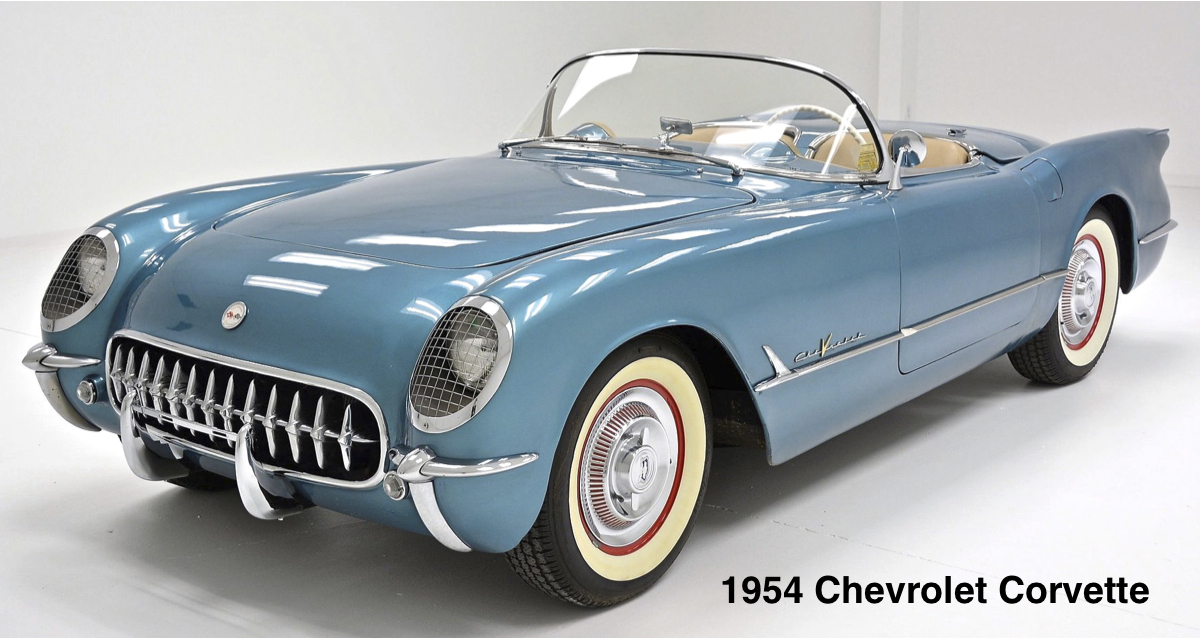
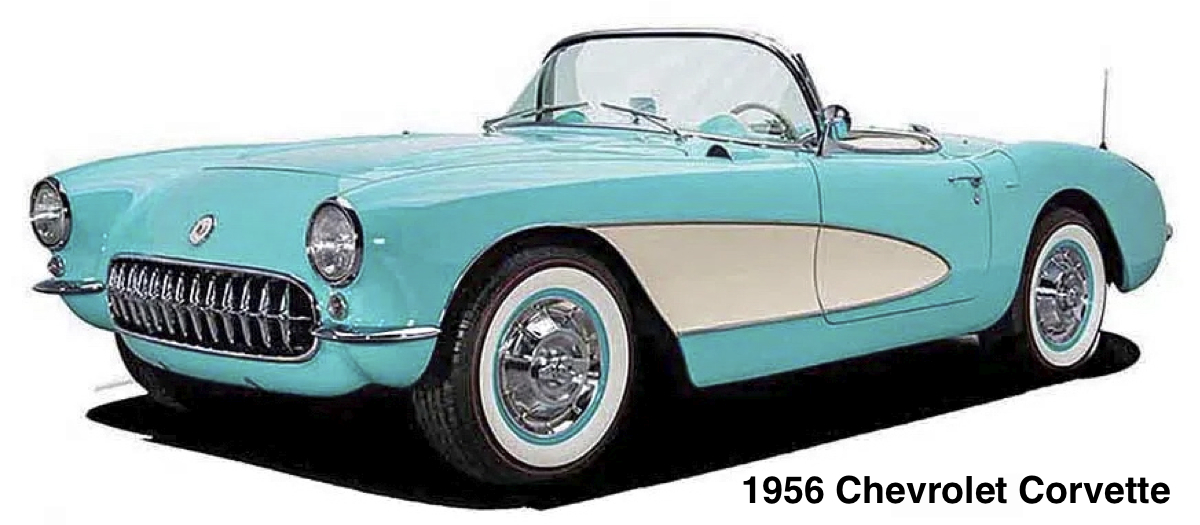
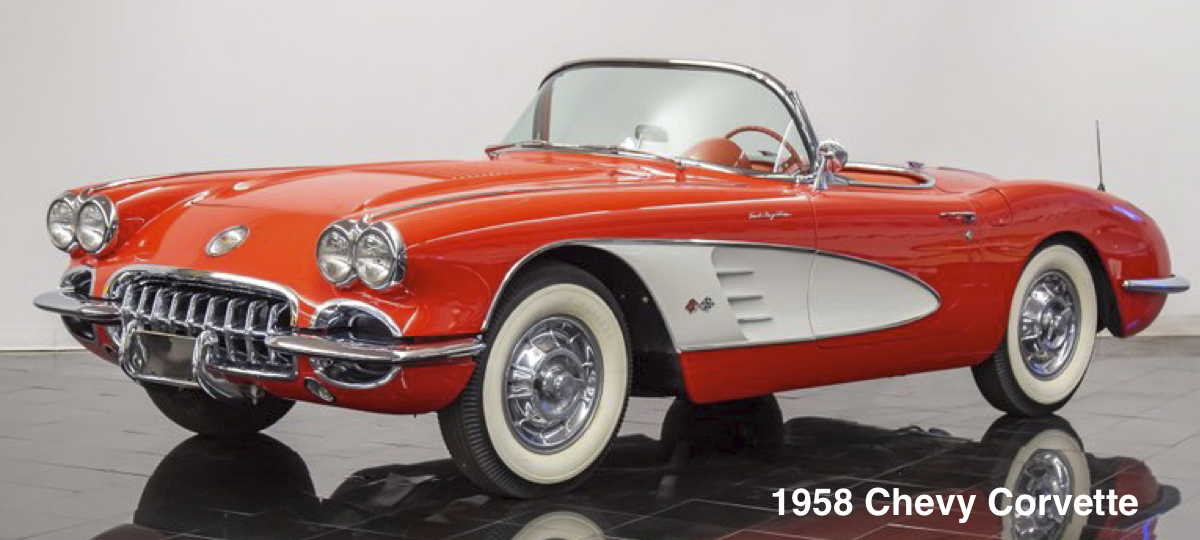
In 1953 Chevrolet launched the legendary Corvette as America’s answer to the European sports car. Of course, early Corvettes were incredibly primitive. When first introduced, they didn’t even have roll-up windows, or outside door handles. Ford watched from across town and had ideas of their own on this. They felt they needed to fire off a response just to maintain their position in the world, but they didn’t want to simply ‘copy’ what GM was doing. They wanted their own unique take on the 2-place sports car. And it was going to be a lot nicer than the Corvette.

In 1953, Henry Ford II recruited former GM exec Lewis Crusoe to head up the project. Chief Ford stylist George Walker and designers Frank Hershey and Bill Boyer shaped the new car and positioned it as a highly-styled luxurious 2-place personal luxury car with a distinctive American flavor, rather than trying to ape the Europeans. The goals were simple and clear cut: Two seats, V8 power, a top speed of at least 100 mph and a weight of around 2,500 pounds.

The engine part was easy. Ford had just introduced it’s first OHV (overhead valve) V8 in 1954 after 2 decades of flatheads. The new Y-block V8 was made in several sizes(239, 256, 272, 292 and 312 cubic inches). The 292 came standard, but starting in 1956 the 312 was optional in the T-Bird. As did nearly every American car back then, they came standard with a 3-speed manual transmission, but a 3-speed manual with overdrive was optional, as was Ford’s Ford-O-Matic 3-speed automatic. No 4-speed was offered. The automatic was by far the most popular choice in the Thunderbird.

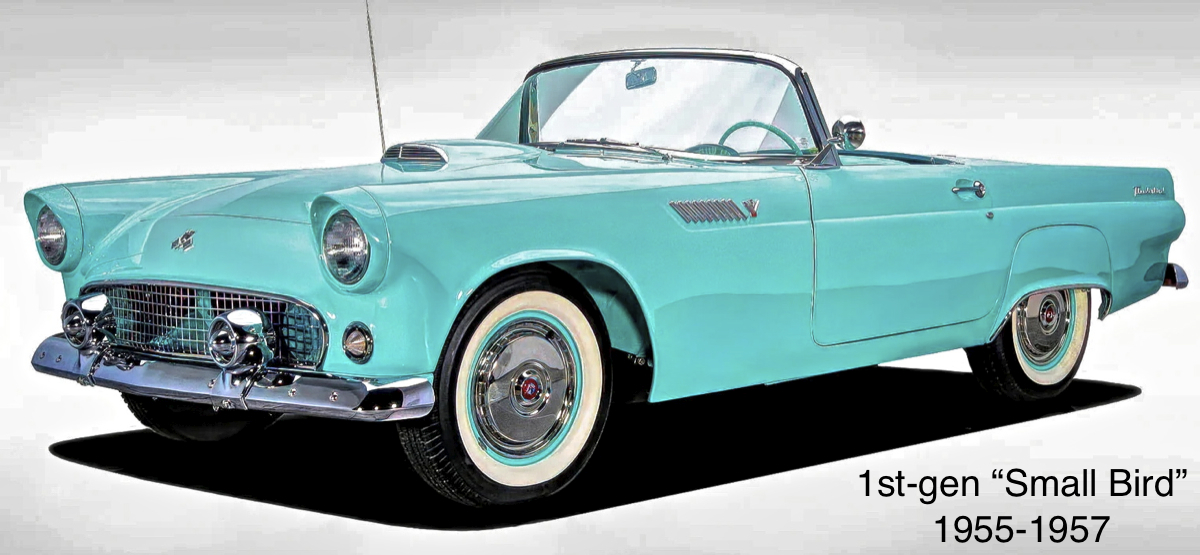
The platform used for the T-Bird was unique and used in no other car. It had a short 102-inch wheelbase. All 1st-gen T-Birds were convertibles with both a ragtop and a removable hardtop. The famous round porthole was not offered on the hardtop in 1955, and was optional on the ’56 and ’57. The interior was highly styled and of top quality for the times. In 1955, the spare tire was placed flat in the middle of the small trunk, using up most of its carrying capacity. This was panned by dealers and customers and so in 1956, the T-Bird grew a ‘Continental Kit’ (ie: the spare tire was mounted vertically between the trunk and the back bumper, visible to the world, in a
hard, metal shell. This changed again in 1957 when they simply extended the length of the trunk to provide the space to place it vertically over on one side (the passenger side). As the result, each of the 1st-gen’s 3 model years had their own distinctive look.

Known today as the “Little Bird”, the Thunderbird debuted on February 20, 1954 at the Detroit Auto Show as a concept, and production started on September 9, 1954 at the Dearborn Assembly Plant. Sales began on September 9, 1954 and over 4,000 orders came in on the first day.

Sales were modest by Ford standards with just 16,155 sales of the 1955 model, 15,631 in 1956 and 21,380 in its final year, 1957. Ford learned a valuable lesson that they wouldn’t forget, at least for another 50 years: 2-seaters don’t sell all that well.

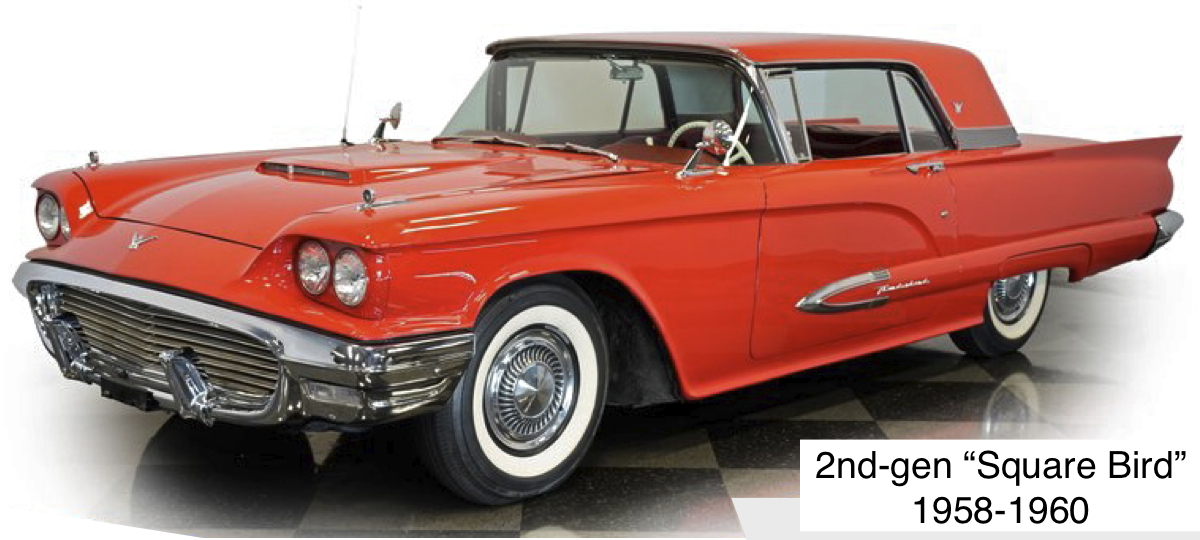
Of course, Ford wanted big sales numbers and this wasn’t doing it for them. So, the 2nd-gen T-Bird, introduced in 1958 was a 4-seater. The “Square Bird” as its known today, was a much larger car with a roomy back seat and the squared-off, flamboyant exterior styling that dominated the 1958-1959 model years of most American cars. A big, chrome grille surrounded by a shapely front bumper was flanked by quad headlights with an angry look. The rear end was just was over-the-top with two round taillights per side looking like jet afterburners, supported by a complex but attractive
rear bumper, flanked by small (by the standards of the day) tail fins. Overall, it was an attractive car that to this day draws crowds to it at shows. It was available both as a hardtop and a convertible, with a few ‘Sport Roadsters’ thrown in.

Ford’s new FE big block was introduced in 1958 across their entire line and the T-Bird got the 352 ci (cubic inch) version with 4-barrel carb making 300 hp. For 1959, the MEL (a Mercury/Edlen/Lincoln engine) V8 displacing 430 ci with 350 hp was made optional. In 1960, an “Interceptor Special” version of the 352 became an option with 360 hp. They’re rare and quite valuable today.

This new 2nd-gen ‘Square Bird’ earned Motor Trends’ coveted Car of the Year award for 1958 and sales jumped up to 37,892 in 1958, 67,456 in ’59 and 92,843 in ’60. Makes you wonder why they would change it at that time. But that’s the way it worked by in the late-50s and early 60s. Cars often got reskinned for every new model year, and generations only lasted two or three years.
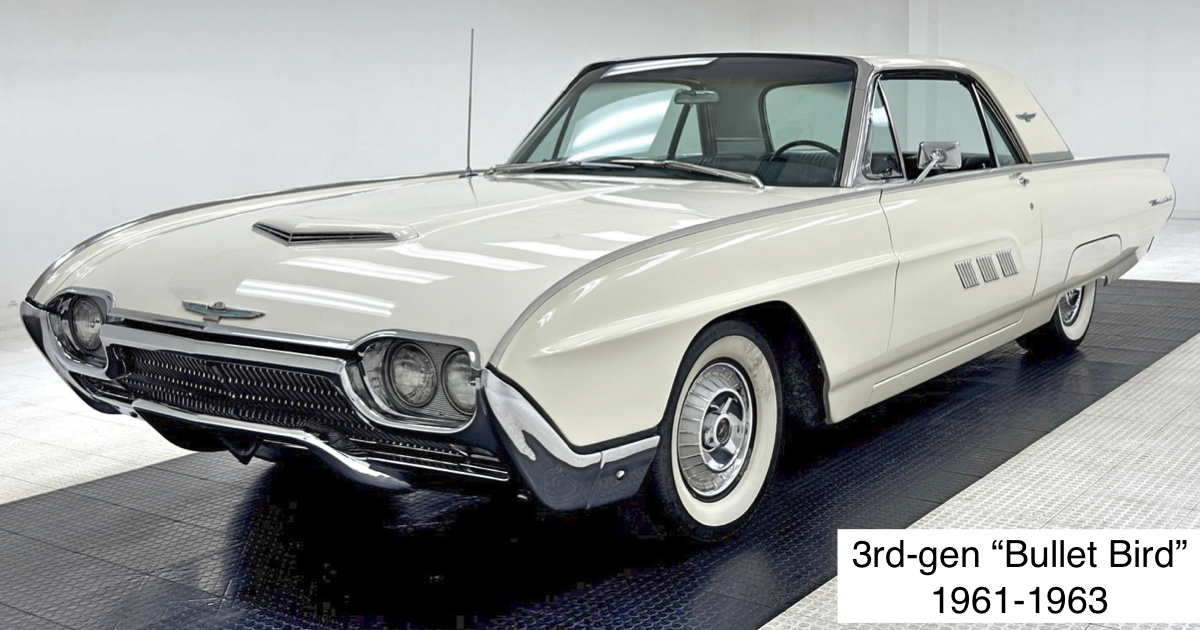
So, a new generation of T-Bird was inevitable for 1961, but as good as sales had been with the prior car, this new ‘Bird did around the same. 73,051 T-Birds were sold in 1961, 87,101 in ’62 and 63,313 in its final year, 1963. The 3rd-gen T-Bird, known today as the “Bullet Bird”, smoothed out the square, choppy lines of the older car with a svelte shape that was pointed at the front, earning it the nickname. They’re great looking cars and still very popular today. During its 3-year life, the Bullet Bird came standard with a 390 FE big block making 300 hp, and starting in 1963 could be ordered
with an ‘M-code’ 390 which used a tri-power setup (three Holley 2-barrels) and a 10.5:1 compression ratio to make 340 hp. Very rare.
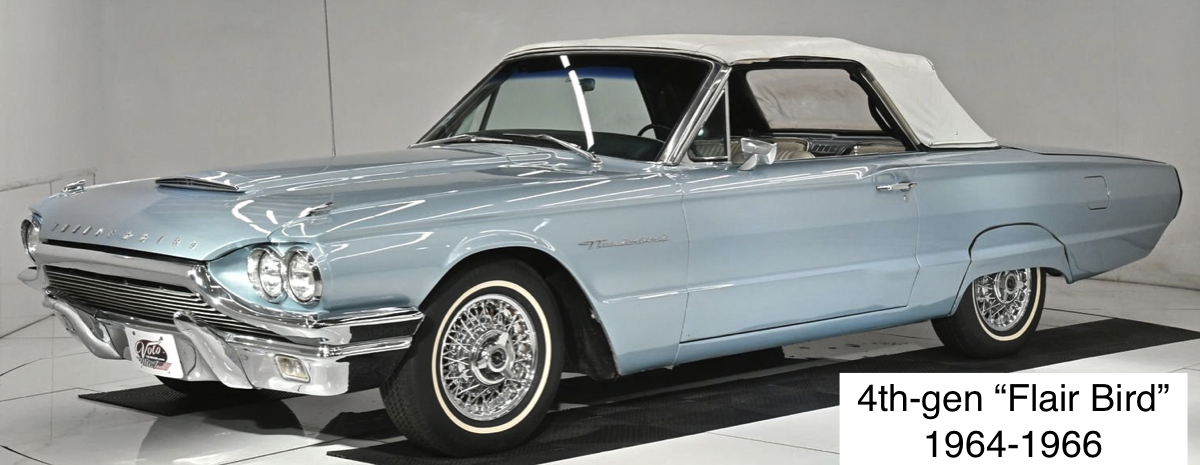
The 4th generation T-Bird came out in 1964 and whatever the Bullet Bird didn’t have, sales-wise, the new “Flair Bird” (as it’s called today) fixed that. As always, the interiors were high-quality, with nicely-upholstered front bucket seats, a center console, tricky bright work everywhere in a blend of luxury and sportiness. The front end changed dramatically with its prominent chromed front bumper and grille receding back under the front end. It was a bold new look, some hated it, but lots of people liked it. 83,897
T-Birds rolled out the door in 1964, 74,972 in ’65 and 69,989 in ’66. Was it the car, or a sign of the times? Car sales in general were on the climb throughout the 60s. Note that this 4th generation lasted 4 model years, where every prior generation lasted only 3.
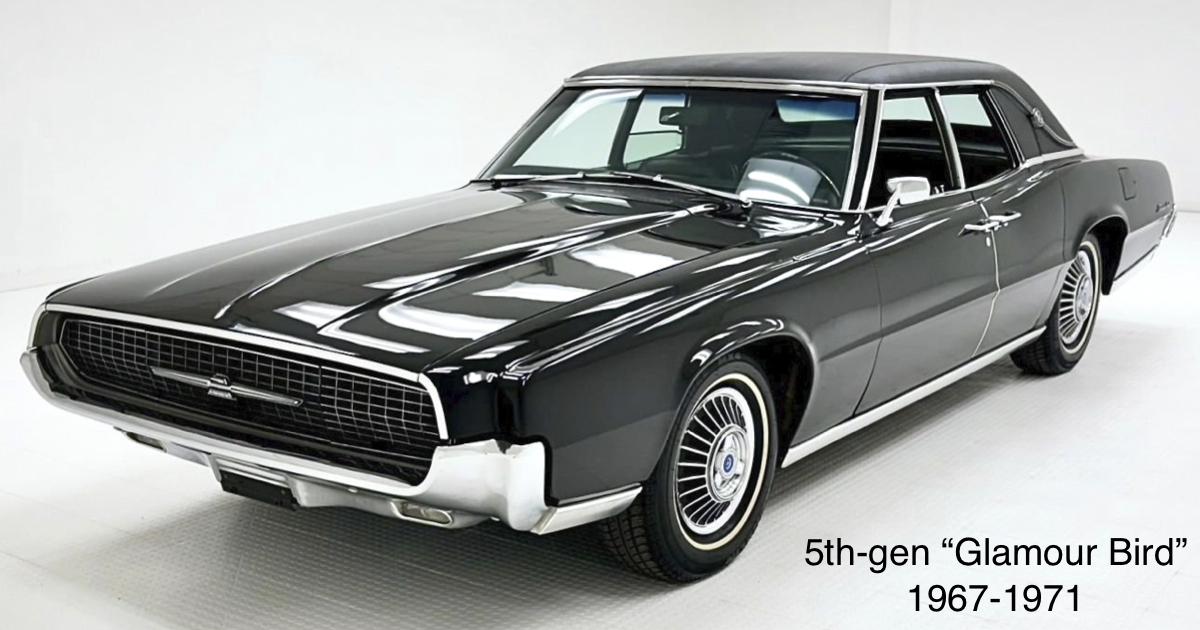
The 5th-gen Thunderbird, nicknamed the “Glamour Bird” ran for 5 model  years, starting in 1967 and running through 1971, and offered a totally new look with a full width grille and hideaway headlights. For engines, the 390 was still standard with an optional 428 FE, but in 1968 the new 385-series V8 came out and was offered as an option as the 429 Thunder Jet with 360 hp. It became the only engine offered in 1969 and ’70. The body lines overall were cleaned up and several new body styles were tried. The ‘Landau’ got a unique roof covered in textured vinyl that eliminated the rear side windows with a massive, solid C-pillar eliminating the rear-side windows entirely.
This ‘blind quarter’ created a very private rear seat. There was also a 4-door version of the Landau, known today as the “More Door T-Bird” with suicide rear doors. All Landaus wore a piece of chrome trim shaped like ‘a lazy S laying down’ on the vinyl covered C-pillars that was called the ‘Landau Iron’, and harkened back to the days of horse and carriage. The Landaus sold quite well, with 155,338 2-door Landaus and 77,496 4-door Landaus sold, accounting for 32% of all T-Birds during the 5th generation.

The 6th gen launched in 1972 known as “The Big Bird” and ran through 1976, so called because they became huge land yachts. With a 120.4-inch wheelbase, the overall length grew year by year, thanks to 5 mph-bumpers being federally-mandated in front in 1973 and also in the back in 1974. The ’72 measured 214 inches in overall length, while the ’73 grew to 217.3 inches and the ’74 to a whopping 225.7 inches in length. Curb weight ballooned also, starting at 4,420 pounds in 1972 and finishing out at over 5,000 by 1976. This big boy needed big power to move so the engine choices were
both 385-series big blocks, the 429 as standard and the 460 as an option. A total of 256,411 6th-gen T-Birds were sold, an average of around 51,000 per year. Not bad, but not great.

Downsizing arrived in 1977 with the “Torino Bird”, so named because they moved it off of the full-sized Lincoln platform used in the 6th-gen and used the mid-sized Torino platform to build a smaller, lighter car, in response to rising fuel costs and customer concerns about fuel economy. They were pretty enough with a unique ‘basket handle’ roof line, a sharp-cornered, long low profile and a prominent formal grille flanked by hideaway headlights. The wheelbase shrunk to 114 inches, overall length came down
to 215 inches and weight dropped to around 4,000 pounds. Despite anemic engines and massive bumpers front and year, this new 7th-gen T-Bird blew away all the previous sales records, due in part to the car, but also to the car market at that time. Cars were flying off the shelves in the late 70s. The ’77 sold 318,140 units, around 350,000 in ’78 and around 295,000 in 1979. Wow!

The downsizing continued in the 8th generation, moving the T-Bird on to the Fox platform, which famously underpinned the Mustang at that time. It shrunk the car even further. Wheelbase shrunk again to 108.4 inches, overall length came down to 200 inches and the weight dropped to around 3,300 pounds, a 700-pound loss. Most of the weight reduction was due to the adoption of the Fox’s lightweight unibody platform, compared to the body-on-frame design of the previous car. As good as that sounds, sales dropped dramatically, averaging around 95,000 cars per year.

The 9th generation launched in 1983, again on the Fox platform. The new “Aero Bird” was very sleek and aerodynamic, having been influenced by the yet-to-be-released 1986 Ford Taurus, still on the drawing board. It was a very handsome car, looking almost European inside and out. The 3.8L Essex V6 was standard but the 5.0 V8 was the main engine of choice. They also offered a hot new “Turbo Coupe” version with the Pinto’s 2.3-liter OHC 4-cylinder and turbo producing 155 hp with without the weight of the cast-iron V8. They were available with either automatic or 5-speed stick. I owned
a 1985 Turbo Coupe with 5-speed and loved it. I’d love to find another. The 9th generation ended with the 1988 model year. A total of around Aero Birds 200,000 were built.

The 10th generation “Super Bird” brought with it a refined look that resembled the BMW 6-series 2-door sport coupe. It even had independent rear suspension, a first for the T-Bird. Gone was the Turbo Coupe with its 4-cylinder turbo, replaced by the ‘Super Bird’ with a 3.8 Essex V6 with an Eaton M90 Roots-type supercharger making 210 hp to 230 hp, added ABS brakes and 4-wheel disc brakes and 16-inch wheels and tires. The 5.0 OHV V8 powered most normal T-Birds, all with automatics, although the Super
Bird could be ordered with a 5-speed stick. The 10th generation ran from 1989 through 1997. Production averaged around 40,000 per year.
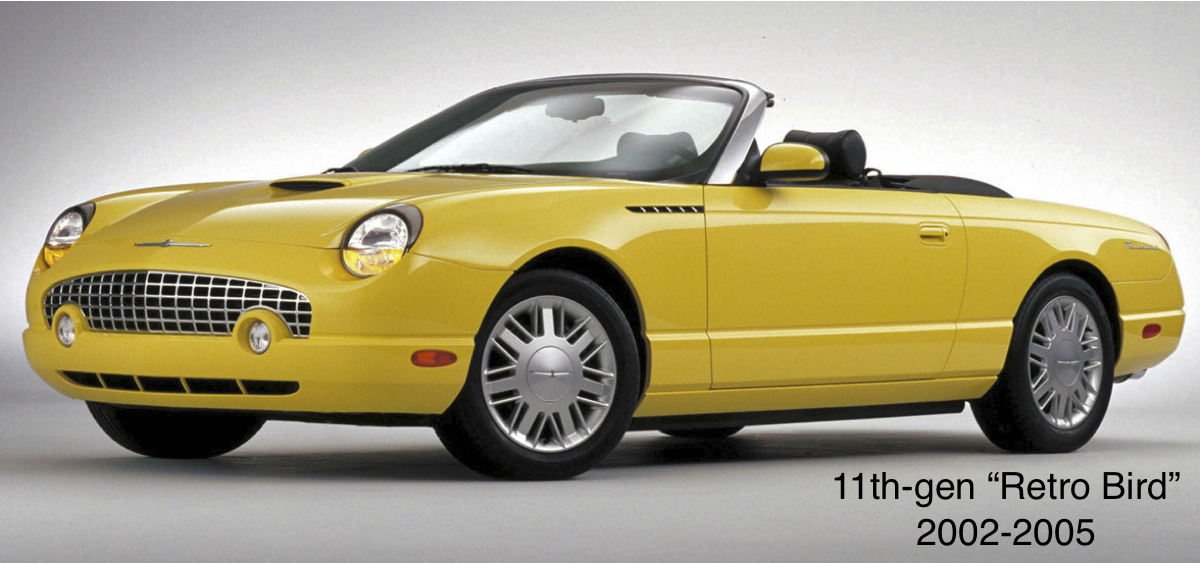
We had to wait until 2002 for a new Thunderbird, ruining an unbroken line of production that started in 1955. But the new 11th-generation T-Bird was part of that crazy Retro Craze that was booming in the early 2000s.  Everyone was doing it, from the Chrysler PT Cruiser to the New Beetle, and this new T-Bird just added to the fire. It’s looks aped the 1st-gen cars with seating for two, a convertible-only body style that really paid homage to the ’55-’57 ‘Birds. They even had a removable hardtop with porthole windows. The interior and exterior successfully blended classic 50s design cues with
modern day technology. It was a stunning car and a stunning achievement.
Unfortunately, sales numbers didn’t justify its existence, with just 31,368 sold in it introductory (and best) year, only 14,678 in 2003, 12,757 in 2004 and just 9,295 in its final year 2005. Some blame Ford’s choice in engines, a version of the 3.9-liter V8 from the Jaguar AJ35, and despite having DOHC and 32 valves, it was small and only made 252 hp at launch, not enough to get it into the big game. It’s a shame. Ford really hung it out there with the “Retro Bird”, and did a commendable job of it. But it wasn’t enough. And, at least as of now, 2005 was the last T-Bird ever.

Motorsports News – 6/2/26 by David Vodden

Motorsports News by David Vodden

The National Hot Rod Association [NHRA] ran in Maryland last weekend where Shawn Langdon beat Doug Kalitta by .002 seconds in the top fuel dragster final. It was close! Austin Prock returned to the winner’s circle for the first time this year beating Jack Beckman to the line with a 3.956 elapsed time for the 1000-foot run. His speed through the traps was 324.20 miles per hour. Greg Anderson took the win in his Hendrick Chevrolet Pro Stock, beating Dallas Glenn in the final. It was Anderson’s 114th final win in the class. Angie Smith won for the first time in four years beating Ryan Oehler with a 6.683 ET at 201.52 miles per hour in the pro stock motorcycle class. Angie’s husband, Matt Smith, was in the hospital where he was calling the shots for his wife. Langdon leads Kalitta in the top fuel points after fourteen meets. Leah Pruett, aka Leah Stewart, is third in that championship point battle. Her famous husband, Tony Stewart is fourth. Ron Capps leads the top fuel funny car points over J. R. Todd, Austin Prock and Matt Hagan. The NHRA races in New England this weekend.

The Indy car race on the narrow streets of Detroit saw Honda hand GM their lunch with Alex Palou winning over Kyle Kirkwood and Graham Rahal. Pato O’Ward was fourth in the first Chevy-powered IndyCar. Palou scored his fourth win in eight races this year making his win percentage 50%. He has won twenty-three out of 106 Indy car races over the last three years, resulting in a win percentage of about 23%. Wow! The Indy cars race this weekend in St Louis. This will be a night race starting at 7pm our time.

Kyle Larson won Monday night’s High Limit sprint car race in Iowa. Larson has won a few sprint car races since his abominable performance doing the Indy/CUP race double in 2025. You can see what doing the double was like for the California kid on PRIME television in a special called, “Larson VS. the Double. It covers both attempts and clearly shows the strain the failed effort put on Larson. He has not won a NASCAR CUP race since that last Indy 500-Charlotte NASCAR CUP series weekend. A major rain delay caused the Nashville NASCAR race to start after 9pm in Nashville and finish on Monday morning. Once again, it was very painful for the fans, television viewers, and the race teams. Terrible! Denny Hamlin won the race after starting on the pole, getting black flagged for jumping the start and then battling his teammates, Chris Bell and Chase Briscoe in a last lap, three-wide showdown. Both Briscoe and Bell messed up in ways that made it possible for the veteran Hamlin to win. Bell finished second followed by Briscoe, Ricky Stenhouse Jr., and Shane Van Gisbergen. Tyler Reddick, Chase Elliott, Ryan Blaney, Zane Smith, and Carson Hocevar completed the top ten. Kyle Larson was running in the top five all night until the last lap when he ran over debris, got a flat tire, and finished 23rd. Larson’s continued bad luck and a crash involving Reddick were missed in the PRIME television coverage on the last lap as far as I could tell.

Justin Allgaier won the O’Reily race on Saturday beating youngster Brent Crews in a good race. William Sawalich came third with Sam Mayer, Brandon Jones and Corey Day completing the top five. Layne Riggs passed Rajah Caruth on the last lap to win the NASCAR Craftsman truck series race. Chandler Smith, Ross Chastain, and Tyler Ankrum followed.

Week after week the truck and O’Reilly series races are more entertaining than the CUP races. The races are shorter; there is no obvious dominant team or marque and the appearance of CUP series drivers in the fields periodically adds drama. Toyota totally dominates the CUP series. The top regular season champion has already been determined, and the races are too long. Steve Latarde’s non-stop dribble last Saturday night and Adam Alexander’s performance on CW make the CUP series third in NASCAR racing entertainment. Only the truck and CUP NASCAR cars race this weekend at the Michigan Speedway. The show will be at nearby Sonoma on June 26-28.

Silver Dollar Speedway hosts races this Saturday night as part of the Dave Tarter Memorial featuring the NARC King of the West series for winged sprint cars and dwarf cars. Thunderhill Park will offer action both Saturday and Sunday at the 5250 Hwy 162 venue.

Tributes to Kyle Busch following his untimely death from sepsis caused by pneumonia were replete at all levels of the sport. His early death was sad, unexpected and unnecessary. His larger-than-life personality will be sorely missed.