
“The Plymouth Road Runner” by Andy Tallone


“The Plymouth Road Runner”

The mid-1960s were the heyday of the muscle car. Started in 1964 by the Pontiac GTO, the muscle car craze boomed out of control as every American carmaker hurried high performance products to market. Cars like Chevy’s Chevelle SS, the GTO, the Oldsmobile 442, the Buick GS, the Ford Fairlane 500XL and GT, even American Motors had the Rambler Rebel. Plymouth, Chrysler’s bargain brand, needed a car that could take a chunk out of that lucrative market for the home team.

Chrysler wanted a low-cost muscle car it could build out of parts it already had. Marketing manager John Herlitz and Product Planner Jack Pitman pushed for a stripped-down B-body (midsize) car with a big engine, but devoid of frills or luxury features as standard equipment with the goal of keeping the MSRP Manufacturer’s Suggested Retail Price) under $3,000.

As it turned out, all of the 1968 cars in its class made it under the $3,000-mark. The Road Runner at $2869 wasn’t even the lowest. That honor went to the Rebel at $2,689. Lots of very stripped Road Runners rolled off the lots with powerful engines, but manual drum brakes, manual steering, ‘dog dish’ hubcaps or even a 3-speed manual shifted on the column. They were actually an option, as it came standard with either the excellent New Process A-833 4-speed manual or the rugged 727 Torque Flite 3-speed automatic. But the 3-speed manual could be optioned to get the cost down. Few were ordered that way.

The ’68 Runner Runner came standard with the 383 Magnum rated at 335 hp. Optional engines were the 440 Magnum with single 4-barrel with 375 hp and the awesome 426 Hemi at 425 hp. Other standard equipment included heavy-duty suspension, dual exhaust, Redline tires, a 3.55:1 rear axle ratio and no frills. Inside they came standard with a front bench seat, no center console, no radio and rubber floor mats instead of carpet. 44,599 Road Runners were built during its first year, 1968, much more than

expected.

The name, by the way came from the popular Saturday morning TV cartoon the Road Runner Show. It featured this road runner that was faster than the speed of sound and he was being chased by this scrawny, starving coyote that was trying to eat him. But the Road Runner was always too fast to catch. As he’d leave the coyote in his dust he would happily say “Meep meep!” and be gone. Chrysler paid Warner Brothers $50,000 for the rights to the image and that crazy “Meep meep”. They named the new car Road Runner and made the horn go “Meep Meep”. They went further by adding a large graphic to the oblong air cleaner lid that said “Coyote Duster” with a picture of Wiley Coyote on it. It was part of the N96 Air Grabber option, available with any engine starting in 1969.

Things went so well the first year, they loaded up the Road Runner with lots of new, and highly profitable options. The new, optional new Air Grabber was a functional hood scoop that offered ram air/cold air induction. The 440 Six-Pack became optional and the styling got more aggressive with a new grille and side stripes. 1969 saw 45,034 Road Runners sold, which turned out to be its high-water mark.

The stated goal of the Road Runner was always to put race-winning performance within reach of young buyers who didn’t have a lot of money, and didn’t demand too many frills. At that, they absolutely nailed it. On the streets, Road Runners quickly gained a reputation for being quick. They had a series of TV commercials back in the day where a young fellow was pulled over in a Road Runner by a pot bellied Southern

sheriff who naturally assumed this kid couldn’t afford a car this nice, so he must have stolen it. He’d say “You’re in a heap a’ trouble, boy”, only to be proven wrong. Even a young kid like this could afford a Road Runner.

1970 saw a complete reskinning of the car that many feel made for the best looking Road Runner ever. It softened the boxy lines of the former model, and gave it more of a ‘Coke bottle-shape’. Faux scoops were added to the rear quarters. The blacked-out grill had a bright band that circled the headlights and crossed the grille forming what is called today a ‘race track’. The entire body shell, with the exception of the greenhouse was changed. 1970 turned out to be the last unfettered year before the Malaise Era

reared its ugly head. It brought with it all sorts of new federal laws governing emissions, fuel consumption and safety, and Detroit scrambled to meet the new rules after two decades of doing whatever the heck they wanted. It was a wakeup call for the industry and it was ugly at first, very ugly. Between the formerly-powerful engines

that now just gasped to the hideous, park bench-sized 5 mph bumpers, it was tough on Detroit and on buyers of high performance cars.

Despite this, the 1970 Road Runner retained its full list of engine options without any reduction in horsepower. This would be the last year of that. The 1970 Road Runner came standard with the 383 Magnum making 335 hp. There were still two 440s available, the good ol’ 440 Magnum Super Commando with single 4-barrel and 375 hp, and the rocking’ 440 Six Pack (three 2-barrel carbs) making 390 hp. And of course, always on the top of the heap, the mighty 426 Hemi, still making a claimed 425 hp (which was understated, they made more like 530 hp).

For the 1971 model year everything changed. Gone were the squared lines of the 1st generation Road Runner (1968-1970), replaced by a sleek new shape that they called ‘fuselage styling’. The front bumper was now a one-piece loop of chrome that encircled the entire grille opening. There was no break between the C-pillar and the rear quarters, they flowed smoothly together. The wheel openings were gently squared up, yet still rounded. It made for an impressive-looking car. The all-new interior was now mostly plastic. It was built on the same B-body platform as before with the same 116-inch wheelbase.

Despite the onset of the Malaise in 1971, the Road Runner managed to hold on to some serious muscle, for one more year at least. The standard 383 was still making 335 hp, but the 440 Magnum dropped from 375 hp to 370, and the 440 Six Pack dropped from 390 hp to 385. But the 426 Hemi thundered on with its same 425 hp.

In 1972 the base engine became the small block 340 making 240 hp, but the 440 was still on the option list, now down to 280 hp. This was the year that the Feds forced carmakers to express net horsepower numbers, rather than gross, so they appear even smaller than they actually were. But horsepower was dropping for sure. A 400 V8 B series big block was added to the option list. Horsepower continued to drop every year and 1974 was the last year for the 440.

1974 was also the last year for the ‘true Road Runners’. In 1975 the Road Runner became nothing more than an option package on the Plymouth Volare. From then on they were called Volare Road Runners and the fun was over. Hardly worth talking about here, and a disappointing end to a glorious car.

On a brighter note, mention must be made about special models. First, obviously, is the GTX. Strangely, it came out one year earlier than the Road Runner. Introduced in 1966 as a 1967 model, it was initially based off of the Belvedere, which would also spawn the Road Runner a year later. Then, for the rest of its short life, the GTX was a top-line version of the Road Runner.

Whereas 1st-gen Road Runners came standard with the 383 Magnum, the GTX came standard with the 440 Magnum, with the 440 Six Pack and 426 Hemi as options, and they came standard with just about every item on the Road Runner option list. The GTX ran from 1967 through 1970.

Of course, the king of the hill as far as Road Runners are concerned is clearly the 1970 Superbird. In late-60s NASCAR, every manufacturer was struggling to win on the track, assuming it would lead to increased sales in the showroom. But the boxy Road Runners were an aerodynamic brick and it was hurting their top speeds and high speed stability. Dodge had the same problem with the Charger, so they crafted a new nose and huge rear wing and cleaned up the back window area, and hit a new NASCAR speed record, topping 200 mph for the first time. They called it the Charger Daytona. So, Plymouth followed suit and built the Superbird.

The 1970 Superbird came standard with the 440 Magnum Super Commando making 375 hp, with the 440 Six Pack (390 hp) and the 426 Hemi (425 hp) as options. Of course the real attention-getter was that big wing on the back. It stood 23 inches off the deck lid and provided over 600 pounds of downforce at 150 mph. They also grafted on a huge fiberglass nosecone with hideaway headlights that streamlined the front end. And the rear window angle was laid down slightly to improve its drag coefficient, sort of like Dodge did with the Daytona.

The Superbird was a homologation car. NASCAR required that 500 similar units be sold to the public to qualify it. Plymouth sold 1,935 Superbirds in the 1970 model year, making it not only one of the rarest muscle cars, but one of the most sought after. One sold at Mecum’s Kissimmee auction in 2023 for $1,430,000! Yikes
“The Chrysler Hemi” by Andy Tallone

“The Chrysler Hemi”

When Japan bombed Pearl Harbor on December 6, 1941 it touched off World War II and mobilized the entire country behind the war effort. This included the auto industry. Ford, Chrysler and GM stopped building cars in 1942 and started producing tanks, planes, amphibious landing vehicles, machine guns and boatloads of other stuff, all to help win the war. Chrysler was, among other things, building aircraft engines and late in the war had been tasked to create an inverted V12. They determined that it would be a ‘hemi’. While the project stalled when the war ended, all that research and development work by Chrysler engineers was still there, waiting to be applied.

First off, what’s a ‘Hemi’? It’s shorthand for an engine with ‘hemispherical combustion chambers’. In other words, the right-sized ball would drop half-way into a hemispherical combustion chamber. It placed the intake and exhaust valves at angles facing one another, which opened the flow paths up to increase flow, and allowed more centrally-located spark plugs for better and faster fuel burning. At the time, this was state of the art engine design, widely used on OHV motorcycle engines of the era. It’s a more complex engine and more expensive to manufacture because the valves aren’t all neatly lined up like in most 6-cylinders of the day.

So, when the war ended and civilian car production resumed in 1946, Chrysler’s brain trust was noodling about the hemi. Their current engine line was aging and desperately in need of replacement. Their flathead straight-6 and straight-8 had been in service since the 1920s. What’s more, word was spreading that GM was getting dangerously close to introducing a new line of lightweight, high-compression OHV (Overhead Valve) V8s. So, those same engineers put all that hard-won knowledge and experience to work designing a new line of engines of their own.

Chrysler’s Engine Development Chief Ernie Code and Tom Hoover (who later gained notoriety in Hemi drag racing) designed an engine that prioritized airflow over packaging. The new engine had two rocker arm shafts per cylinder bank, supporting the intake and exhaust valves which were at a 27.5-degree angle to one another. It made for a wide cylinder head and big block, and with the casting techniques in those days, that made it a heavy engine, around 700 pounds. A typical 1950s Chevy small block weighed around 550 pounds. That’s a big difference.

Cadillac and Oldsmobile launched their futuristic new OHV V8s in 1949 as the world watched. Chrysler introduced it’s first OHV V8, the 331 ci (cubic inch) Chrysler FirePower Hemi in its full-size car line in 1951 through 1955. In 1952 they downsized it to 276 ci for Desoto duty under the name Desoto Fire Power, and in 1953 they downsized it again to just 241 ci as the Dodge Red Ram Hemi. They punched it out again on 1956 to 315 ci and again in 1957 to 325 ci still under the Red Ram banner and only used in Dodges. In 1956 they arrived at 354 ci with the new Chrysler FirePower Hemi and in 1957 one last enlargement took it to 392 ci. This last entry is the most famous of all, used for decades in drag racing. Bulletproof, they took well to boosting and were capable of making big power.

But alas, the high cost and complexity of manufacture, and the advancement of other, simpler designs spelled the end of Gen I (1st generation) Hemi production, replaced by Chyrsler’s new B-block Big Blocks and Wedge motors. Simpler and cheaper to produce, and lighter, they could make almost the same power if done right.

The sunset in Hemi land from 1958 until the mid-1960s. By this time the muscle car power struggle was on and running at full throttle. The Big 3 were each trying to outdo the others in this horsepower arms race. Chevy had launched its game-changing small block V8, now up to 327 ci. They also had their W-series big block in 348 and 409 ci. And soon they would launch their Gen IV big block 396. Ford came out with their FE big block engine family in 1958 and now it was up to 390 ci and growing. Chrysler had its own big block family, two actually, the B- and RB-series big blocks. B stood for “Big” and “RB” stood for “Raised Block”, which had a taller deck height to support the longer stroke of the 440.

Chrysler started with the big RB block and built a new set of hemi heads for it that were massive. And heavy. They had huge intake and exhaust ports and gigantic valves (2.25” intakes and 1.94” exhausts set 30-degrees apart this time), and a wild valve train that again used two rocker arm shafts per bank with long and short push rods that took divergent paths. When introduced in the 1966 model year, the 2nd gen 426 Hemi made an advertised 425 hp and 490 lb-ft of torque. Both numbers were grossly understated. Chrysler was concerned with rising insurance costs and didn’t want to scare the underwriters.

The 426 Hemi was and is one of the most legendary engines of all time. It’s big, it’s mean, it’s brutishly handsome and it makes power and torque like nobody’s business. Like their predecessors these were bulletproof engines that loved to be supercharged. Gen II Hemis fueled some of the world’s most famous and successful drag racers and have made as much as 4,500 hp, blown on alcohol. That’s how solid the 426 Hemi was and how good it was at flowing air.

The 426 Hemi stormed through the 60s as the top dog, the biggest, baddest dude on the block. The Chevy 409 and the later 427 hit that number, but it was probably more honest than the Hemi’s. Most people think that 425 hp-claim was a joke! Modern day dyno pulls have confirmed they were in the 530 hp-range. Only the 1970 Chevy LS6 454 beat it. Hemis were insanely expensive engines in their day. At around $900 the option package represented a 31% increase in the price of the car, at a time when a ’69 Road Runner MSRP’d for $2,869.

But the Gen II Hemi was not only expensive and massively heavy on the front end, but they were hard to live with in the real world. Great for racing, those two big carburetors swallowed gas and didn’t like low speeds or stop-and-go traffic. They loaded up, fouled plugs, ate tires and made too much heat. Those factors along with the astronomical insurance premiums, which could be as high as your car payment on a Hemi, doomed it to tiny sales numbers. Despite appearing in Dodge Coronets, Super Bees, Chargers and Challengers and Plymouth Belvederes, Road Runners, GTXs and ‘Cudas, over 6 model years (1966-1971) of production only 10,669 were built. The Malaise Era with its oppressive smog, safety and fuel mileage regulations killed performance starting in 1971, which also happened to be the last year for the 426 Hemi.

The lights went out on the Chrysler Hemi for 32 years. Then a newly revived Chrysler came at it again with a Gen III Hemi in 2003 to replace the ancient 5.9-liter LA small block V8. The new 5.7 Hemi V8 made its first appearance in the 2003 Dodge Ram 1500 and once Chrysler got back in the business of rear-wheel drive cars, its use expanded into its full-size line, Chrysler 300, Dodge Charger, Magnum and Challenger.

Over the next two decades the evergreen Hemi would expand to 6.1, 6.2 and 6.4 liters, it would be supercharged, and it would break the bounds of peoples’ thinking of what a street engine could be. Starting in 2015 Dodge used clever supercharging and inter cooling to create a 707 hp monster in the Hellcat. Further variants with names like Demon and Redeye made crazy horsepower all the way up to 1,025! In a street car! With financing!! And a factory warranty!!! Holy crap!!!! You could kill yourself with that much horsepower.

A 2023 Dodge Challenger SRT Demon 170 can do the quarter-mile in 10.8 seconds at 131 mph from the factory! They come with a crate in the trunk with a bunch of drag racing goodies that they couldn’t put on it as a street car and sell it to you. But no one said the owner couldn’t put the goodies on himself, after the sale.

This new engine was designed from a clean sheet of paper with no physical connection to either previous generation of Hemi, with the exception of calling the 6.4-liter a 392 to honor the biggest engine in the 1st-Gen Hemi family. The cam was set high in the block to both shorten the push rods and to allow more room for expansion via a longer stroke. The combustion chambers are true hemis (half a sphere) with huge valves set at 34.5 degrees from each other and two spark plugs. The deep skirt block was cast in iron with aluminum heads. The intake and exhaust ports were large and flowed well. It had the same 4.4” bore center as the small block Chevy. It was built to be strong and to make big power when supercharged.

Because of the Gen III Hemi, the Dodge Challenger was able to not just compete in the big horsepower game, but lead it. The Hellcat was the first mass-produced car to cap 700 hp and it didn’t end there. When it happened in 2015, no one else had anything close. By the time they’d rallied their resources to respond, Dodge had already blown past than number and was now about 800, then soon 1,000.

The Hemi was a legend in its 1st-generation in the 1950s, and the Gen II was certainly legendary in the 1960s. And this new Gen III Hemi carries on that tradition brilliantly, exceeding it even, by a wide margin. They called the small block Chevy the ‘Mouse Motor’, so naturally the Chevy big block was a Rat Motor. In the same vain, the Chrysler Hemi was the ‘Elephant Motor’.

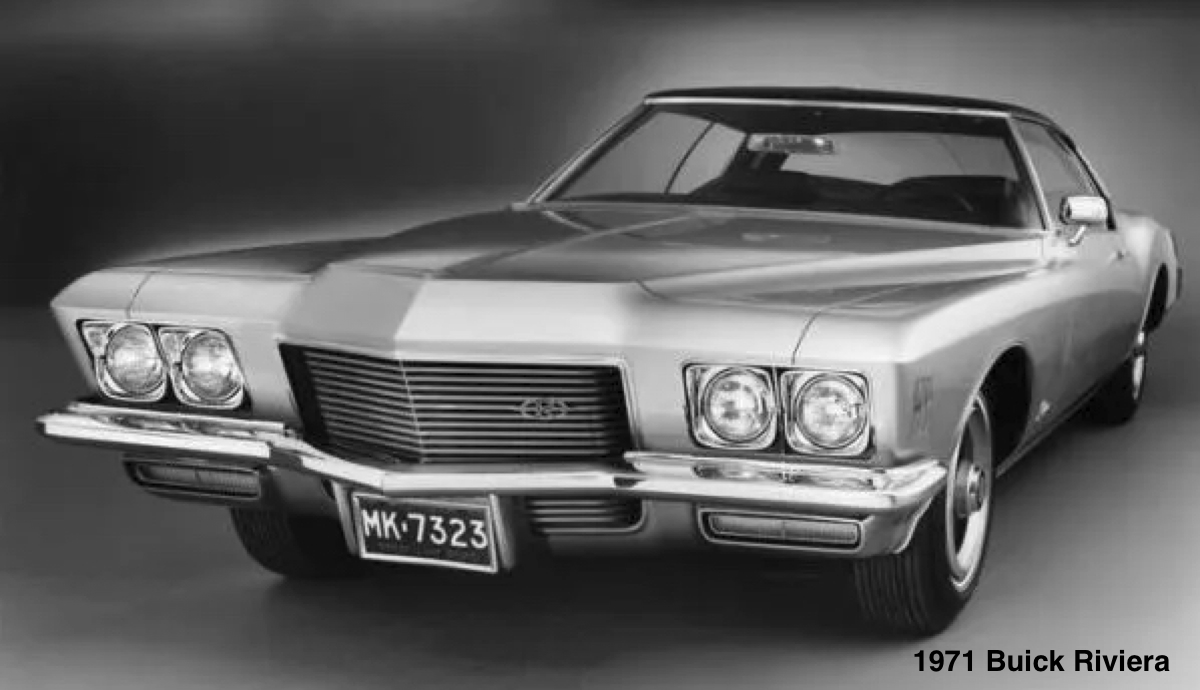
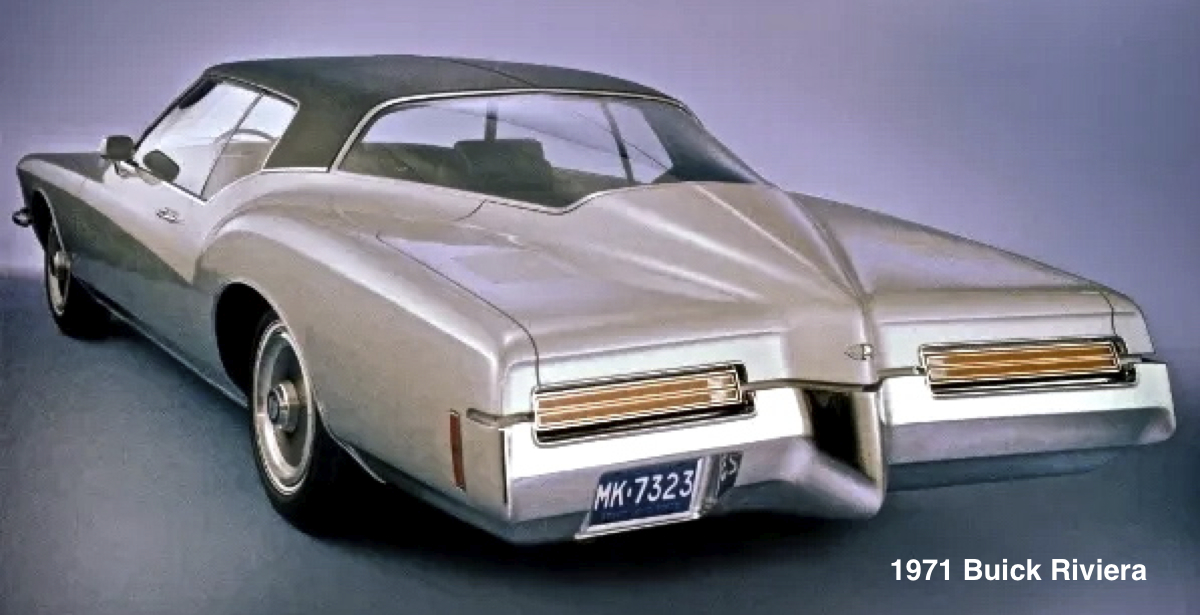
Buick Riviera


The Ford Thunderbird really created the personal luxury car segment in 1955. The ‘Baby Birds’ carved out a market that no one else realized existed. It wasn’t a high performance sports car like the Corvette, and it wasn’t a staid luxury yacht like a Cadillac or Lincoln. As cute and as popular as they were though, they didn’t sell all that well because they were lacking one thing: a back seat. The two-seater’s three year run, 1955 through 1957, only produced 53,188 cars in three model years. Sales more than tripled when the next generation came out in 1958 with a back seat. The industry took notice. 2-seat convertibles look great in car shows but sales are what matters and buyers of personal luxury cars wanted back seats.

The competition scrambled to respond with their own car that would bite into this lucrative new market. It took a full 7 years, but Pontiac was first up with the Grand Prix in 1962. The upscale two-door hardtop was built on GM’s B-body platform and was considered a full-size intermediate, positioned between the full-size Catalina/Bonneville and the compact Tempest. They sold 34,000 of them the first year.

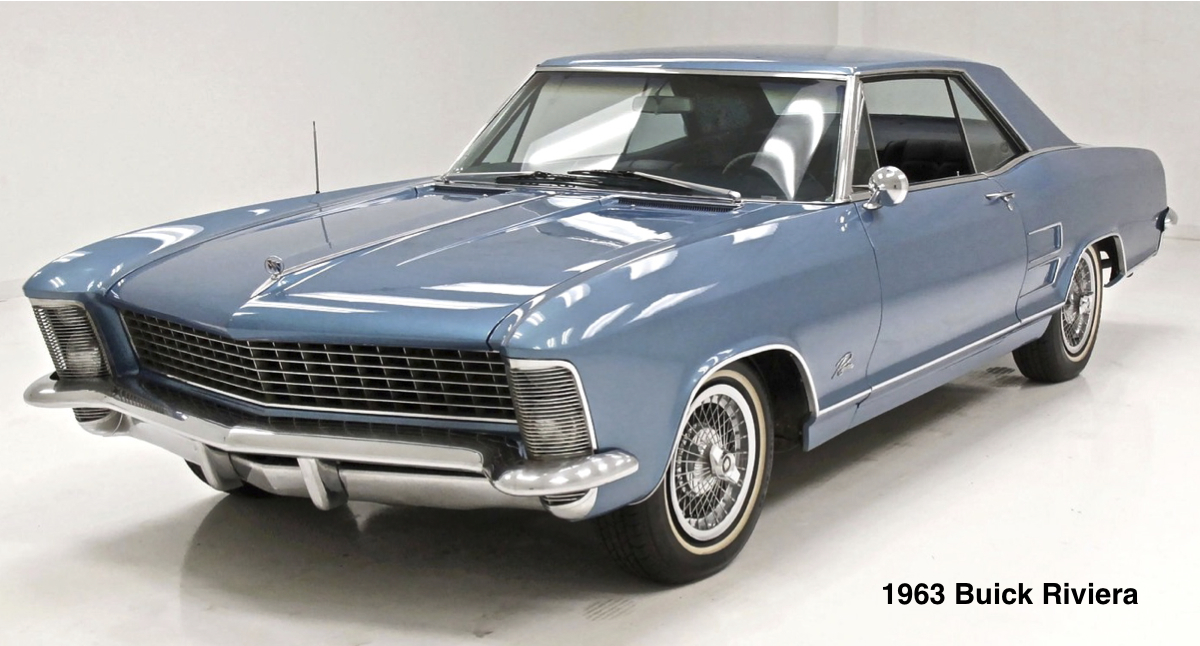
GM developed the new E-body platform to be flexible enough to accept any power train or drive configuration. It was used both for the rear-wheel drive 1963 Buick Riviera and later the front-wheel drive 1966 Oldsmobile Toronado and the 1967 Cadillac Eldorado. These were the only three cars built off the E-body.

GM Stying Chief Bill Mitchell oversaw the design with its flat surfaces, razor-sharp creases and hideaway headlights. It had classic long hood-short deck proportions and a pillar-less hardtop. It was considered at the time, and still today, to be one of the most beautiful American production cars from the 1960s. In fact, it won Motor Trend’s Car of the Year award in 1963.

The new Riviera came exclusively with Buick’s 401 ci ‘Nailhead’ V8 with 340 hp and all were automatics. 40,728 were built in its first year, 1963. This first-generation lasted just three model years and by 1965 it was over. The ’65 models took the hideaway headlights to another level with ‘clamshell’ covers over the stacked headlights that stopped people in their tracks when they saw them open or close.

1965 was also the first year for the Riviera GS (Grand Sport), the hot rod version. It came standard with the 455 and a sportier suspension. Heavy duty suspension, dual exhaust and a limited-slip differential in 3.42:1 or 3.73:1 ratios were all part of this performance package, along with special badging, unique wheel covers, special striping, dual functional hood scoops and an optional hood-mounted tach. The GS package was available on 1965 through 1973 Rivieras.

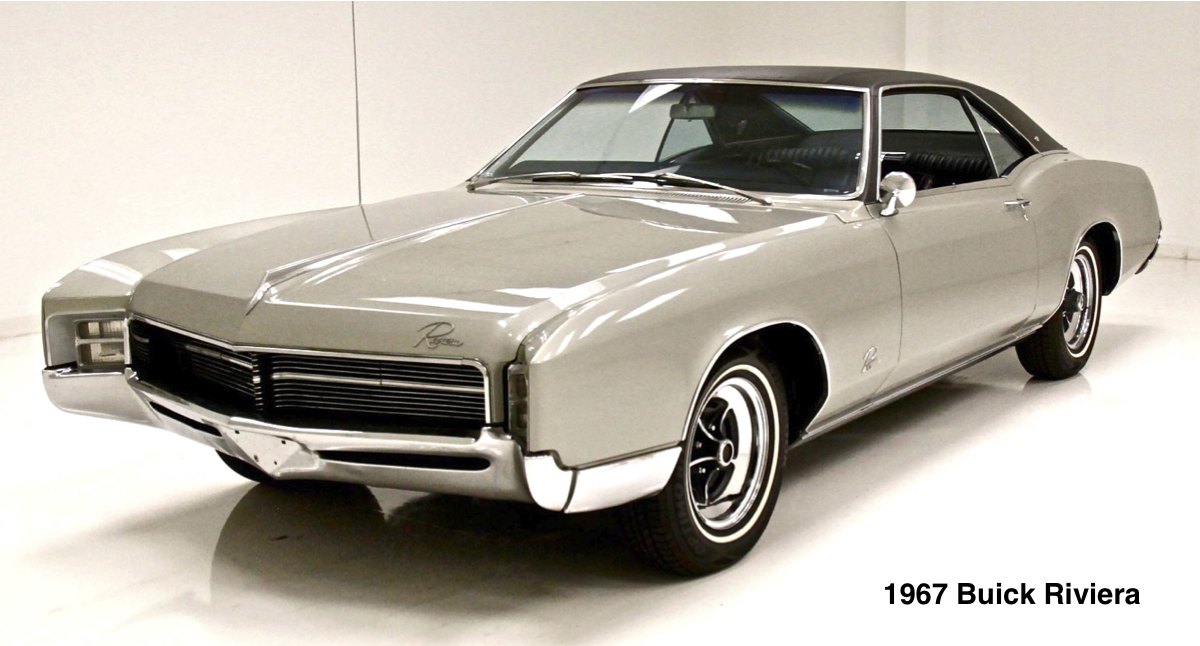
The second generation launched in 1966 introduced a more rounded, Coke-bottle shape and a semi-fastback roof line. It looked like a much bigger car than before, even though they shared the same 119-inch wheelbase. Buick upped the ante with one of the largest Nail head V8s in its arsenal, the 425 making 340 hp with single 4-barrel or 360 hp with a dual-quad setup. In 1968 they upped it again with an optional 455 that made 370 hp. Over 200,000 Riv’s were built in its 2nd-generation, its most successful generation in Riviera history.

The 3rd-gen Riviera launched in 1971 and was a bigger, bolder car, longer, heavier and more formal looking. The front end was ‘shark-nosed’ which means that the grille and headlights leaned forward. But what really set it off was it’s ‘boattail’. This triangular shaped rear window aped the looks of the 2nd-gen Corvette (1963-67) and was very controversial. Some people never warmed to it but most thought it was a beautiful, novel feature that stood out among its contemporaries.

Of course this was right in the beginnings of the Malaise Era which, starting in 1971, piled on restrictive new federal smog, fuel economy and safety regulations that forced carmakers to detune their engines to get them to pass. The 455 was now the standard engine but it’s power had been clipped from 370 to 270hp. A loss of 100 ponies! Of course, at this same time the Feds were forcing carmakers to express horsepower as a ‘net’ figure rather than ‘gross’, which dropped the numbers even more than the power actually decreased.

The best year ever for Riviera sales was 1969 (2nd-gen) with 52,000 cars sold. 1971, the first year of this new 3rd-generation saw sales drop to 37,000 and they just kept going down after that. It’s not that the cars were bad, although the boat tail styling did put some buyers off, but the times were changing. Inflation was raging, the first oil embargo was right around the corner and people were concerned about fuel economy for the first time in their lives. Big cars and cars with big engines struggled to find
buyers in this environment, and Riviera sales suffered as the result. Only about half as many Riv’s were built in the 3rd-generation as in the 2nd.

In 1974, the first oil embargo (1973) had just hit and America was still dealing with it. For the 4th generation, launched in 1974, the Riviera was downsized. It had been growing with each passing generation. The 1st-gen car weighed in at around 4,100 pounds and was 208 inches in length. The 2nd-gen grew by 200 pounds and 7 inches, despite keeping the same 119-inch wheelbase as the 1st-gen. The 3rd-gen got a 122-inch wheelbase and was of course longer by another six inches, now at 221 inches in length and got another 300 pounds heavier, bringing it to 4,600 pounds.

This new 4th-gen Riv got even bigger. The wheelbase stayed the same at 122 inches, but length grew again, now to 227 inches and the weight ballooned to 4,700 pounds. The only engine option was the 455, now rated at just 245 hp. And it wasn’t done falling yet. The 1974 455 had a 8.5:1 compression ratio and made 385 lb-ft of torque, not bad. But for 1975 the compression was reduced to 8.0:1, horsepower dropped to just 205 hp and torque fell to 320 lb-ft. 205 horsepower from a 455 cubic inch V8? How is that even possible?! Just 90,000 Rivieras were sold during the 4th generation, 1974-1976.

The big Riv got downsized for the first time, in its 5th-generation. Launched in 1977 and lasting just two model years, it was now built on the B-body platform, shared with the Chevy Impala and Buick LeSabre and had a 114-inch wheelbase, a full 8-inch reduction. Length came down to 206 inches, two inches shorter than the original in 1963, and the weight dropped by 700 pounds to roughly 4,000 pounds, also less than the original. A 350 ci V8 was available for the first time, with the 455 as an option, now making only 200 hp. This was the first round of downsizing, but it wasn’t over yet. This was also the last rear-wheel drive Riviera.

In 1979, just two years after launching the 5th-gen Riviera the 6th-gen car replaced it, and it was…are you ready for it? Front-wheel drive. Built off the E-platform shared with the Olds Toronado and Cadillac Eldorado, the new car kept the same 114-inch wheelbase as before, and the length stayed the same, but the weight dropped by 100 pounds or so. Gone were the big blocks. Engine choices were now the Oldsmobile sourced 350 ci V8, a 4.1-liter V6, Buick’s own 3.8-liter V6 with turbocharger, and the ill fated 350 ci diesel V8. It may have helped GM’s CAFE numbers but it didn’t help sales.
Already low and slipping, sales had been hovering around 15,000 to 26,000 sales per year in the 1980s, but had taken a nose-dive in the 90s, and going into the 6th generation, even after this radical change to front-wheel drive, sales actually went up for the first year then declined steadily after that. Every new generation brings with it one good year, the first year. It almost always happens that way. The 6th-gen Riviera ran from 1979 through 1985. The turbo was the highlight.

From an enthusiasts’ point of view, things just went downhill after that. Each new generation got smaller, and they were all front-wheel drive. The 7th-gen was built off an updated E-platform with a standard 3.8L V6, optional 4.9L V8 or a 4.3L diesel. The focus was on luxury and comfort, not performance.

The 8th and final generation of Riviera ran from 1995 through 1999 and there hasn’t been a Riviera since. In its final iteration it was spun off of the G-body platform, shared with the Oldsmobile Aurora, a platform known for it’s rigid structure and good handling. The only engine was Buick’s own excellent 3.8-liter V6 in two configurations. The normally-aspirated version made 205 hp while the supercharged engine had 240 hp. All were front-wheel drive with 4-speed automatics.

The world was changing and unfortunately the Riviera had been on a steady decline from the start. Sales were never strong by GM standards. But they slowly got worse and worse over the decades. In the 1960s, sales ranged from 37,000 to 52,000 cars per year. Through the 1970s, those numbers fell to between 15,000 and 37,000. In the 1980s it fell again to between 12,000 and 25,000. In the 1990s, those same numbers were now only 6,000 to 12,000 cars per year, worst and best years. In the Riviera’s final year of production, 1999, they sold just 6,000 cars. However, over it’s life, the over 1.3 million Rivieras were built.

The first three generations were true American classics, each with their own distinct personality, but always distinctive and classy, and a notch above other cars in its class, like the Pontiac Grand Prix and the Ford Thunderbird. Their smart styling and impressive interiors, and their strong performance set them apart. Time is the test of all things and the collector car market views these early Riviera’s as treasures. A 1965 Riviera GS sold for $275,000 at Mecum’s Kissimmee sale in January 2024.

It seems surprising that a giant, high-volume corporation like GM would have invested the time, energy, money and people to make a car like the Riviera considering how relatively few sales it got. Yet, they’ve done it over and over, many times, on cars like the Corvette, the Nomad, the Z/28, the Trans Am, and the Olds Series I. It proves that they weren’t just penny-pinching bureaucrats squeezing every last dollar out of high volume models like the Chevy Nova or Impala. Taking the risk and investing in wonderful cars like the Buick Riviera shows that they had a soul, and that making great cars, legendary, memorable cars, really did matter to them after all.

Motorsports News by David Vodden


Roger Penske was the big winner last weekend in American motorsports. The 89-year-old godfather of auto racing is celebrating his sixtieth year in the sport that began for him when he attended the Indy 500 race in the fifties with his dad. His love for sport has endured his entire lifetime during which his impact has been greater than anyone else in auto racing. Roger Penske has over 630 major race wins as a car owner including 245 wins in Indy car racing with twenty Indy 500 triumphs. He has 158 NASCAR CUP series wins including five CUP series Championships. He has fielded race cars under his team’s name around the world in various forms of road racing. He owns the legendary Indianapolis Motor Speedway as well as the series that races there. Roger Penske is to American motorsports what the Yankees are to baseball! Maybe more. As a driver he has one west coast stock car win and a few wins in Sports Car Club of American road racing.


Last weekend his driver, Josef Newgarden, won the Indy car race at Phoenix International Raceway. One day later his driver, Ryan Blaney, won the NASCAR Cup series race at the same track. It is fair to say that Roger Penske plans to make his 60th year as a leader in motorsports incredibly special. This would include another Indy 500 win and series Championship as well as the NASCAR Cup series title with several major wins along the way. He is motivated. His huge team of dedicated racers is motivated. It seems to me that the stars in the sky and a massive number of resources are lined up to make 2026 the best year ever in Roger Penske’s life and racing legacy. Penske is eighty-nine.


The double header featuring the Indy cars and NASCAR stock cars at Phoenix last weekend was great. It was terrific value for the fans! The O’Reilly Auto Parts series for NASCAR stock cars ran on Saturday where Justin Allgaier won over Jesse Love, Carson Kvapil, Sheldon Creed, and Sam Mayer. On Sunday, Blaney was dominant despite a strong showing by Chris Bell who finished second. Kyle Larson took third with Ty Gibbs, Denny Hamlin, Bubba Wallace, William Byron, Tyler Reddick, Michael McDowell, and Erik Jones completing the top ten. Reddick continues to lead the playoff point championships ahead of Blaney, Wallace, Chase Elliott, Shane van Gisbergen, Bell, Joey Logano, McDowell, Chris Buescher and Larson. Tenth place Larson is 116 points behind his fellow Northern Californian, Reddick. The top sixteen CUP series drivers in points after twenty-six regular season races will face-off in a ten-race playoff to decide the 2026 driver champion where total points earned in just those ten races will determine the champion.

NASCAR races in Las Vegas with the O’Reilly series on Saturday and the CUP cars on Sunday. This will be the fifth race of thirty-six scheduled in 2026.


The Las Vegas race weekend will also feature the start of the High Limit winged sprint car series, Thursday through Saturday nights. Larson will compete in the sprint car races as well as the O’Reilly stock car series on Saturday afternoon. When that race ends Larson will run over to the dirt track for that series final. The presence of NASCAR champion Kyle Larson in five races over four days will ensure a huge attendance. As if that was not enough, Larson is the odds-on favorite to win in all the races that he has entered. Doing so would be a huge sports story on Monday. Odds? Seems impossible, which makes it even more enticing. Stay tuned!


The Formula One race on Australia was interesting. It turns out that the massive changes in the design of the cars, their engines and much more were the story. As suspected the Mercedes team did fine a loophole in the rules that enabled driver George Russell to win with some level of ease. Given that the Mercedes team had a secret edge, Russell’s teammate Kimi Antonelli was an easy second. Ferrari was also expected to have an advantage and so they did. This gave them third and fourth with Charles LeClare and Lewis Hamilton in that order. Fifth place went to last years F-1 champion Lando Norris in a McLaren. Oscar Piastri, Norris’s McLaren teammate, was the victim of a power surge caused by an unexpected electrical power boost on the pace lap sending him into the crash wall and out of the race. Weird stuff to be sure. This story has so many plot lines that we may have to wait well into the season to line up our suspects in this mystery drama. Stay tuned.


The Art & Science of Cars “Second-Channel Brands” By Andy Tallone

The Art & Science of Cars “Second-Channel Brands” By Andy Tallone

First off, what is a ‘Second-Channel Brand? It’s what Acura is to Honda, or
Infiniti is to Nissan. It’s what happens when a volume carmaker like Toyota wants to continue making gobs of common, high-volume cars, but they also want to cash in on the lucrative, high-profit luxury car market. If Toyota would have tried to build high-end luxury cars with Toyota badges on them they would likely have met with market resistance because people associate Toyotas with cheap cars, not prestigious luxury models. Think VW Phaeton.

Instead, Toyota launched a whole new brand under its corporate umbrella and called it Lexus, and today some of the finest luxury- and near-luxury cars come from them. And Lexus is widely accepted as a legitimate luxury brand, on par with Cadillac and a notch above Lincoln. In the past, some Lexi have been tarted-up rebadged Toyotas, but most only share some platforms and powertrains, just like over here.
But, it was Detroit who did it first. Long ago. William P. Chrysler was on a tear in the late 20s. He acquired Dodge in 1928 and formed a whole new car brand, Plymouth in 1929. Plymouth was Chrysler’s second-channel brand, their Lexus if you will. However, this wasn’t intended to be a high-end brand, quite the opposite, it was going to be their bargain brand, positioned below their high-volume brand, Dodge, meant to compete with Ford and Chevrolet.

And compete they did. By 1931, Plymouth was the third-biggest carmaker in
America, and maintained that position until World War II curtailed all the fun. They even passed Ford for the #2-spot for a few months at a time during the early 30s, but never for a full year. However, considering the number of brands that were competing for the car-buying dollar back then, #3 is admirable. And of course, Plymouth continued to be Chrysler’s bargain brand until their demise in 2001, at a time when they were still averaging over 150,000 cars per year. That’s more that some stand-alone brands.
Jaguar would have killed for numbers like that. In 1973, Plymouth sold 882,196 cars!

So, clearly the second-channel concept worked for Chrysler. It’s hard to believe they killed the brand. It gave them an outlet for cheaper versions of their Dodge products. That’s all they were really doing of course, de-contenting Dodges and giving them different skins and interiors. It only made sense. They were already building the cars over at Dodge. In the 60s, that meant the Dodge Coronet was morphed into the Plymouth Belvedere with cheaper upholstery, less trim, fewer standard features (most were still available as options), and a one-inch shorter wheelbase. What? That’s right.
Chrysler went to the trouble of shortening the Dodge to make the Plymouth. Not much, just enough to say they did it, thus differentiating the two cars and the two brands. The Dodge had the longer wheelbase, which placed it above the Plymouth in Chrysler’s hierarchy of brands.

They did the same thing on the Challenger and Barracuda. There was a two inch difference in wheelbases there, and the Challenger had four headlights to the Barracuda’s two. All of this was code for their brand positioning. Did the public notice it or even care? What it did bring us though was two takes on the same great car. The same can be said about the Dodge Charger and Plymouth Road Runner. They call them ‘sister cars’.
Ford took an entirely different approach. Where Chrysler, the brand, was that company’s high-end luxury product, over at Ford, Ford cars were the bargain-brand and the high-volume brand. And Old Henry was opposed to opulence or complexity in the cars that bore his name. But the company wanted and needed to go upmarket. Ford’s ‘everyman reputation’ would have likely hurt any attempt at building luxury Ford cars at that time, and would have diluted Ford’s public image. So, in 1922 Ford acquired Lincoln and applied it’s massive engineering and production acumen to building luxury cars and establishing Lincoln as a legitimate luxury brand, on par with, or surpassing Cadillac.

Lincoln was never a high-volume car brand, but then that’s the point. Cars like this carry much fatter markups than economy cars. More profit can be made on fewer cars. Ford did it again with the creation of Mercury in 1938. Ford wanted a midmarket brand, nicer than a Ford, but not as nice as a Lincoln, to compete with the midmarket brands over at GM, like Buick and Oldsmobile.

Ford also took a different approach to making the cars. Unlike Chrysler, who
altered the wheelbases between brands, a very expensive proposition compared to leaving it alone, Ford simply reskinned its Ford cars with unique Mercury bodies, redid the interiors, loaded the Mercs up with more chrome and more standard features and voila’, you’ve got a Mercury. They also put larger engines in the Merc as standard. By the 1960s though, the two brands shared engines. Mercury barely got going before the War started but by 1950 they sold 344,082 cars that year. Throughout the 70s, Mercury was good for over 500,000 sales annually with 1979 being their best year ever at 669,138 cars. In the early 2000s they were still averaging over a quarter million cars, but volume fell starting in 2005. Ford killed the
brand in 2011.

GM literally invented the game of second-channel branding. Their entire
corporate structure is an ascending pantheon of brands, starting at the bottom with Chevrolet, then moving up to Pontiac, then Buick, then Olds, then finally Cadillac. It was a system that produced some outstanding cars and some duds, and everything in between, and kept car buyers for life as they moved up the ladder. William C. “Billy” Durant never created new brands, he acquired them, Buick and Oldsmobile in 1908, Cadillac, Oakland (later to be renamed Pontiac) and Rapid and Reliant truck companies (renamed GMC) in 1909, and Chevrolet in 1918. That was the entire basis of the GM empire for decades. Then, as the world changed, in 1985
GM decided it was time to invent a second-channel brand, this one to compete with those industrious Japanese car companies. They called it Saturn. Then in 1999 they acquired the rights to the Hummer name from AM General and bought Saab in 2000.

All of these second-channel moves were intended to broaden their market reach and to allow them to leverage their incredible manufacturing capacity and economies of scale into new segments they weren’t reaching before or that didn’t exist until then. All of this created a top-heavy structure, each brand with its own redundant requirements, a massive bureaucracy and brands that were competing with one another. They were literally cannibalizing each other’s sales. Chevy and Pontiac were in constant competition, Chevy Trucks and GMC, Olds and Buick all battled it out for
an ever smaller slice of a dwindling pie.

Oldsmobile was the first to go. GM pulled the plug in 2004, 101 years after it’s acquisition. But GM had to pare down. Too many brands, too many people, too much capacity, too much money. Then hard times hit in 2008-2009, GM went into bankruptcy and the government stepped in to both save them and to slash and burn.

Pontiac was the next to go in 2010. What a shame. They had positioned
themselves as the high-end performance brand and now had cars like the G6 and G8 and the awesome GTO coming over from Holden in Australia. Great cars that deserved better, but GM stateside gave them no advertising and so they died on the vine. Likely it still might not have saved Pontiac from the government axe men. Hummer was put up for sale but no buyers materialized, so it was shut down in 2010. Saturn was also shut down in 2010, with no attempt made to sell it. Saab, theperpetually unprofitable Swedish niche brand was finally sold to Spyker Motors of the Netherlands also in 2010. That left GM with just a few core brands: Chevrolet, it’s bargain/high-volume brand; Buick, preserved primarily for the Chinese market; Cadillac, the premier luxury brand; Chevy and GMC trucks. All the second-channel brands have been wrung out,if Buick gets cut. They sell almost nothing in the US and now their hopes for lucrative returns from Buick in China are fading.

So, if Buick bites the dust, GM’s only second-channel brand will be GMC.
Chevy will fill three roles in the new GM: 1.) the bargain-priced brand; 2.) the high volume brand; and 3.) the performance brand. Cadillac will of course be the high-end luxury brand, and the two truck brands will continue to compete with one another. Ford shuttered Mercury in 2001 so that leaves only Ford as the: 1.) bargain priced entry-level brand; 2.) high-volume brand; and 3.) performance brand, and Lincoln, the high-end luxury brand. However, Lincoln is wobbly and struggling forrelevance with just 106,868 units sold in 2025.

Chrysler is a little harder to nail down since it’s part of this global consortium of second-rate brands. Stellantis has 14 brands in all. Dodge, Jeep and Ram are the crown jewels, although its doubtful the suits in Europe would ever admit it. From here its like a list of who hasn’t succeeded in selling cars in America. Abarth, Alpha Romeo, Fiat, Lancia, Maserati, Citroen, DS Automobiles, Peugeot, Opel and Vauxhall. And of course, the ailing Chrysler brand, now down to just the Pacifica minivan.

For Chrysler, Dodge is obviously the bargain brand, the volume brand and the performance brand, and Chrysler is supposed to be the luxury brand, their Cadillac, but it’s just not cutting it. The Jeep brand and the newly-minted RAM truck brand both do well generally, although everyone’s fallen on hard times lately.

So, really the Big 3 don’t have much left of their second-channel brands. It’s interesting that almost all of the at-one-time-successful second channel brands that the Big 3 fostered are gone now, and the only good examples of the practice that are left come out of Asia. Lexus for Toyota, Infinity for Nissan, Acura of Honda and Genesis for Kia. For them, it makes sense because their core brands were built on lower-priced economy cars, so all of them benefitted by moving upmarket. Most of Europe’s brands, at least those that make it to America are already considered luxury or near-luxury brands so their second channels would only likely move them down
market, and Europe being the most expensive place on Earth to manufacture cars, that doesn’t make much sense.

BMW tried it with the Mini, but after the initial cuteness wore off, they’ve
struggled to get people to pay a premium price of such a tiny car. Toyota tried it with Scion in 2004, a brand aimed at the ‘youth market’. It struggled from the start and died in 2016. In the end, the car business is a business, and car companies have to make money. To do that, they need to make cars that people want to buy and can afford. Looking back, the auto industry has done an admirable job of delivering some solid, worthy products that were safe, reliable and served us well, along with some stunning standouts that please the eye and move the soul.

Second channels have given large manufacturers new avenues to reach niches that their normal product line didn’t address. The result of all this is a plethora of wonderful cars that, at one time were within reach of most people, financially. Great cars that everyone could afford, what a concept.


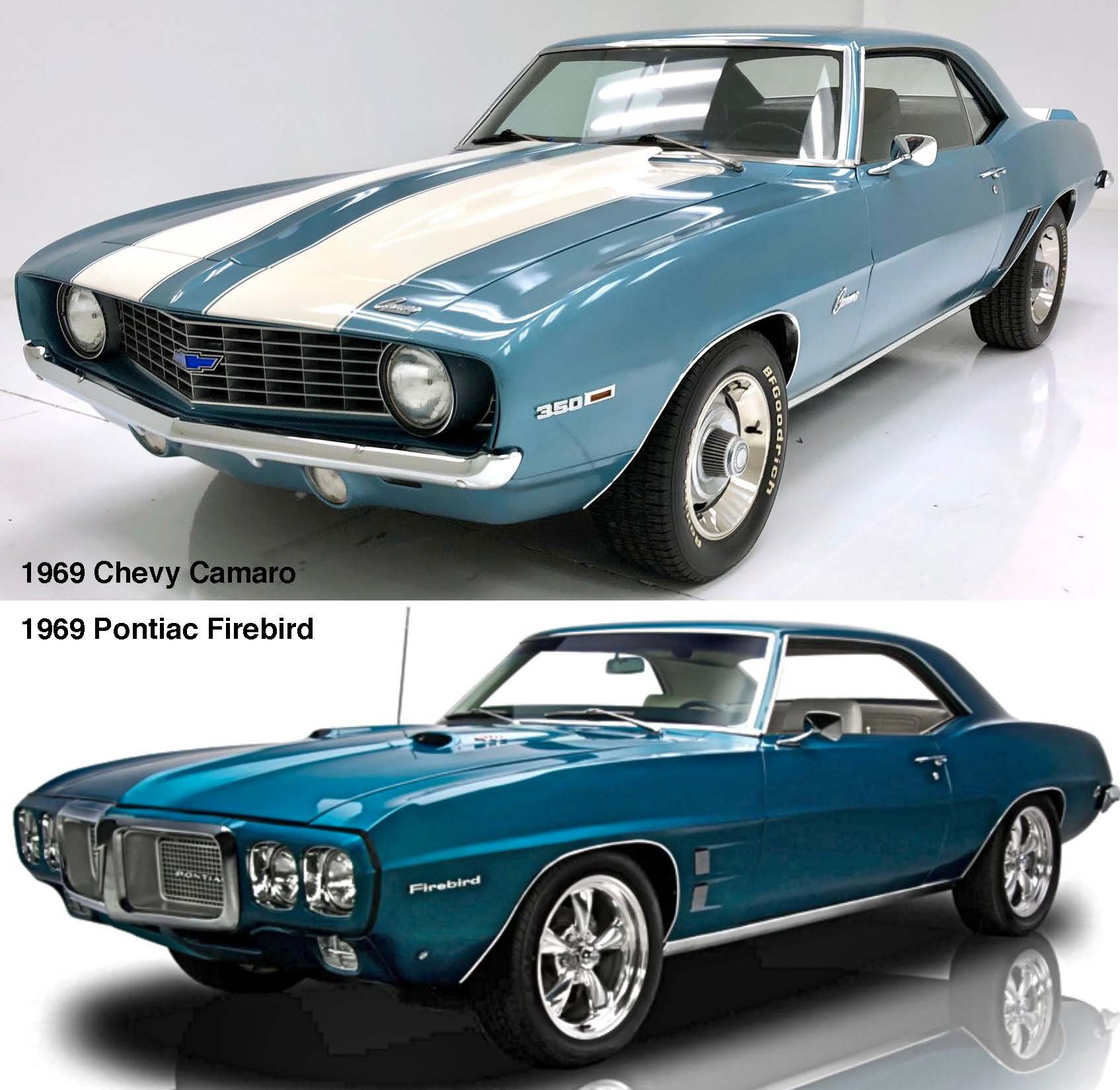
The Camaro and Firebird have always been essentially the same car, just with a different skin.

The Fox-body T-Birds and Cougars were very similar. The Merc was slightly better appointed inside and had a standup rear window to the T-Bird’s semi-fastback.

The Challenger had 2-inches more wheelbase than the Barracuda, and two extra headlights. Different skins also. Only the roof and glass are the same.

“A LIFETIME OF MOPARS” by Mark Pedrazzi


“A LIFETIME OF MOPARS”


I was brought up in a home that never seemed to be without a Mopar.  From the time I was born until I was in my 40’s, my parents always owned a Mopar, whether a Chrysler, Dodge, Plymouth or Desoto – heck, after birth, I was even brought home from the hospital in my mom’s 1948 Chrysler Town & Country 4dr sedan, at the time when my dad drove a 1948 Desoto 4dr sedan.


By the time I was in high school and got my driver’s license, I was occasionally able to take my mom’s 1969 Chrysler 300 (with the 440 TNT, 375 hp engine and 480 lb-ft of torque) out on an “errand” or date.  That would often times result in a drag race with one of my friends or challenging someone off-the-line at a stop sign – what an enjoyably comfortable and fast ride as it was a car that few of my friend’s cars at the time were able to beat!


Over the years, my parents owned numerous 1940’s – 2000’s Mopars, but never classic Mopar muscle cars, which, of course, I admired growing up – particularly every chance we got to go down to the local Normandin’s Chrysler dealership in San Jose.  It wasn’t until after I was out of college and had owned a few non-Mopar muscle cars that I bought my first Mopar in 1984.  I have never been without a Mopar since, and have been fortunate enough to have owned a number of classic Mopars since, including A, B, C, D, and E body Mopars from every decade of the 1950’s through the 2010’s – keeping our Mopar family tradition alive and well.


When my dad decided to downsize the number of cars he had and get rid of his 1966 Chrysler 300 2dr hardtop in 1994, I jumped at the chance to buy it.  After 31 years of ownership, I still try to drive it weekly.  And because it has the front fold down arm rest / middle seat option and is the only car we now own that seats six, it makes it a great car to take our family or friends comfortably to places that otherwise wouldn’t be able to go with just one car.  The 300 is equipped with a 383 CID with 325 hp engine, an automatic column shift, and is believed to have 104K original miles on it, with one repaint in its factory color of ZZ1 Spice Gold Poly metallic.  When I purchased the car, Beanie Babies were all the rage and quite popular.  As a result, our family decided to name our classic cars after Beanie Babies.  That’s why you’ll often hear me refer to our Chrysler 300 as “Goldie” – it’s named after a goldfish Beanie Baby.  It’s a fun car to take to car shows, drive-ins, cruises and other places.  Regardless of the cars around us, we always hear the comment “I remember when my parents used to own (or drive) one just like that”.


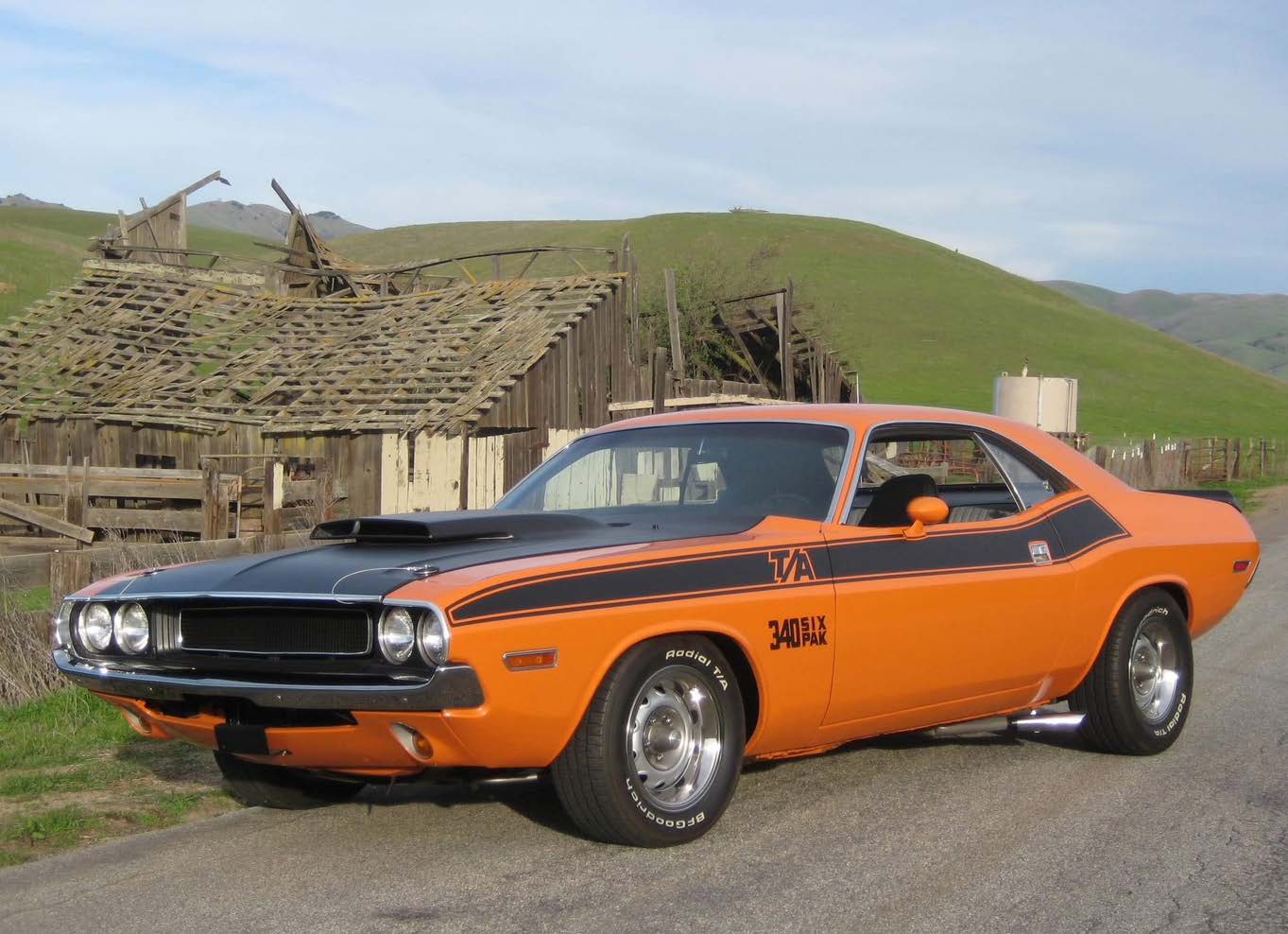
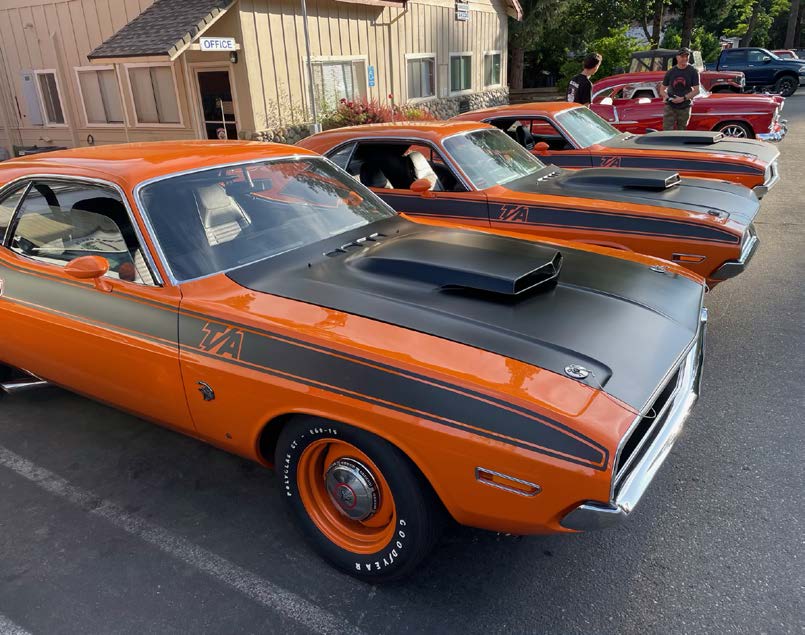
A few years prior to buying Goldie from my dad, I purchased my first 1970 Dodge Challenger – a 383 2bbl LA-manufactured car with an automatic transmission and center console.  After a few years of owning that Plum Crazy purple Challenger, I sold it because it eventually sat outside as I didn’t have enough garage space for another 1970 Challenger I would eventually buy.  In 1993, I purchased my 1970 Dodge Challenger T/A from a man by the name of Dave Dozier out of Saratoga, CA, who was a famed Bonneville Salt Flat Streamliner Record Holder & Elite 300 MPH Club member was getting rid of one of his many Mopars.  When I purchased the 1970 Challenger, it needed a lot of work – the color was wrong, it was primered in some areas, the interior needed to be refreshed, and for the most part other than the factory twin-snorkel fiberglass hood, it was externally unrecognizable as a T/A.  Luckily, the VIN and fender tag indicated it was a Challenger T/A, and Dave even had the build sheet to go with the car.


After buying the T/A, I parked it in the garage, but I would take the car out for short drives once or twice a month.  Because Dave Dozier had at one time installed a 4.10:1 rear end gear in the car prior to me purchasing it, the T/A was easily able to lay rubber in all four gears.  As a result, our kids quickly gave it the Beanie Baby nickname “Squealer”.


In 2008, a restoration on the car was finally started, with the help from one of my great friends by the name of Dave Ingles – a paint and body man by trade.  Dave took the car down to bare metal, replaced damaged sheet metal, performed necessary body work, repainted the car to its factory correct Go Mango color, and performed much of the reassembly.  Between work and family keeping me extremely busy, I was finally able to complete the restoration, following the reinstallation of the interior, exterior trim and lights.  By 2010 the car was back on the road.


Of the 2399 Challenger T/A’s produced for the US market, only 989 were equipped with pistol-grip four-speeds like mine.  According to Barry Washington, the Challenger T/A authority, my car is only one of five known to exist with a 4-speed in the Go Mango orange color and having the rare salt & pepper cloth interior option.


My T/A has since had the factory-correct 3.55:1 rear end gears installed and continues to be a car enjoyed by all of our children and grandchildren.  I plan to drive “Squealer” for many years to come, and is planned to someday be passed down to another family member, all of whom are wanting it and want to keep it in the family.


The Arnold Classic Car Show By Andy Tallone

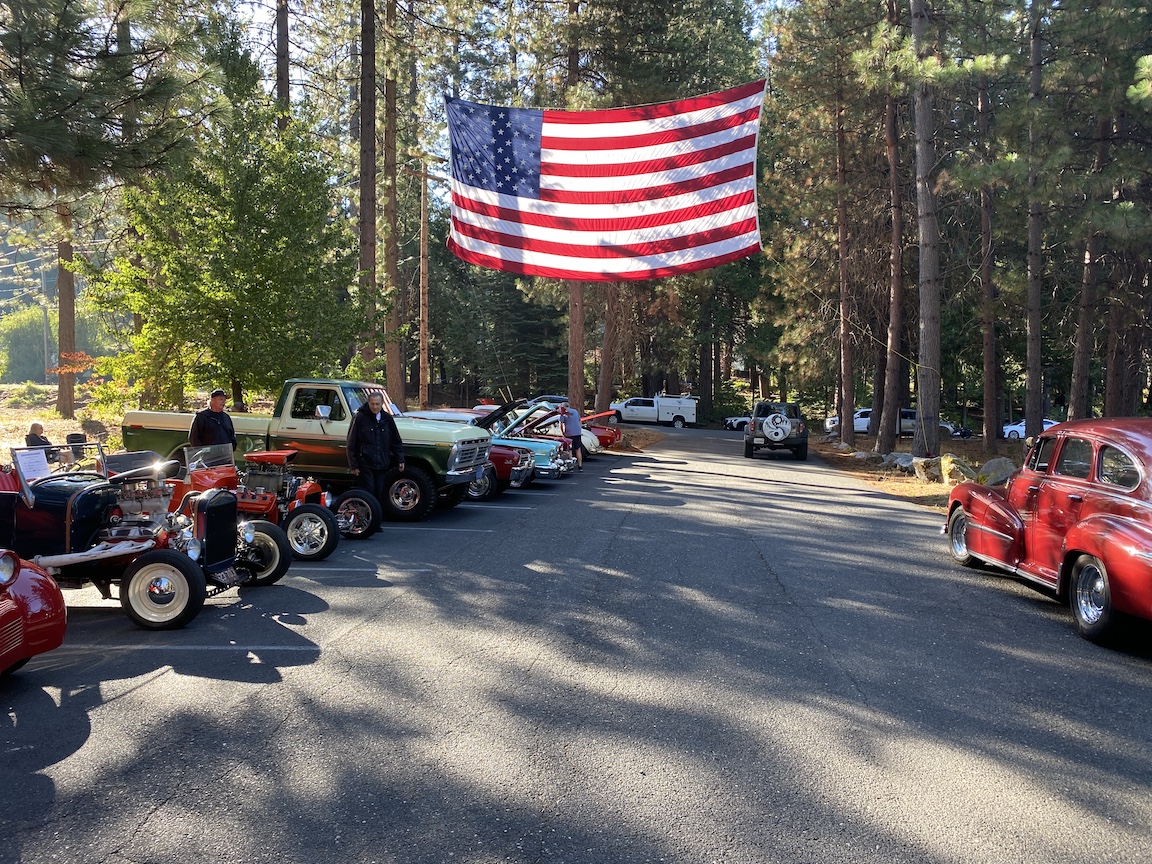
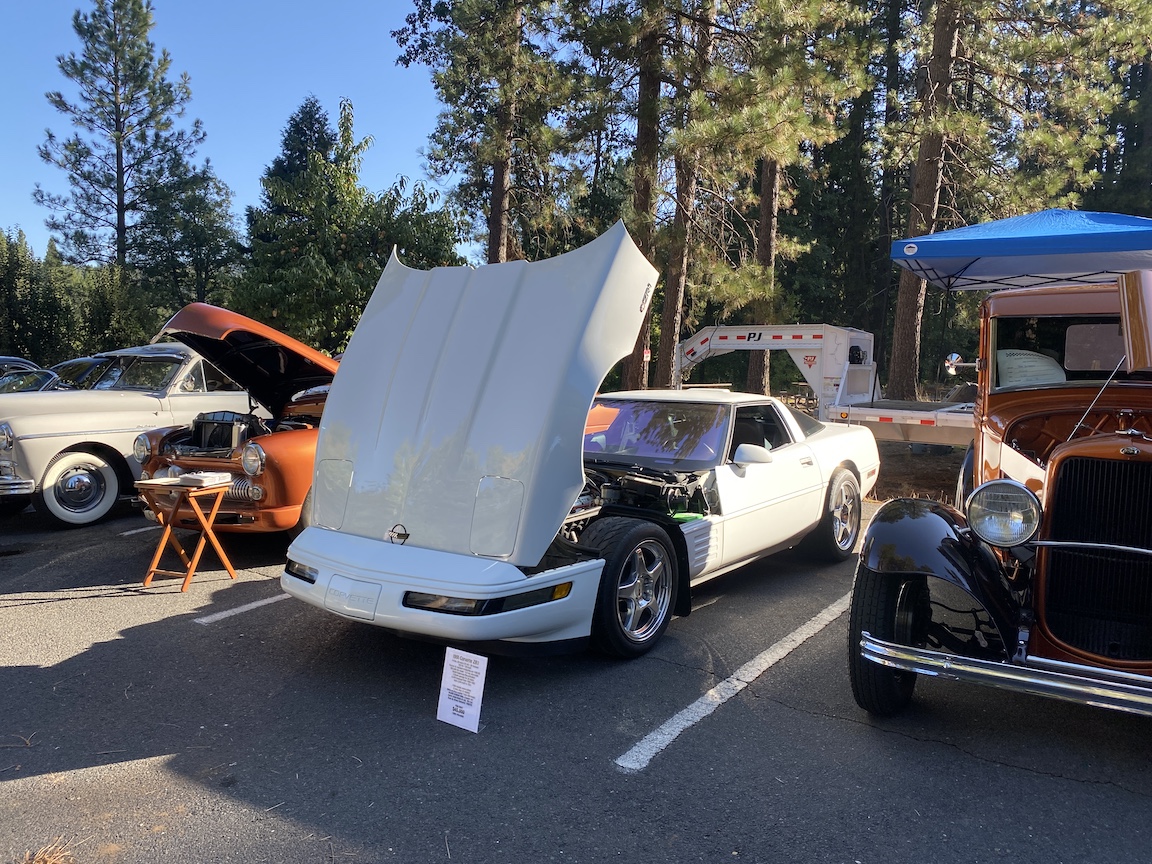
I took my ’91 Corvette ZR1 to a very nice car show on Saturday, September 20, 2025 called the 20th Annual Arnold Classic Car Show. It took place on the shores of beautiful White Pines Lake. The location was further enhanced by tall redwood and pine trees that provided ample shade.

The 100-or-so cars ran the gamut, antiques, 50s classics, lead sleds, low riders, Jeeps, trucks, hot rods, pro streets, and muscle cars, lots and lots of muscle cars.

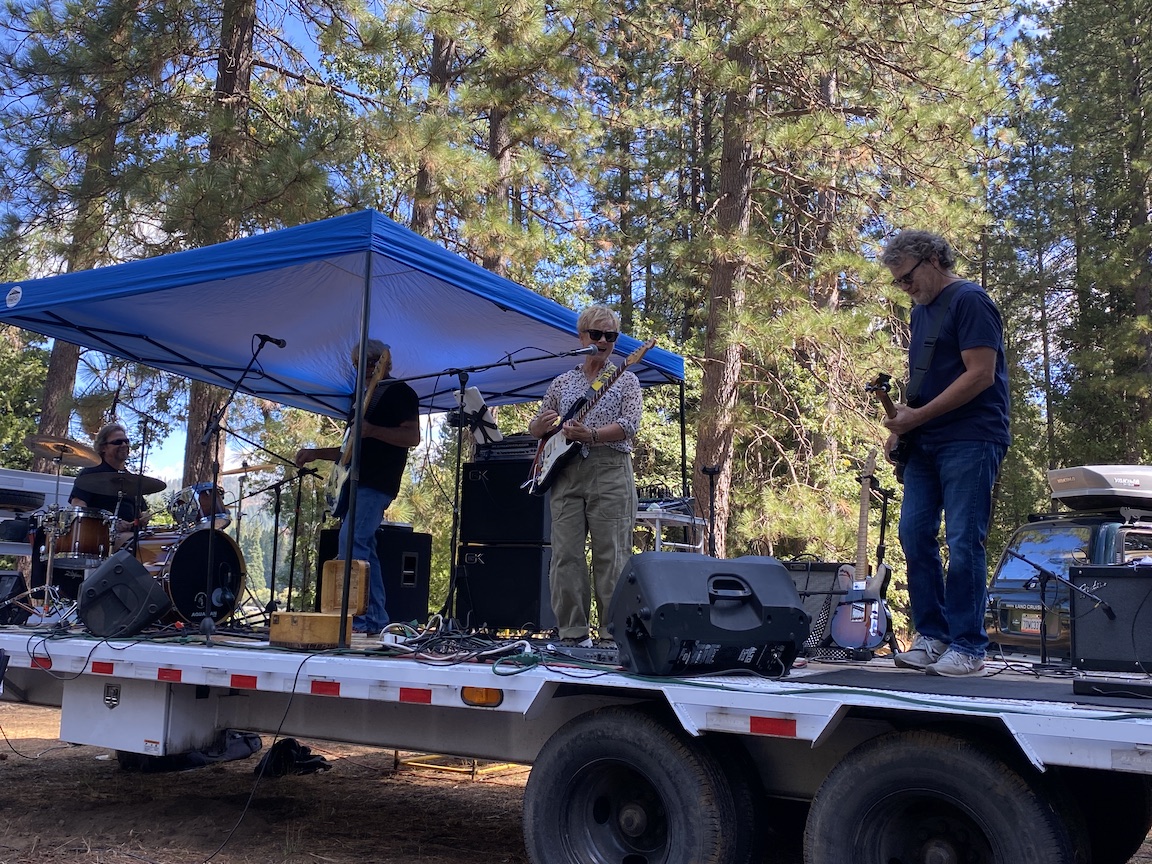
Arnold Car Show 1I arrived a little late at almost 9:00 am, but as luck would have it there was one open space left and it was right in front of the band stand. That’s right, there was going to be a live band! Now, that’s my kind of car show. Of course, the cars are always the stars of the show at these things, but the people are a huge part of it. Both the car owners and the spectators,
although I have a particular fondness for classic car owners, especially the ones who work on their own cars.

The three food vendors there had it covered, with hot dogs, BBQ and burgers. There was even a full bar! Again, my kind of car show.

After a perfect morning of looking at cars and talking to friendly folks, then enjoying some fine barbecue, the band opened up with a wicked rendition of ‘Take Me to the River’ that morphed into few bars of ‘Victim of Love’ then back again. I was hooked. I opened by folding chair, had my drink and thoroughly enjoyed the show. And my car was parked right there so it was perfect.

Jill & the GiantsJill and the Giants are a local band (Arnold and Avery) with a female lead singer who really belts out the tunes. And she’s an awesome guitarist in her own right. They played a wide variety of classic rock tunes all with their own unique flavor, and they were tasty. With breaks they played for almost three hours and I enjoyed every minute of it.

A total of 13 trophies were given out in a mix of categories. 102 registered entries showed up, so that’s a pretty good ratio. If you want to up your odds of getting a trophy, enter your car in small, local shows.

The Arnold Classic Car Show started in 2005 when car enthusiast Don Shinn proposed a car show to the local town council. For the first several years it was held at another location but in around 2015 the show was moved to White Pines Lake.

White Pines Lake is on private property, owned by the local Water District, so it receives no support from the County, the City or the Water District. So, the local town folk formed the White Pines Park Committee, and it is supported entirely through private donations, volunteers and events like this one.

I was very impressed with the spunk of the local community to pick up the ball and run with it. The lake is beautiful, but had fallen into disrepair and neglect. Today it’s clean, well-run and lovingly manicured. I was quite impressed with the spotless condition of the park and its facilities.

Andy's ZR1Alas my car didn’t win anything, but I had an excellent time, meeting wonderful people, having a fantastic meal and rocking out to one of the best bands I’ve heard in a while. So, a day well spent, I’d say. But, that wasn’t all. I got to drive that awesome 1991 Corvette ZR1 home on those curvy Gold Country roads. What a drive!

Motorsports News by David Vodden


Lando Norris of the McLaren F-1 team is now leading that series point championship over teammate Oscar Piastri by one point. Third place driver Max Verstappen is thirty-six points behind. There are four races to go in the only global auto racing series for the rich and famous. In case you were wondering if I am the only one who thinks that McLaren is orchestrating the 2025 championship battle outcome, Norris, who is a good guy, was resoundingly booed when he led every lap and won the Mexico F-1 race from the pole last weekend. Contrary to critics of season-long point tabulation being the basis for determining who is the champion driver, this year’s F-1 battle is a three-way battle where any one of these drivers can claim the title in Abu Dhabi in December. Stay tuned.

The NASCAR final, winner-take-the championship title fields are set for this weekend’s closing event in Phoenix Arizona. In the CUP, top series, the four finalists are Denny Hamlin, Chase Briscoe, William Byron, and Kyle Larson. There will be two Toyota drivers racing for Joe Gibbs and two Chevrolet drivers racing for Rick Hendrick. There will be no Fords or Roger Penske drivers in this face-off for the title. Penske and his Ford drivers Joey Logano and Ryan Blaney have won the NASCAR championship for the last three years at Phoenix where everyone feels they have a distinct advantage and would have won again had they made the final four. Hamlin, Briscoe, and Byron earned their spots by winning in the last segment of the three-stages that make up the qualifying races. Only Larson got in this final contest based on points. He beat fifth place and first non-qualifier Christopher Bell by six points in the final race last weekend at Martinsville. Byron won at Martinsville by qualifying number one, leading the most laps, winning both stages and the race. He even scored the fastest lap of the race. One might think that Byron is the favorite to win the title by beating the other three finalists in a race that will be won by a Penske Ford driver. Maybe. Larson is the only driver in the final who has won the CUP Series title before. This should provide some advantage. Maybe. Byron has been in the last three finals and enters the race with the most momentum. He and Larson drive Chevrolets for the most powerful team in this series. Hendrick Motorsports is seeking his fifteenth Cup series title. Rick Hendrick helped get Joe Gibbs into NASCAR CUP series racing. Gibbs Racing is now the second-best team in that series and has veteran Hamlin seeking his first CUP series title to go with his sixty CUP wins. He is overdue and a sentimental favorite as was Dale Earnhardt Sr., when seeking his first Daytona 500 win for decades before finally adding that goal to his list of achievements. Briscoe is new to the playoffs driving a Gibbs Toyota. His crew chief is also new to this final contest. If it were not for luck playing such a significant role in the outcome, I would mark Briscoe as the least likely to win this Sunday. The other three drivers have equal chances. The pundits are picking Byron. Second seems to be Larson with the Hamlin camp split with wanting him to win and hoping he does not due to the lawsuit that he is part of against NASCAR for restraint of trade law violations. The one given is that we will all see this play out amidst a thirty-six-car cluster of drivers who all want to win and stay out of the way of the four whose race performance equates to millions of dollars and the highest status in American stock car racing.

The Xfinity series has Connor Zilisch, Justin Allgaier, Jesse Love and Carson Kvapil as the final four. Kvapil has one Xfinity series wins, and it occurred last weekend at Martinsville. Zilisch has ten wins, eighteen top five finishes and has totally dominated the class. There are strong opinions that if Zilisch does not win the Xfinity series championship, the system for determining that outcome is fatally flawed. Most everyone agrees and that is why the one-race winner take all at the hands of lady luck will not return in 2026. Among the four final contenders are three drivers racing for Kelly Earnhardt-Miller [Dale Jr.] and one, Jesse Love, who drives for Richard Childress.

The Craftsman truck series has the same problem. Cory Heim has dominated that program and has eleven wins. Finalist Tyler Ankrum has one win. Ty Majeski and Kayden Honeycutt have no wins in the 24-race contest, which is the truck series. All four drivers will start even and race for the championship. One bit of bad luck could replace a real 2025 driver champion with another driver who, at best, scored one win. Not a good measure of a season-long sporting competition. Let us hope that Zilisch and Heim win in Phoenix and that NASCAR produces a three-race face-off for the final four contenders and that the stages, winner take all and the playoff format for twelve, not sixteen, drivers is the 2026 format. Stay tuned.

The Gearhead Revival

“The Gear Head Revival”
By Andy Tallone
I love small, local car shows. These can range from 30 to 300 cars or so, and
during the spring-summer-fall season, there’s one almost every weekend somewhere near where you live. Of course I also love the big money shows like the Goodguys where you might see 3,000 cars, or SEMA where the craftsmanship on the cars is off the charts. If you have a driver-quality car that you like to take to shows, how do you compete against cars like that? The answer is: you don’t. I put my drop-dead gorgeous orange ’72 Corvette in the August 2024 Goodguys show in Pleasanton and it barely got noticed. I just finished customizing my 2005 Mustang GT and it came out
awesome, but at the Goodguys show in March it just disappeared.
And when I see the kinds of cars that win those shows I ask myself, “What’s the point?” I could never compete with cars like that. I don’t have the fabrication skills or the money to hire someone who does. Besides, if I built a car like that, I’d never want to drive it. It would be tucked away in some climate-controlled cocoon awaiting the next show it would be trailered to.
No thanks. I want to drive my cars. So how do you get some attention, and
maybe even a trophy with your driver-quality classic? Small locals shows like the GearHead Revival Car Show in Twain Harte CA on Saturday, July 26, 2025. I caravanned there with members of my car club, the Tuolumne Chapter of the AACA (Antique Automobile Club of America) and brought my Corvette to the show. The cute little downtown area was blocked off and the show and vendors took over. There were a total of 85 cars there and they gave away 14 trophies. Now that’s a darn good ratio! Check out the Awards List below for more details on that. It was a great show, with tons of cool cars and very nice folks. That’s another plus to local shows like this, you end up meeting lots of people just like you who live in your hometown! I made some good contacts and met some fine people. Like most of these great little shows, this one is loaded with history. Over 50 years ago Dennis Scroggs opened his barber shop in quaint downtown Twain Harte.
He was a car nut and attracted fellow car guys to his barber shop, before long leading to a vast network of like minded hobbyists. 22 years ago he started having annual car shows in the parking lot of the shopping center where his barber shop was located, limited to just 25 cars. It grew and evolved and as Dennis was nearing retirement age, he handed the reigns over to David and Carol Hallett who have run the show for the past 5 years.
Dennis still attends every show, and his barber shop is still open. Come get a
haircut while you’re there! David and Carol want to pay homage to Dennis and it shows. All of the show’s promo materials, posters, T-shirts, etc., include a barber pole and so do some of the trophies, all handmade by locals. David himself builds a unique trophy each year for the LD Award (LD stands for ‘Little Dennis’, the small metal sculpture facsimile of Dennis on the trophy). This trophy is awarded by Dennis each year for his personal choice of Best in Show. It is truly the most coveted trophy given out at the show each year. Each judge is free to indulge his/her personal taste in
choosing their winner and they run the gamut. Some were works of fabrication genius and others were rough around the edges. That’s good. Everyone has a chance. You see very few true ‘show cars’ or ‘trailer queens’ at shows like this. You get a sense that most of them drove their cars there and were driving them home. While some were certainly show quality and there were some #1-level restorations, most were drivers of sorts. And the awards reflected that. While some were bona fide show cars, man of the awards went to driver-quality cars that would be in reach for most middle-class car guys. That’s what I like. I love drivers. Anyone with enough money can sculpt a piece of ‘metal art’ that would never be practical to drive anywhere, but I like ‘the real cars’, cars that can still do what they were designed to do: drive forever. David and Carol are working on a Cruise Night in the Sonora CA-area, and possibly a regular, monthly Cars & Coffee also in Sonora.
Trophy Winners Outstanding Entry 65 Pontiac GTO Lance Anastasakes #6
Outstanding Entry 1946 Club Coupe #80 Twain Harte FD Hot Car 1967 Corvette Mark & Lori Cole #53 Rick Bacon’s Choice 1977 Chevy K10 Shawn Amber #78 Calif Hot Rods Choice 1932 Ford Roadster Sam Hans #65
Sierra Auto Resto Choice 1979 Jeep J10 Ed Sunday #8 Phase II Autobody Choice 1969 Chevy Malibu SS Tim Gray #69 D&D Rods & Rewire Choice 1952 Chevy Eric Brown #75 Three Amigo’s. Choice 1946 Ford Coupe Al Johnson #41 Sonora Coating/Blasting Choice 1968 Chevy C10 #84 Dave Cahal NSRA Appreciation 1967 VW Bus Randy McDaniel #86 LD Barber Pole Award 1950 Chevy Pickup Randy Shurtz #79 Gearhead Custom Best of Show 1965 Lincoln Continental Jack & Mary Wilson #58 Gearhead Coupe Best of Show 1967 Mustang Vic Costello #24

1970 Dodge Challenger T/A By Mark Pedrazzi

1970 Dodge Challenger T/ABy Mark Pedrazzi

My story starts, like many Mopar stories, with “who
you know” and “how did you find that Mopar”. Nearly
all of the classic and Mopar muscle cars I have owned
over the years and/or still have today are because I’ve
had great friends looking out for me, since they knew I
have always had a passion for ANYTHING Mopar! As
some members of Mopar Alley may know, after 37.5
years, I retired from a company in San Jose / Santa Clara by the name of FMC, which later became United
Defense, and eventually was acquired by BAE Systems.
I used to put on an annual car show, called the SAE
MotorFest, at our facility on Coleman Avenue, which
several Mopar Alley members attended over its 17
years of existence. Internal to the company, we also
hosted a Diversity Fair, where several of us that had
and liked anything cars, trucks and motorcycles
displayed our vehicles once a year for other employees
to see.
One of the people I worked with who was also into
cars and enjoyed displaying his vehicles at our Diversity
Fair and SAE MotorFest events was a friend of mine by the name of Jack Costella. Jack was the foreman of our
model shop at Plant 7, our company’s experimental
shop where everything from scale models to full-scale
world-class prototype tracked vehicle were made for
both the Army and Marine Corps.
When Jack wasn’t at work, he spent evenings and
weekends building and working on hot rods, as well as other things that moved and intrigued him. In 1969,
Jack set his first world speed record, of all things, with
a Bonanza mini bike, not once, but twice in the late
1960’s when he worked for Bonanza in his early years
– both achieved speeds over 75 mph. Although he
wasn’t the driver of the mini bike, he was one of the
key builders. By the mid-1980’s, Jack got the urge to
race again after going to Bonneville and became
fascinated with streamliners. It was then, that Jack set
out to break another world speed record, but this time
developing from scratch a streamliner of his own
design. You see, he was one of those guys that could
build just about anything you asked him to and/or he
put his mind to, whether at work or at home. Jack was
one of the smartest non-degreed designers I’d ever
met and I always looked forward to seeing his next
creation and what he was going to display at our
events. By 1992, Jack set his first of many streamliner
world speed records at Bonneville – at a speed of over
239 mph. That got my attention, as it would anyone,
and Jack and I would often discuss design ideas and his
next speed record goal and/or project.
In one of our many conversations, Jack mentioned to
me in 1993 that he had a friend who also raced
Bonneville streamliners and was sponsored by Mopar
– his name was Dave Dozier. Jack told me that Dave
had several Challengers he had been getting rid of, and
there was one last one that he hadn’t sold as there
weren’t many of them made.
It happened to be the 1970 Dodge
Challenger T/A I now own today.
I immediately called Dave and went over to his home
in Saratoga, CA. When I got to Dave’s house and he
gave me the grand tour of his garages, I quickly
realized that Dave not only raced, but he collected any
unique Mopars, including everything from a Chrysler
Airflow to a 1966 Hemi Charger that he was the
original owner of. He even loaned cars out to movie
companies to use in their productions.

When we got around to Dave showing me the
Challenger T/A, it was obvious that it needed a lot of
work. The car was going to not only need paint, as the
color was wrong and it was primered in some areas,
but the interior needed to be refreshed and Dave
mentioned the wrong heads were installed on the
block. There was absolutely nothing from the exterior
of the car other than the hood that gave you the
impression it was recognizable as a T/A. Luckily, the
VIN and fender tag indicated it was a Challenger T/A,
and Dave even had the build sheet for the car. After
some discussion on price and him agreeing to re-install
the correct heads on the engine, we struck a deal a few
months later, and I loaded the car on my car trailer and
brought it home.
For the first 15 or so years, the car was
always parked in my garage and I would
take it out for a short drive once or twice
a month.
It wasn’t until about 2008 that I decided to start a
restoration on the car. A good friend of mine by the
name of Dave Ingles was an excellent paint and body
man by trade, and he agreed to work on my car on the
side in his spare time. We decided it would be best to
strip the car and take it down to bare metal.
I remember shortly after that having a dismantling
party in my garage where four of my friends, including
Dave, came over, we collectively disassembled the car
and bagged-and-tagged everything. After Dave got the
car and started stripping the paint down to bare metal,
we quickly discovered the car had, at one time, been in
an accident and the right rear quarter panel was filled
with Bondo and beyond repair. Dave, being the skilled
craftsman he was, cut out the old quarter panel, which
turned out not to be original, and rewelded a new
quarter panel back in, consistent with how the factory
would have done it and how the previous quarter
panel should have been welded in place.
When Dave finished the painting of the body about four months later, I picked the car up and put it back in
my garage to be reassembled. After having it sit for
over a year and it not getting the restoration attention
it deserved due to our family keeping busy, as well as
work obligations and travel, I decided to give it back to
Dave for reassembly and to get it running again. Dave
completed everything except the interior, exterior trim,
and lights. It was then up to me to complete the rest
of the reassembly, which was completed in 2010.
Of the 2399 Challenger T/A’s produced for
the US market, only 989 were equipped
with pistol-grip four-speeds, like my car.
During my restoration research, in addition to knowing
the Hemi Orange paint was the wrong color on “part
of the car” when I bought it, I also discerned the
interior in the car was incorrect. Rather than the car
being equipped with the black vinyl interior it had, it
should have been equipped with salt & pepper cloth
inserts as well. Needless to say, I was thrilled when I
found out how rare this option was on a Challenger, let
alone a Challenger T/A. According to Barry
Washington, the Challenger T/A authority, my car is
only one of five known to exist with a 4-speed in the
Go Mango orange color and having the salt & pepper
interior. Oddly enough, mine is one of two consecutive
Challenger T/A’s built with these exact same options.

In the restoration of the car, there are two things that I
have installed that are not original options to the car,
but were an option for that year. I have added the
passenger side, body-colored, rear view mirror (to
match the driver’s side mirror) and I installed a rally
dash with the 8K tachometer.
When I bought the car, Dave Dozier had also installed
a 4:10:1 rear end in the car, which I kept in it for many
years. It was fun as I could lay rubber in all four gears,
but it wasn’t practical for the freeway or long drives. A
few years ago, I finally installed the 3.55:1 rear end
gear that was originally optioned on the car and I have
since enjoyed driving it much more these days. In the
past few years, I have become friends with two other 1970 Go Mango
Challenger T/A owners – one has 4-speed car without
the salt & pepper interior, and the other is the owner of
the tribute Challenger T/A that appeared in Season 17 of
Graveyard Carz and is equipped with the supercharged
800+ HP HELLcrate Redeye 6.2L engine. You might see
us from time to time, going to car shows together and
really putting smiles on people’s faces.

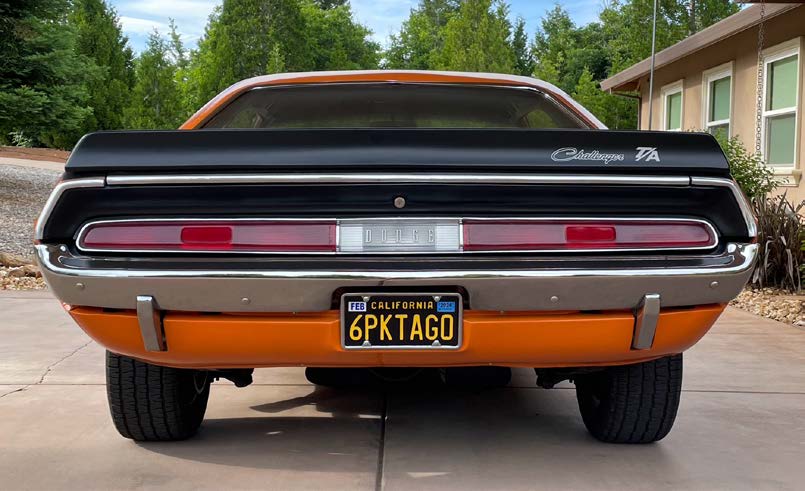
My Dodge Challenger T/A wears a black and yellow
personalized license plate of
6PKTAGO, which took me
years to obtain. It is a Challenger “T/A”
(for Trans Am) and has a 340 engine with a 6-bbl (three 2-bbl)
carburetor set-up, which Dodge called a“6-Pak”
. Its color is “Go Mango” or “Go-Man-Go” (Chrysler always
played on words). Growing up in the liquor business
and working for my Dad in the liquor stores, I always
heard people come in and ask for a “Six pack (of beer)
to (ta) go” – “6PK” “T/A” “Go”                                                                                        – hence the 6PKTAGO license plate.
Dave Ingles has remained one of my best friends over
the years and he has painted another one of my
Mopars for me since. Although he is now retired, Dave
finally has time to work on restoring several of his
classics and muscle cars. You’ll likely see them at car
shows in the near future. If you’re wondering about
Jack Costella and Dave Dozier, between them, they set
over 100 world records on the salt flats and both
became members of the 300-mph club at Bonneville
before their passings. It was an honor to know both of
them and it is only because of these great Bonneville
salt flat racers, their creative geniuses, and me getting
to know them that I own the car I still have today after
32 years. It has become a car that is the envy of all of
our children and grandchildren, one which they all
someday want to own. It will stay in our family for
years to come, and will always have a special
place in my heart and my shop until it is
passed down through our family members.