“The Chrysler Hemi” by Andy Tallone

“The Chrysler Hemi”

When Japan bombed Pearl Harbor on December 6, 1941 it touched off World War II and mobilized the entire country behind the war effort. This included the auto industry. Ford, Chrysler and GM stopped building cars in 1942 and started producing tanks, planes, amphibious landing vehicles, machine guns and boatloads of other stuff, all to help win the war. Chrysler was, among other things, building aircraft engines and late in the war had been tasked to create an inverted V12. They determined that it would be a ‘hemi’. While the project stalled when the war ended, all that research and development work by Chrysler engineers was still there, waiting to be applied.

First off, what’s a ‘Hemi’? It’s shorthand for an engine with ‘hemispherical combustion chambers’. In other words, the right-sized ball would drop half-way into a hemispherical combustion chamber. It placed the intake and exhaust valves at angles facing one another, which opened the flow paths up to increase flow, and allowed more centrally-located spark plugs for better and faster fuel burning. At the time, this was state of the art engine design, widely used on OHV motorcycle engines of the era. It’s a more complex engine and more expensive to manufacture because the valves aren’t all neatly lined up like in most 6-cylinders of the day.

So, when the war ended and civilian car production resumed in 1946, Chrysler’s brain trust was noodling about the hemi. Their current engine line was aging and desperately in need of replacement. Their flathead straight-6 and straight-8 had been in service since the 1920s. What’s more, word was spreading that GM was getting dangerously close to introducing a new line of lightweight, high-compression OHV (Overhead Valve) V8s. So, those same engineers put all that hard-won knowledge and experience to work designing a new line of engines of their own.

Chrysler’s Engine Development Chief Ernie Code and Tom Hoover (who later gained notoriety in Hemi drag racing) designed an engine that prioritized airflow over packaging. The new engine had two rocker arm shafts per cylinder bank, supporting the intake and exhaust valves which were at a 27.5-degree angle to one another. It made for a wide cylinder head and big block, and with the casting techniques in those days, that made it a heavy engine, around 700 pounds. A typical 1950s Chevy small block weighed around 550 pounds. That’s a big difference.

Cadillac and Oldsmobile launched their futuristic new OHV V8s in 1949 as the world watched. Chrysler introduced it’s first OHV V8, the 331 ci (cubic inch) Chrysler FirePower Hemi in its full-size car line in 1951 through 1955. In 1952 they downsized it to 276 ci for Desoto duty under the name Desoto Fire Power, and in 1953 they downsized it again to just 241 ci as the Dodge Red Ram Hemi. They punched it out again on 1956 to 315 ci and again in 1957 to 325 ci still under the Red Ram banner and only used in Dodges. In 1956 they arrived at 354 ci with the new Chrysler FirePower Hemi and in 1957 one last enlargement took it to 392 ci. This last entry is the most famous of all, used for decades in drag racing. Bulletproof, they took well to boosting and were capable of making big power.

But alas, the high cost and complexity of manufacture, and the advancement of other, simpler designs spelled the end of Gen I (1st generation) Hemi production, replaced by Chyrsler’s new B-block Big Blocks and Wedge motors. Simpler and cheaper to produce, and lighter, they could make almost the same power if done right.

The sunset in Hemi land from 1958 until the mid-1960s. By this time the muscle car power struggle was on and running at full throttle. The Big 3 were each trying to outdo the others in this horsepower arms race. Chevy had launched its game-changing small block V8, now up to 327 ci. They also had their W-series big block in 348 and 409 ci. And soon they would launch their Gen IV big block 396. Ford came out with their FE big block engine family in 1958 and now it was up to 390 ci and growing. Chrysler had its own big block family, two actually, the B- and RB-series big blocks. B stood for “Big” and “RB” stood for “Raised Block”, which had a taller deck height to support the longer stroke of the 440.

Chrysler started with the big RB block and built a new set of hemi heads for it that were massive. And heavy. They had huge intake and exhaust ports and gigantic valves (2.25” intakes and 1.94” exhausts set 30-degrees apart this time), and a wild valve train that again used two rocker arm shafts per bank with long and short push rods that took divergent paths. When introduced in the 1966 model year, the 2nd gen 426 Hemi made an advertised 425 hp and 490 lb-ft of torque. Both numbers were grossly understated. Chrysler was concerned with rising insurance costs and didn’t want to scare the underwriters.

The 426 Hemi was and is one of the most legendary engines of all time. It’s big, it’s mean, it’s brutishly handsome and it makes power and torque like nobody’s business. Like their predecessors these were bulletproof engines that loved to be supercharged. Gen II Hemis fueled some of the world’s most famous and successful drag racers and have made as much as 4,500 hp, blown on alcohol. That’s how solid the 426 Hemi was and how good it was at flowing air.

The 426 Hemi stormed through the 60s as the top dog, the biggest, baddest dude on the block. The Chevy 409 and the later 427 hit that number, but it was probably more honest than the Hemi’s. Most people think that 425 hp-claim was a joke! Modern day dyno pulls have confirmed they were in the 530 hp-range. Only the 1970 Chevy LS6 454 beat it. Hemis were insanely expensive engines in their day. At around $900 the option package represented a 31% increase in the price of the car, at a time when a ’69 Road Runner MSRP’d for $2,869.

But the Gen II Hemi was not only expensive and massively heavy on the front end, but they were hard to live with in the real world. Great for racing, those two big carburetors swallowed gas and didn’t like low speeds or stop-and-go traffic. They loaded up, fouled plugs, ate tires and made too much heat. Those factors along with the astronomical insurance premiums, which could be as high as your car payment on a Hemi, doomed it to tiny sales numbers. Despite appearing in Dodge Coronets, Super Bees, Chargers and Challengers and Plymouth Belvederes, Road Runners, GTXs and ‘Cudas, over 6 model years (1966-1971) of production only 10,669 were built. The Malaise Era with its oppressive smog, safety and fuel mileage regulations killed performance starting in 1971, which also happened to be the last year for the 426 Hemi.

The lights went out on the Chrysler Hemi for 32 years. Then a newly revived Chrysler came at it again with a Gen III Hemi in 2003 to replace the ancient 5.9-liter LA small block V8. The new 5.7 Hemi V8 made its first appearance in the 2003 Dodge Ram 1500 and once Chrysler got back in the business of rear-wheel drive cars, its use expanded into its full-size line, Chrysler 300, Dodge Charger, Magnum and Challenger.

Over the next two decades the evergreen Hemi would expand to 6.1, 6.2 and 6.4 liters, it would be supercharged, and it would break the bounds of peoples’ thinking of what a street engine could be. Starting in 2015 Dodge used clever supercharging and inter cooling to create a 707 hp monster in the Hellcat. Further variants with names like Demon and Redeye made crazy horsepower all the way up to 1,025! In a street car! With financing!! And a factory warranty!!! Holy crap!!!! You could kill yourself with that much horsepower.

A 2023 Dodge Challenger SRT Demon 170 can do the quarter-mile in 10.8 seconds at 131 mph from the factory! They come with a crate in the trunk with a bunch of drag racing goodies that they couldn’t put on it as a street car and sell it to you. But no one said the owner couldn’t put the goodies on himself, after the sale.

This new engine was designed from a clean sheet of paper with no physical connection to either previous generation of Hemi, with the exception of calling the 6.4-liter a 392 to honor the biggest engine in the 1st-Gen Hemi family. The cam was set high in the block to both shorten the push rods and to allow more room for expansion via a longer stroke. The combustion chambers are true hemis (half a sphere) with huge valves set at 34.5 degrees from each other and two spark plugs. The deep skirt block was cast in iron with aluminum heads. The intake and exhaust ports were large and flowed well. It had the same 4.4” bore center as the small block Chevy. It was built to be strong and to make big power when supercharged.

Because of the Gen III Hemi, the Dodge Challenger was able to not just compete in the big horsepower game, but lead it. The Hellcat was the first mass-produced car to cap 700 hp and it didn’t end there. When it happened in 2015, no one else had anything close. By the time they’d rallied their resources to respond, Dodge had already blown past than number and was now about 800, then soon 1,000.

The Hemi was a legend in its 1st-generation in the 1950s, and the Gen II was certainly legendary in the 1960s. And this new Gen III Hemi carries on that tradition brilliantly, exceeding it even, by a wide margin. They called the small block Chevy the ‘Mouse Motor’, so naturally the Chevy big block was a Rat Motor. In the same vain, the Chrysler Hemi was the ‘Elephant Motor’.

Buick Riviera


The Ford Thunderbird really created the personal luxury car segment in 1955. The ‘Baby Birds’ carved out a market that no one else realized existed. It wasn’t a high performance sports car like the Corvette, and it wasn’t a staid luxury yacht like a Cadillac or Lincoln. As cute and as popular as they were though, they didn’t sell all that well because they were lacking one thing: a back seat. The two-seater’s three year run, 1955 through 1957, only produced 53,188 cars in three model years. Sales more than tripled when the next generation came out in 1958 with a back seat. The industry took notice. 2-seat convertibles look great in car shows but sales are what matters and buyers of personal luxury cars wanted back seats.

The competition scrambled to respond with their own car that would bite into this lucrative new market. It took a full 7 years, but Pontiac was first up with the Grand Prix in 1962. The upscale two-door hardtop was built on GM’s B-body platform and was considered a full-size intermediate, positioned between the full-size Catalina/Bonneville and the compact Tempest. They sold 34,000 of them the first year.

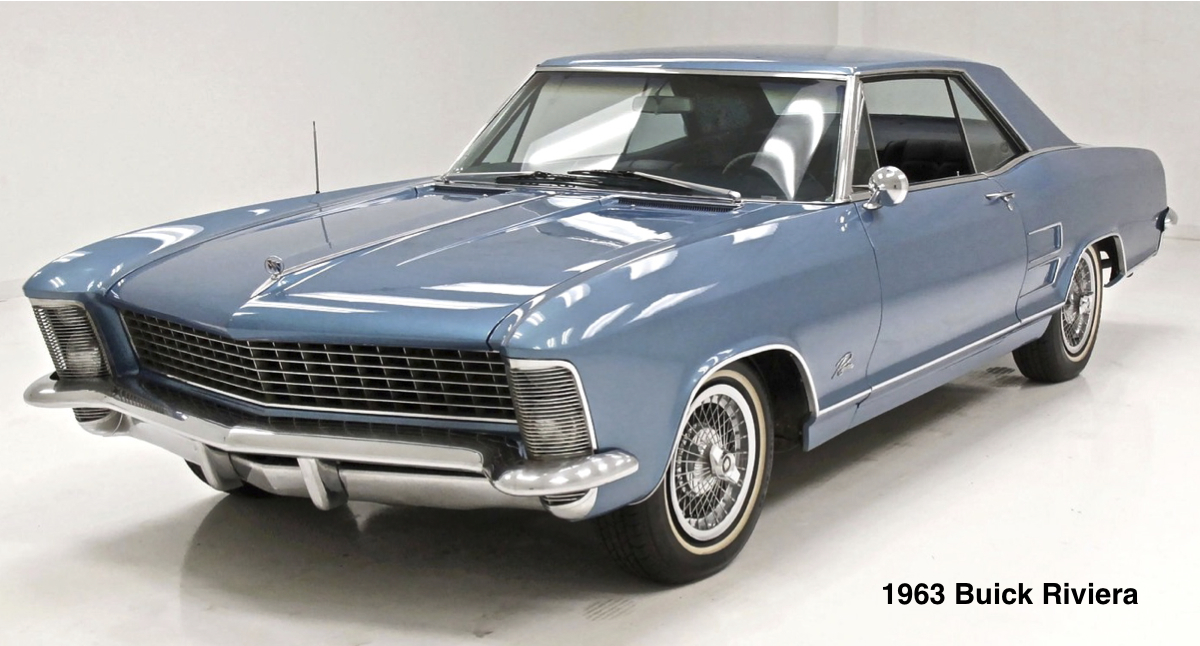
GM developed the new E-body platform to be flexible enough to accept any power train or drive configuration. It was used both for the rear-wheel drive 1963 Buick Riviera and later the front-wheel drive 1966 Oldsmobile Toronado and the 1967 Cadillac Eldorado. These were the only three cars built off the E-body.

GM Stying Chief Bill Mitchell oversaw the design with its flat surfaces, razor-sharp creases and hideaway headlights. It had classic long hood-short deck proportions and a pillar-less hardtop. It was considered at the time, and still today, to be one of the most beautiful American production cars from the 1960s. In fact, it won Motor Trend’s Car of the Year award in 1963.

The new Riviera came exclusively with Buick’s 401 ci ‘Nailhead’ V8 with 340 hp and all were automatics. 40,728 were built in its first year, 1963. This first-generation lasted just three model years and by 1965 it was over. The ’65 models took the hideaway headlights to another level with ‘clamshell’ covers over the stacked headlights that stopped people in their tracks when they saw them open or close.

1965 was also the first year for the Riviera GS (Grand Sport), the hot rod version. It came standard with the 455 and a sportier suspension. Heavy duty suspension, dual exhaust and a limited-slip differential in 3.42:1 or 3.73:1 ratios were all part of this performance package, along with special badging, unique wheel covers, special striping, dual functional hood scoops and an optional hood-mounted tach. The GS package was available on 1965 through 1973 Rivieras.

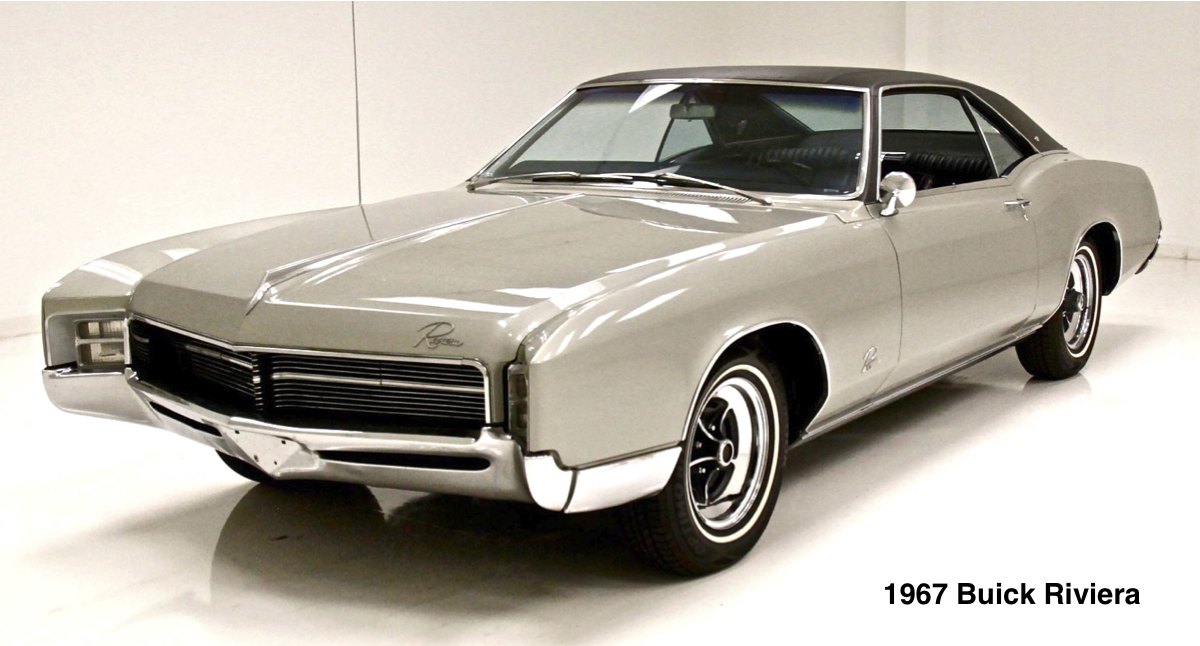
The second generation launched in 1966 introduced a more rounded, Coke-bottle shape and a semi-fastback roof line. It looked like a much bigger car than before, even though they shared the same 119-inch wheelbase. Buick upped the ante with one of the largest Nail head V8s in its arsenal, the 425 making 340 hp with single 4-barrel or 360 hp with a dual-quad setup. In 1968 they upped it again with an optional 455 that made 370 hp. Over 200,000 Riv’s were built in its 2nd-generation, its most successful generation in Riviera history.

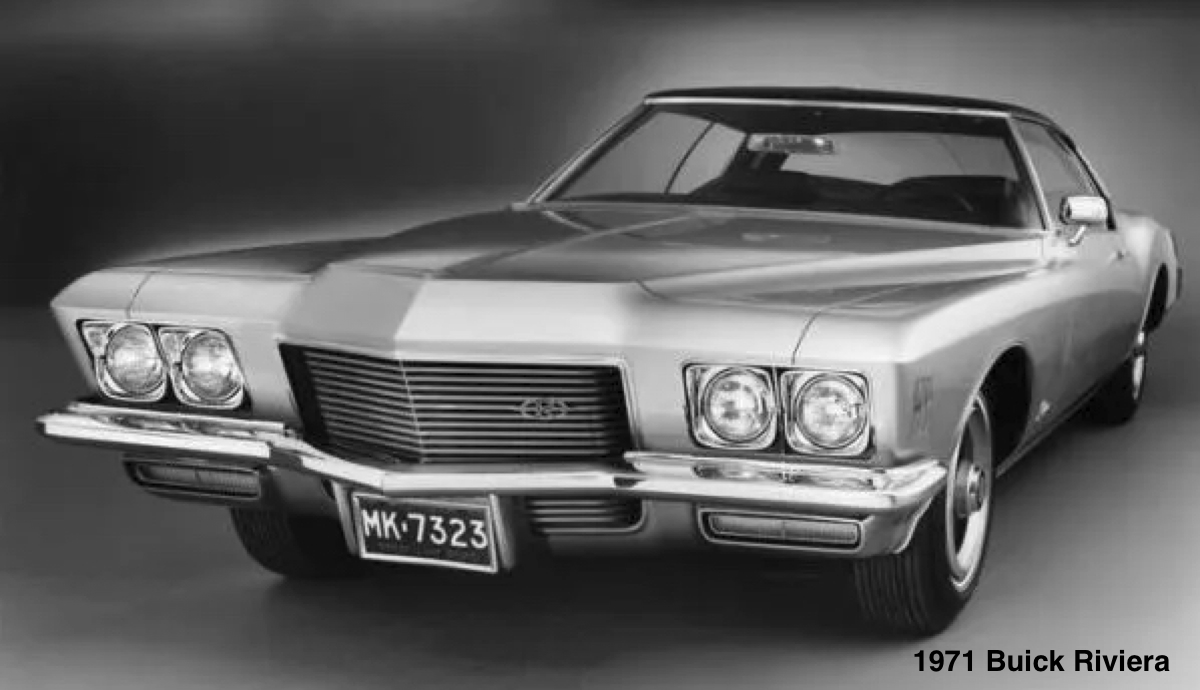
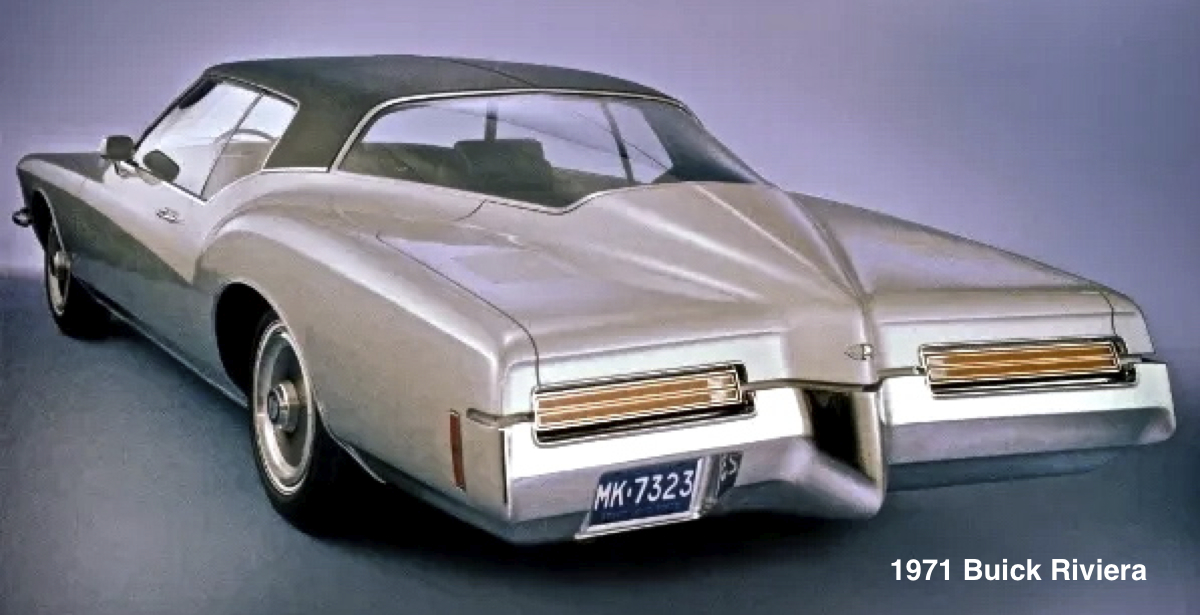
The 3rd-gen Riviera launched in 1971 and was a bigger, bolder car, longer, heavier and more formal looking. The front end was ‘shark-nosed’ which means that the grille and headlights leaned forward. But what really set it off was it’s ‘boattail’. This triangular shaped rear window aped the looks of the 2nd-gen Corvette (1963-67) and was very controversial. Some people never warmed to it but most thought it was a beautiful, novel feature that stood out among its contemporaries.

Of course this was right in the beginnings of the Malaise Era which, starting in 1971, piled on restrictive new federal smog, fuel economy and safety regulations that forced carmakers to detune their engines to get them to pass. The 455 was now the standard engine but it’s power had been clipped from 370 to 270hp. A loss of 100 ponies! Of course, at this same time the Feds were forcing carmakers to express horsepower as a ‘net’ figure rather than ‘gross’, which dropped the numbers even more than the power actually decreased.

The best year ever for Riviera sales was 1969 (2nd-gen) with 52,000 cars sold. 1971, the first year of this new 3rd-generation saw sales drop to 37,000 and they just kept going down after that. It’s not that the cars were bad, although the boat tail styling did put some buyers off, but the times were changing. Inflation was raging, the first oil embargo was right around the corner and people were concerned about fuel economy for the first time in their lives. Big cars and cars with big engines struggled to find
buyers in this environment, and Riviera sales suffered as the result. Only about half as many Riv’s were built in the 3rd-generation as in the 2nd.

In 1974, the first oil embargo (1973) had just hit and America was still dealing with it. For the 4th generation, launched in 1974, the Riviera was downsized. It had been growing with each passing generation. The 1st-gen car weighed in at around 4,100 pounds and was 208 inches in length. The 2nd-gen grew by 200 pounds and 7 inches, despite keeping the same 119-inch wheelbase as the 1st-gen. The 3rd-gen got a 122-inch wheelbase and was of course longer by another six inches, now at 221 inches in length and got another 300 pounds heavier, bringing it to 4,600 pounds.

This new 4th-gen Riv got even bigger. The wheelbase stayed the same at 122 inches, but length grew again, now to 227 inches and the weight ballooned to 4,700 pounds. The only engine option was the 455, now rated at just 245 hp. And it wasn’t done falling yet. The 1974 455 had a 8.5:1 compression ratio and made 385 lb-ft of torque, not bad. But for 1975 the compression was reduced to 8.0:1, horsepower dropped to just 205 hp and torque fell to 320 lb-ft. 205 horsepower from a 455 cubic inch V8? How is that even possible?! Just 90,000 Rivieras were sold during the 4th generation, 1974-1976.

The big Riv got downsized for the first time, in its 5th-generation. Launched in 1977 and lasting just two model years, it was now built on the B-body platform, shared with the Chevy Impala and Buick LeSabre and had a 114-inch wheelbase, a full 8-inch reduction. Length came down to 206 inches, two inches shorter than the original in 1963, and the weight dropped by 700 pounds to roughly 4,000 pounds, also less than the original. A 350 ci V8 was available for the first time, with the 455 as an option, now making only 200 hp. This was the first round of downsizing, but it wasn’t over yet. This was also the last rear-wheel drive Riviera.

In 1979, just two years after launching the 5th-gen Riviera the 6th-gen car replaced it, and it was…are you ready for it? Front-wheel drive. Built off the E-platform shared with the Olds Toronado and Cadillac Eldorado, the new car kept the same 114-inch wheelbase as before, and the length stayed the same, but the weight dropped by 100 pounds or so. Gone were the big blocks. Engine choices were now the Oldsmobile sourced 350 ci V8, a 4.1-liter V6, Buick’s own 3.8-liter V6 with turbocharger, and the ill fated 350 ci diesel V8. It may have helped GM’s CAFE numbers but it didn’t help sales.
Already low and slipping, sales had been hovering around 15,000 to 26,000 sales per year in the 1980s, but had taken a nose-dive in the 90s, and going into the 6th generation, even after this radical change to front-wheel drive, sales actually went up for the first year then declined steadily after that. Every new generation brings with it one good year, the first year. It almost always happens that way. The 6th-gen Riviera ran from 1979 through 1985. The turbo was the highlight.

From an enthusiasts’ point of view, things just went downhill after that. Each new generation got smaller, and they were all front-wheel drive. The 7th-gen was built off an updated E-platform with a standard 3.8L V6, optional 4.9L V8 or a 4.3L diesel. The focus was on luxury and comfort, not performance.

The 8th and final generation of Riviera ran from 1995 through 1999 and there hasn’t been a Riviera since. In its final iteration it was spun off of the G-body platform, shared with the Oldsmobile Aurora, a platform known for it’s rigid structure and good handling. The only engine was Buick’s own excellent 3.8-liter V6 in two configurations. The normally-aspirated version made 205 hp while the supercharged engine had 240 hp. All were front-wheel drive with 4-speed automatics.

The world was changing and unfortunately the Riviera had been on a steady decline from the start. Sales were never strong by GM standards. But they slowly got worse and worse over the decades. In the 1960s, sales ranged from 37,000 to 52,000 cars per year. Through the 1970s, those numbers fell to between 15,000 and 37,000. In the 1980s it fell again to between 12,000 and 25,000. In the 1990s, those same numbers were now only 6,000 to 12,000 cars per year, worst and best years. In the Riviera’s final year of production, 1999, they sold just 6,000 cars. However, over it’s life, the over 1.3 million Rivieras were built.

The first three generations were true American classics, each with their own distinct personality, but always distinctive and classy, and a notch above other cars in its class, like the Pontiac Grand Prix and the Ford Thunderbird. Their smart styling and impressive interiors, and their strong performance set them apart. Time is the test of all things and the collector car market views these early Riviera’s as treasures. A 1965 Riviera GS sold for $275,000 at Mecum’s Kissimmee sale in January 2024.

It seems surprising that a giant, high-volume corporation like GM would have invested the time, energy, money and people to make a car like the Riviera considering how relatively few sales it got. Yet, they’ve done it over and over, many times, on cars like the Corvette, the Nomad, the Z/28, the Trans Am, and the Olds Series I. It proves that they weren’t just penny-pinching bureaucrats squeezing every last dollar out of high volume models like the Chevy Nova or Impala. Taking the risk and investing in wonderful cars like the Buick Riviera shows that they had a soul, and that making great cars, legendary, memorable cars, really did matter to them after all.

Motorsports News by David Vodden


Roger Penske was the big winner last weekend in American motorsports. The 89-year-old godfather of auto racing is celebrating his sixtieth year in the sport that began for him when he attended the Indy 500 race in the fifties with his dad. His love for sport has endured his entire lifetime during which his impact has been greater than anyone else in auto racing. Roger Penske has over 630 major race wins as a car owner including 245 wins in Indy car racing with twenty Indy 500 triumphs. He has 158 NASCAR CUP series wins including five CUP series Championships. He has fielded race cars under his team’s name around the world in various forms of road racing. He owns the legendary Indianapolis Motor Speedway as well as the series that races there. Roger Penske is to American motorsports what the Yankees are to baseball! Maybe more. As a driver he has one west coast stock car win and a few wins in Sports Car Club of American road racing.


Last weekend his driver, Josef Newgarden, won the Indy car race at Phoenix International Raceway. One day later his driver, Ryan Blaney, won the NASCAR Cup series race at the same track. It is fair to say that Roger Penske plans to make his 60th year as a leader in motorsports incredibly special. This would include another Indy 500 win and series Championship as well as the NASCAR Cup series title with several major wins along the way. He is motivated. His huge team of dedicated racers is motivated. It seems to me that the stars in the sky and a massive number of resources are lined up to make 2026 the best year ever in Roger Penske’s life and racing legacy. Penske is eighty-nine.


The double header featuring the Indy cars and NASCAR stock cars at Phoenix last weekend was great. It was terrific value for the fans! The O’Reilly Auto Parts series for NASCAR stock cars ran on Saturday where Justin Allgaier won over Jesse Love, Carson Kvapil, Sheldon Creed, and Sam Mayer. On Sunday, Blaney was dominant despite a strong showing by Chris Bell who finished second. Kyle Larson took third with Ty Gibbs, Denny Hamlin, Bubba Wallace, William Byron, Tyler Reddick, Michael McDowell, and Erik Jones completing the top ten. Reddick continues to lead the playoff point championships ahead of Blaney, Wallace, Chase Elliott, Shane van Gisbergen, Bell, Joey Logano, McDowell, Chris Buescher and Larson. Tenth place Larson is 116 points behind his fellow Northern Californian, Reddick. The top sixteen CUP series drivers in points after twenty-six regular season races will face-off in a ten-race playoff to decide the 2026 driver champion where total points earned in just those ten races will determine the champion.

NASCAR races in Las Vegas with the O’Reilly series on Saturday and the CUP cars on Sunday. This will be the fifth race of thirty-six scheduled in 2026.


The Las Vegas race weekend will also feature the start of the High Limit winged sprint car series, Thursday through Saturday nights. Larson will compete in the sprint car races as well as the O’Reilly stock car series on Saturday afternoon. When that race ends Larson will run over to the dirt track for that series final. The presence of NASCAR champion Kyle Larson in five races over four days will ensure a huge attendance. As if that was not enough, Larson is the odds-on favorite to win in all the races that he has entered. Doing so would be a huge sports story on Monday. Odds? Seems impossible, which makes it even more enticing. Stay tuned!


The Formula One race on Australia was interesting. It turns out that the massive changes in the design of the cars, their engines and much more were the story. As suspected the Mercedes team did fine a loophole in the rules that enabled driver George Russell to win with some level of ease. Given that the Mercedes team had a secret edge, Russell’s teammate Kimi Antonelli was an easy second. Ferrari was also expected to have an advantage and so they did. This gave them third and fourth with Charles LeClare and Lewis Hamilton in that order. Fifth place went to last years F-1 champion Lando Norris in a McLaren. Oscar Piastri, Norris’s McLaren teammate, was the victim of a power surge caused by an unexpected electrical power boost on the pace lap sending him into the crash wall and out of the race. Weird stuff to be sure. This story has so many plot lines that we may have to wait well into the season to line up our suspects in this mystery drama. Stay tuned.


The Art & Science of Cars “Second-Channel Brands” By Andy Tallone

The Art & Science of Cars “Second-Channel Brands” By Andy Tallone

First off, what is a ‘Second-Channel Brand? It’s what Acura is to Honda, or
Infiniti is to Nissan. It’s what happens when a volume carmaker like Toyota wants to continue making gobs of common, high-volume cars, but they also want to cash in on the lucrative, high-profit luxury car market. If Toyota would have tried to build high-end luxury cars with Toyota badges on them they would likely have met with market resistance because people associate Toyotas with cheap cars, not prestigious luxury models. Think VW Phaeton.

Instead, Toyota launched a whole new brand under its corporate umbrella and called it Lexus, and today some of the finest luxury- and near-luxury cars come from them. And Lexus is widely accepted as a legitimate luxury brand, on par with Cadillac and a notch above Lincoln. In the past, some Lexi have been tarted-up rebadged Toyotas, but most only share some platforms and powertrains, just like over here.
But, it was Detroit who did it first. Long ago. William P. Chrysler was on a tear in the late 20s. He acquired Dodge in 1928 and formed a whole new car brand, Plymouth in 1929. Plymouth was Chrysler’s second-channel brand, their Lexus if you will. However, this wasn’t intended to be a high-end brand, quite the opposite, it was going to be their bargain brand, positioned below their high-volume brand, Dodge, meant to compete with Ford and Chevrolet.

And compete they did. By 1931, Plymouth was the third-biggest carmaker in
America, and maintained that position until World War II curtailed all the fun. They even passed Ford for the #2-spot for a few months at a time during the early 30s, but never for a full year. However, considering the number of brands that were competing for the car-buying dollar back then, #3 is admirable. And of course, Plymouth continued to be Chrysler’s bargain brand until their demise in 2001, at a time when they were still averaging over 150,000 cars per year. That’s more that some stand-alone brands.
Jaguar would have killed for numbers like that. In 1973, Plymouth sold 882,196 cars!

So, clearly the second-channel concept worked for Chrysler. It’s hard to believe they killed the brand. It gave them an outlet for cheaper versions of their Dodge products. That’s all they were really doing of course, de-contenting Dodges and giving them different skins and interiors. It only made sense. They were already building the cars over at Dodge. In the 60s, that meant the Dodge Coronet was morphed into the Plymouth Belvedere with cheaper upholstery, less trim, fewer standard features (most were still available as options), and a one-inch shorter wheelbase. What? That’s right.
Chrysler went to the trouble of shortening the Dodge to make the Plymouth. Not much, just enough to say they did it, thus differentiating the two cars and the two brands. The Dodge had the longer wheelbase, which placed it above the Plymouth in Chrysler’s hierarchy of brands.

They did the same thing on the Challenger and Barracuda. There was a two inch difference in wheelbases there, and the Challenger had four headlights to the Barracuda’s two. All of this was code for their brand positioning. Did the public notice it or even care? What it did bring us though was two takes on the same great car. The same can be said about the Dodge Charger and Plymouth Road Runner. They call them ‘sister cars’.
Ford took an entirely different approach. Where Chrysler, the brand, was that company’s high-end luxury product, over at Ford, Ford cars were the bargain-brand and the high-volume brand. And Old Henry was opposed to opulence or complexity in the cars that bore his name. But the company wanted and needed to go upmarket. Ford’s ‘everyman reputation’ would have likely hurt any attempt at building luxury Ford cars at that time, and would have diluted Ford’s public image. So, in 1922 Ford acquired Lincoln and applied it’s massive engineering and production acumen to building luxury cars and establishing Lincoln as a legitimate luxury brand, on par with, or surpassing Cadillac.

Lincoln was never a high-volume car brand, but then that’s the point. Cars like this carry much fatter markups than economy cars. More profit can be made on fewer cars. Ford did it again with the creation of Mercury in 1938. Ford wanted a midmarket brand, nicer than a Ford, but not as nice as a Lincoln, to compete with the midmarket brands over at GM, like Buick and Oldsmobile.

Ford also took a different approach to making the cars. Unlike Chrysler, who
altered the wheelbases between brands, a very expensive proposition compared to leaving it alone, Ford simply reskinned its Ford cars with unique Mercury bodies, redid the interiors, loaded the Mercs up with more chrome and more standard features and voila’, you’ve got a Mercury. They also put larger engines in the Merc as standard. By the 1960s though, the two brands shared engines. Mercury barely got going before the War started but by 1950 they sold 344,082 cars that year. Throughout the 70s, Mercury was good for over 500,000 sales annually with 1979 being their best year ever at 669,138 cars. In the early 2000s they were still averaging over a quarter million cars, but volume fell starting in 2005. Ford killed the
brand in 2011.

GM literally invented the game of second-channel branding. Their entire
corporate structure is an ascending pantheon of brands, starting at the bottom with Chevrolet, then moving up to Pontiac, then Buick, then Olds, then finally Cadillac. It was a system that produced some outstanding cars and some duds, and everything in between, and kept car buyers for life as they moved up the ladder. William C. “Billy” Durant never created new brands, he acquired them, Buick and Oldsmobile in 1908, Cadillac, Oakland (later to be renamed Pontiac) and Rapid and Reliant truck companies (renamed GMC) in 1909, and Chevrolet in 1918. That was the entire basis of the GM empire for decades. Then, as the world changed, in 1985
GM decided it was time to invent a second-channel brand, this one to compete with those industrious Japanese car companies. They called it Saturn. Then in 1999 they acquired the rights to the Hummer name from AM General and bought Saab in 2000.

All of these second-channel moves were intended to broaden their market reach and to allow them to leverage their incredible manufacturing capacity and economies of scale into new segments they weren’t reaching before or that didn’t exist until then. All of this created a top-heavy structure, each brand with its own redundant requirements, a massive bureaucracy and brands that were competing with one another. They were literally cannibalizing each other’s sales. Chevy and Pontiac were in constant competition, Chevy Trucks and GMC, Olds and Buick all battled it out for
an ever smaller slice of a dwindling pie.

Oldsmobile was the first to go. GM pulled the plug in 2004, 101 years after it’s acquisition. But GM had to pare down. Too many brands, too many people, too much capacity, too much money. Then hard times hit in 2008-2009, GM went into bankruptcy and the government stepped in to both save them and to slash and burn.

Pontiac was the next to go in 2010. What a shame. They had positioned
themselves as the high-end performance brand and now had cars like the G6 and G8 and the awesome GTO coming over from Holden in Australia. Great cars that deserved better, but GM stateside gave them no advertising and so they died on the vine. Likely it still might not have saved Pontiac from the government axe men. Hummer was put up for sale but no buyers materialized, so it was shut down in 2010. Saturn was also shut down in 2010, with no attempt made to sell it. Saab, theperpetually unprofitable Swedish niche brand was finally sold to Spyker Motors of the Netherlands also in 2010. That left GM with just a few core brands: Chevrolet, it’s bargain/high-volume brand; Buick, preserved primarily for the Chinese market; Cadillac, the premier luxury brand; Chevy and GMC trucks. All the second-channel brands have been wrung out,if Buick gets cut. They sell almost nothing in the US and now their hopes for lucrative returns from Buick in China are fading.

So, if Buick bites the dust, GM’s only second-channel brand will be GMC.
Chevy will fill three roles in the new GM: 1.) the bargain-priced brand; 2.) the high volume brand; and 3.) the performance brand. Cadillac will of course be the high-end luxury brand, and the two truck brands will continue to compete with one another. Ford shuttered Mercury in 2001 so that leaves only Ford as the: 1.) bargain priced entry-level brand; 2.) high-volume brand; and 3.) performance brand, and Lincoln, the high-end luxury brand. However, Lincoln is wobbly and struggling forrelevance with just 106,868 units sold in 2025.

Chrysler is a little harder to nail down since it’s part of this global consortium of second-rate brands. Stellantis has 14 brands in all. Dodge, Jeep and Ram are the crown jewels, although its doubtful the suits in Europe would ever admit it. From here its like a list of who hasn’t succeeded in selling cars in America. Abarth, Alpha Romeo, Fiat, Lancia, Maserati, Citroen, DS Automobiles, Peugeot, Opel and Vauxhall. And of course, the ailing Chrysler brand, now down to just the Pacifica minivan.

For Chrysler, Dodge is obviously the bargain brand, the volume brand and the performance brand, and Chrysler is supposed to be the luxury brand, their Cadillac, but it’s just not cutting it. The Jeep brand and the newly-minted RAM truck brand both do well generally, although everyone’s fallen on hard times lately.

So, really the Big 3 don’t have much left of their second-channel brands. It’s interesting that almost all of the at-one-time-successful second channel brands that the Big 3 fostered are gone now, and the only good examples of the practice that are left come out of Asia. Lexus for Toyota, Infinity for Nissan, Acura of Honda and Genesis for Kia. For them, it makes sense because their core brands were built on lower-priced economy cars, so all of them benefitted by moving upmarket. Most of Europe’s brands, at least those that make it to America are already considered luxury or near-luxury brands so their second channels would only likely move them down
market, and Europe being the most expensive place on Earth to manufacture cars, that doesn’t make much sense.

BMW tried it with the Mini, but after the initial cuteness wore off, they’ve
struggled to get people to pay a premium price of such a tiny car. Toyota tried it with Scion in 2004, a brand aimed at the ‘youth market’. It struggled from the start and died in 2016. In the end, the car business is a business, and car companies have to make money. To do that, they need to make cars that people want to buy and can afford. Looking back, the auto industry has done an admirable job of delivering some solid, worthy products that were safe, reliable and served us well, along with some stunning standouts that please the eye and move the soul.

Second channels have given large manufacturers new avenues to reach niches that their normal product line didn’t address. The result of all this is a plethora of wonderful cars that, at one time were within reach of most people, financially. Great cars that everyone could afford, what a concept.


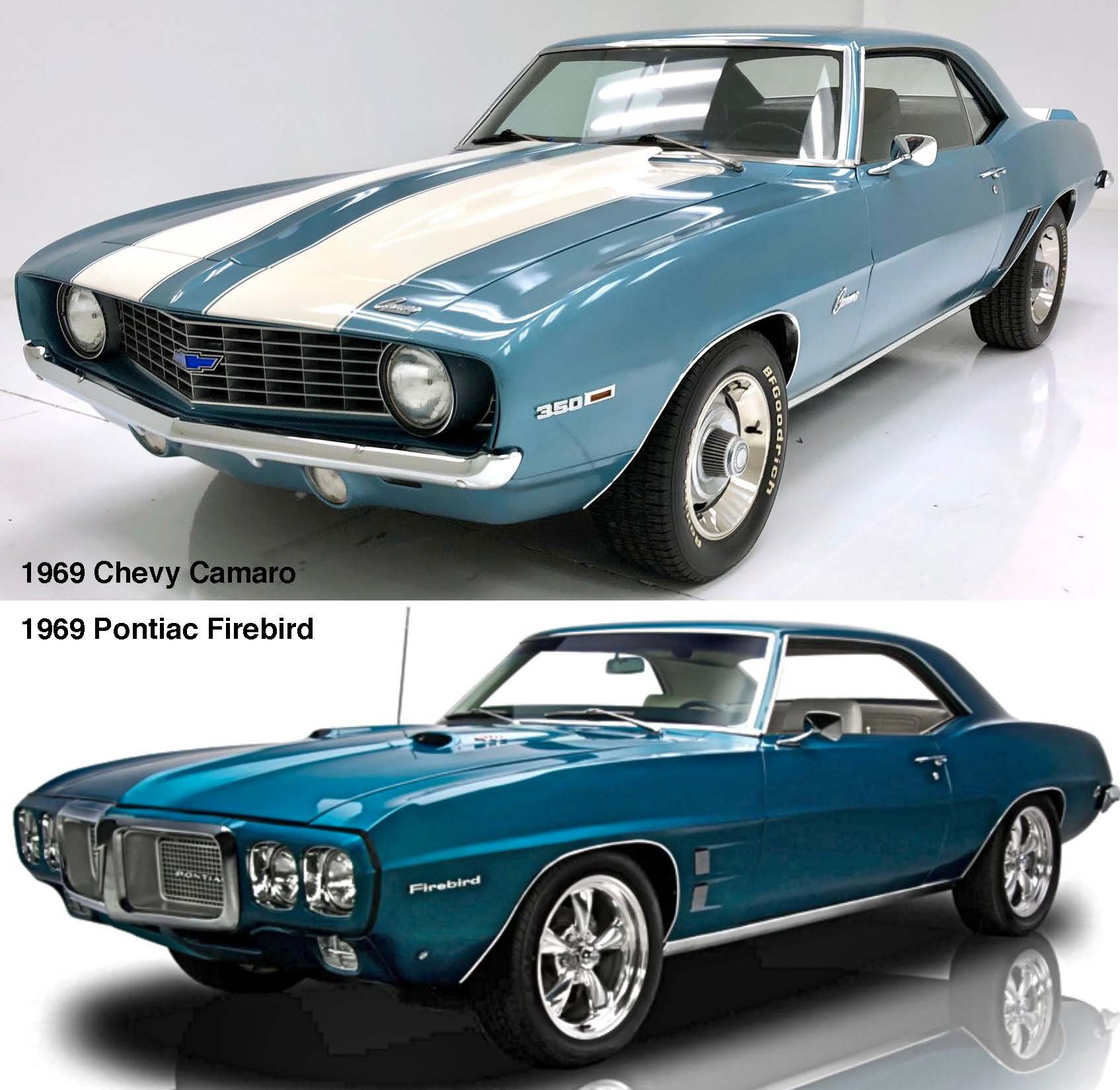
The Camaro and Firebird have always been essentially the same car, just with a different skin.

The Fox-body T-Birds and Cougars were very similar. The Merc was slightly better appointed inside and had a standup rear window to the T-Bird’s semi-fastback.

The Challenger had 2-inches more wheelbase than the Barracuda, and two extra headlights. Different skins also. Only the roof and glass are the same.